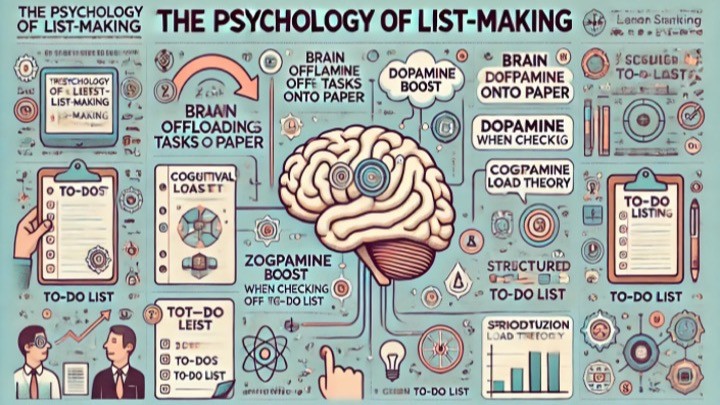
Sure, some may claim they “just remember things,” but in reality, they’re likely relying on subconscious mental lists. The brain isn’t designed to store and organise endless tasks; that’s why external lists, written or digital, are so powerful. List-making is a seemingly simple yet profoundly effective tool that has been used for centuries to organize thoughts, prioritize tasks, and achieve goals. They are nothing new, the earliest known lists date back to ancient Mesopotamia, around 3100–3000 BCE, during the rise of the first known writing system. These early lists demonstrate how ancient civilizations used written records to organize knowledge, manage economies, and preserve history, a practice that continues in modern life.
From to-do lists to bucket lists, the practice of list-making transcends cultures and professions, offering both practical and psychological benefits. What is the psychology behind list-making, how does it enhance performance, reduce cognitive load, and (amazingly) provide some and overwhelming sense of satisfaction.
One of the primary psychological benefits of list-making is its ability to reduce what is termed cognitive load. Cognitive load theory advances the theory that our working memory has limited capacity and overloading it can impair decision-making and performance [1]. By externalizing tasks and goals onto a list, we free up mental resources, allowing our brains to focus on execution rather than recall. I can confirm that using lists is particularly valuable in high-pressure environments where multitasking is required. I didn’t come across the benefits of list making through my own endeavours. I was introduced to the power of lists by a young Chemistry graduate some 25+ years ago, possibly one of the most intelligent people I have ever worked with.
Lists help you prioritize tasks by providing a clear overview of what needs to be accomplished. The act of writing down tasks forces us to evaluate their importance and urgency, a process aligned with the Eisenhower Matrix—a decision-making tool that categorizes tasks based on their significance and deadlines [2]. This prioritization reduces decision fatigue, a phenomenon where the quality of decisions deteriorates after prolonged mental exertion [3].
List-making is closely tied to goal-setting theory, which suggests that specific and measurable goals enhance motivation and performance [4]. Breaking down larger goals into smaller, actionable steps on a list makes them more manageable and less overwhelming. I wish I had been aware of this when I had been working on my PhD. It took me far too long to grasp the concept of ‘chunking,’ the practice of organising information into ever smaller units to improve data retention and organisation and advance comprehension [5].
Have you heard of the Zeigarnik Effect, a psychological phenomenon named after Bluma Zeigarnik, that suggests that people remember uncompleted tasks better than completed ones [6]. Unfinished business can create mental tension and list-making helps alleviate it. I live for crossing off completed tasks for the sense of closure it provides. This is why I still prefer written lists to electronic solutions. Seeing the number of scrubbed tasks is an effective means of reducing anxiety and promoting mental clarity. Completing tasks and checking them off a list triggers the release of dopamine, a neurotransmitter associated with pleasure and reward [7]. This neurochemical response reinforces the behaviour, making list-making a self-sustaining habit. Perhaps that explains why I am hooked on lists. The satisfaction derived from ticking off items can boost motivation and create a positive feedback loop, encouraging continued productivity.
List-making can serve as a coping mechanism for anxiety by providing a sense of control over one’s environment. Research has shown that organizing tasks externally can reduce feelings of stress that can overwhelm you and on the other hand increase perceived competence [8]. For individuals prone to anxiety or perfectionism, lists offer a structured way to manage expectations and track progress.
Lists can act as a form of self-accountability. By documenting tasks, individuals make a commitment to themselves, increasing the likelihood of follow-through. This is supported by the theory of self-regulation, which emphasizes the role of self-monitoring in achieving goals [9]. Keeping your old lists allows you to self-audit, particularly if you date your lists. Similarly, publicly shared lists, such as team task boards, further enhance accountability by introducing social pressure. In group settings, lists serve as a communication tool, ensuring that everyone is aligned on priorities and responsibilities. This is particularly important in project management, where shared task lists (e.g., Kanban boards) facilitate collaboration and transparency [10]. By visualizing progress, teams can identify bottlenecks and celebrate milestones, fostering a sense of collective achievement.
Effective lists are concise and focused. I promise that overloading a list with too many tasks like I do can be counterproductive, leading to feelings of inadequacy and stress. The ‘rule of three,’ which suggests limiting daily tasks to three priority items, is a popular strategy for maintaining focus and should help you from getting overwhelmed [11]. Incorporating SMART criteria (Specific, Measurable, Achievable, Relevant, and Time-bound) into your list-making takes your productivity to another level. It ensures that tasks are clear and actionable, minimizing ambiguity and increasing the likelihood of task completion [12]. While creating structure in your lists is important, flexibility is equally crucial. Life is unpredictable, and rigid lists can lead to frustration when plans change. Allowing room for adjustments ensures that lists remain a helpful tool rather than a source of stress.
While list-making offers numerous benefits, it is not without pitfalls. For example, over-reliance on lists can lead to a mechanistic approach to life, where spontaneity and creativity are stifled. If you focus only on what’s on the list, you might neglect big-picture thinking, creativity, or deep work that doesn’t fit neatly into a checklist. Some people spend more time organizing tasks than actually doing them, leading to what’s called productive procrastination.’ Beware of decision fatigue, where a never-ending to-do list leads to analysis paralysis and don’t know where to start. Woe betides the consequences if you misplace your list, the subsequent emotional fallout will quickly undo your efficiencies. In addition, an excessive focus on productivity will contribute to any pressures you may be experiencing and could drive burnout, as you prioritise task completion over self-care and enjoying your life [13]. To mitigate these risks, it is important to strike a balance between the use of lists, enjoying their benefits and knowing when to stop, ensuring that lists serve as a guide rather than a rigid mandate. If you need a hint, stop when you start to include ‘rewrite list’ on your list.
List-making is more than a practical tool; it is a psychological strategy that empowers users and satisfies the mind. By reducing cognitive load, enhancing focus, and providing a sense of control, lists enable individuals to navigate complex tasks with greater ease. At Niche we have our own bespoke Tracker, effectively a huge list that captures the power of multiple experts managing different aspects of multiple projects simultaneously. The emotional satisfaction derived from completing tasks, coupled with the dopamine-driven reward system, reinforces the habit, making it a sustainable practice for personal and professional growth. Just remember to use lists wisely:
The effectiveness of list-making depends on how it is implemented. Keeping lists simple, using SMART criteria, and balancing structure with flexibility are key to maximizing their benefits. When used mindfully, list-making can transform chaos into order, uncertainty into clarity, and aspirations into achievements. In a world that often feels overwhelming, this timeless practice offers a pathway to productivity, fulfilment, and peace of mind.
References

Get our latest news and publications
Sign up to our news letterResources
Social


Contact us
Address
Niche Science & Technology
Unit 26 Falstaff House
Bardolph Road
Richmond TW9 2LH
United Kingdom