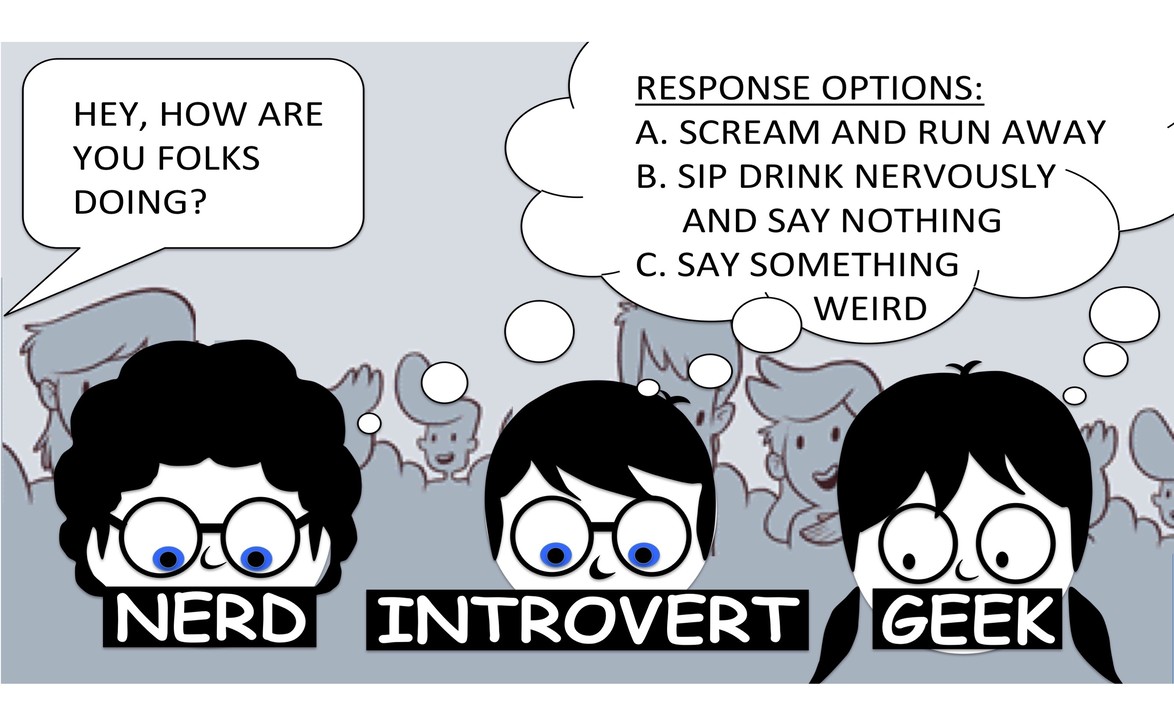
You may be naturally shy, or you may have developed a pathological level of introversion after years of working alone, locked in a laboratory studying for a PhD. You could be like me and be affected both ways, with your situation being made worse by a tendency to geek‑ism or nerd‑ism (I am told these two are totally different). These are conditions often not appreciated by the general public but common among the scientific disciplines [1].
Shyness and introversion can be debilitating, and nowhere is it more obvious than at conferences. Even though you share the same interests and many of the same daily challenges as your fellow attendees, you find yourself stressed by the situation and (most often) end up leaving the congress without having achieved whatever modest goals you had set yourself [2].
What’s to be done? These occasions offer unmissable opportunities to extend your network, progress your career and learn what’s new in your industry. But you end up kicking yourself for once again failing to make the most of the time and resources you have invested in attending.
If, plate in hand, you emerge from the coffee line or dinner queue to find yourself feeling isolated and alone, too nervous to approach the islands of noise being made by pockets of colleagues happily chatting (without a care in the world), then you are probably shy, and it is likely you are facing another disappointing conference [3]. There are things you can do to ensure that this doesn’t happen to you again.
If you are like me, you probably spend more time organising travel and accommodation than you do preparing for the conference and determining how you are going to get what you need out of it. You are going to feel more comfortable with your environment if you can minimise the number of unknowns. Find out what you can about the venue, the agenda/programme and the attendees. Identify which subjects are most important to you and what you want to get out of each session. Organisers often provide a list of expected attendees. Go through the list and identify whom you would like to talk with [4].
Before the conference, reach out to people you don’t particularly know (as well as those you know — doh!) and ask them (by email) if they are attending. That will allow you to approach this person while at the congress and say, “Hi, I’m Tim, so pleased to meet you in person.” This is so much easier than cold‑meeting people. The power of this inbound networking approach is that you don’t have to feel like you are interrupting anyone or that you will face rejection. Connections happen organically. And no harm is caused in the unlikely event that you miss connecting with any of the people on your list. If this feels like it is too pushy, you could simply announce or blog about your attendance — see if this creates requests from people to meet [5].
The best connections are often made through colleagues and mutual acquaintances. Someone you know may be going to the conference, and they may be more sociable and less introverted than yourself. If it is a close friend, you might explain your predicament and have them help you by making introductions, doing the legwork in breaking the ice. Alternatively, just ask to tag along if it is just an acquaintance. Obviously, hanging with the cool guy is an easy option — though it may not get you all the introductions you are looking for. Good luck if you are both wallflowers. As a pair, you are likely to attract people eager to join a group. Be open. If you struggle to introduce yourself, why not try introducing your friend and help break the ice. Have a few of the old favourites ready to keep the ball rolling once the conversation has started [6]:
Create in your mind a carefree alter ego who is (a little more) prepared to step outside your buttoned‑down identity. Alcohol can help — use with caution! This will allow you to let go of some of the nervousness that builds up (and has possibly been reinforced by previous unhappy experiences). It might be worth considering that half the people there are probably faking it too. One of our biggest fears is not knowing what to say next — build hypothetical conversations based on a list of pre‑prepared questions that your super‑confident alter‑ego persona would ask. Being contentious can be entertaining (excellent for the super‑confident), but being agreeable is attractive. Interjecting a conversation with “You’re absolutely right” — followed by an occasional nod of agreement — is easy. Doing this not only affirms the speaker’s intelligence and values but also shows that you find them likeable, which makes people feel good [7].
We all tend to gravitate towards our comfort zones that validate our own perspectives and points of view. It is less challenging — and potentially less contentious or confrontational — mingling with people who share our beliefs and outlooks. But if it is a conference with multiple speakers and a menu of sessions, I suggest you pick at least one that you wouldn’t normally attend. Purposely step outside your comfort zone. Now you are in an unusual space (with people you are unlikely ever to meet again), you might try saying to someone on the way out, “You know, I walked in here thinking I wouldn’t get anything out of (whatever topic) ... but I was surprised by ...” That’s all you need to say to start a great conversation, because people love talking to people when they are “the expert” [8].
When you step out of character you are putting on an act. But most actors won’t go on stage without a script. Prepare open‑ended questions you can use. Conversations with strangers typically move through five stages:
Break the ice with some observation of the environment; keep it simple. People think they have to be urbane and witty; what they really have to be is nice. To get the conversation humming, use open‑ended questions like “Have you come far?” Don’t panic if the conversation stops for a moment; this is often our biggest fear. Pick another question from your predefined list and carry on, ensuring that the “close” of the conversation is natural.
Practice looking approachable. When people conceal social anxiety behind a neutral mask, it makes others feel uneasy — they interpret faces as being aloof or hostile. Smile. When we hunch up and lower our heads, we feel more introspective. Make good eye contact to create a good first impression. It demonstrates engagement with that person. You can then soften your gaze, moving your eyes around that person’s face; it demonstrates a desire to know more [9]. DON’T STARE.
Living outside your comfort zone is exhausting. Allow yourself to switch between your super‑confident alter ego and patho‑introvert personas. Conferences are typically packed with action: sessions, seminars, meetings, breakouts, meetups ... lots of “on‑time” that creates a serious energy drain. Extroverts typically draw energy from others, while introverts typically need time to recharge their own mental and emotional batteries. So, schedule some downtime into your day to help you recharge and review your successes [10].
Familiarity is one of the best ways to help with discomfort — return to the same conference each year (though it may be at a different location). Familiar faces, settings and subjects may help you overcome some of your inhibitions. This can be a very slow process, but if you improve your performance year on year, you might have it cracked in a decade. Return often enough and the organisers might ask you to present or even chair a session; if you can achieve this, people will approach you and you won’t have to worry so much about approaching them. Taking this concept to an extreme, conference organisers are always looking for willing volunteers, and this gives you a valid reason to speak to everyone and anyone, though from my own experience, I doubt you will find much time to network effectively [11].
Most introverts are great listeners, especially in one‑on‑one settings. Use that skill to your advantage. Listen. This will empower you to ask insightful questions. Ask a person how they did what they did. Or why. Or what they learned from doing it, or liked about doing it. Asking real questions and paying attention to the answers is one of the greatest compliments you can give [12].
If you aim to have short conversations with as many people as possible, you will put less pressure on yourself and open fewer opportunities for you to feel “rejected.” See your interactions as a means of making contacts that you are collecting (use LinkedIn). Just be sure to consolidate connections made at the conference (e.g., sending a brief, personalised email referencing the conversation).
We are all “hunting” for meaningful “connections” (though we might not know how we define this) — and where connections don’t feel right, we tend to break them off. Some people are not very adept at this, and to a shy person this might feel like rejection. In this case, it is perfectly appropriate to apply the “it’s not me, it’s them” argument. Obviously, before blaming someone else, you might want to check whether you have committed some faux pas, but then go ahead and use “defences” to avoid taking it personally. That person may just be having a bad day (or be shy themselves). Now try your luck with someone else and pay the episode no more attention. The next person you meet could be your future boss, best friend or love of your life; go for it [13].
One last suggestion, and it may seem really sad, but we must try everything to dispel our serial anxieties. We all find it easier when someone speaks first. Here’s a suggestion: be the first to arrive. If you’re hanging about waiting for a session to start as the second person arrives, the social requirement is for them to say “hello” to you. Obviously, they may be trying to be first themselves — gives you the upper hand. Hopefully, you will both be chatting happily by the time the other attendees arrive — and everyone will be in awe of your social dexterity [14].
References

Get our latest news and publications
Sign up to our news letterResources
Social


Contact us
Address
Niche Science & Technology
Unit 26 Falstaff House
Bardolph Road
Richmond TW9 2LH
United Kingdom