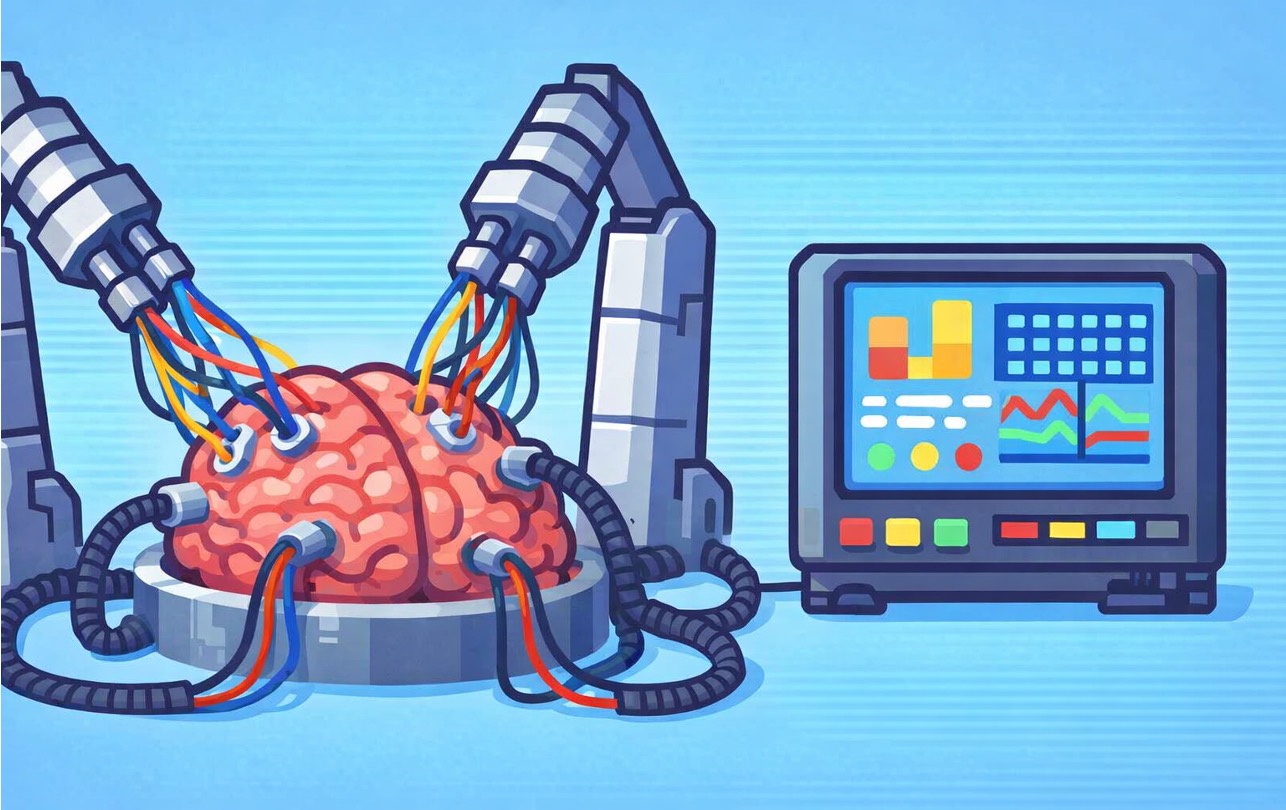
In an age defined by ubiquitous connectivity and unprecedented access to information, the idea that anyone can become an expert instantly has moved from cultural curiosity to a widely accepted assumption. Digital search tools, open scientific literature, online courses, and collaborative intelligence systems have radically accelerated the pace at which individuals can acquire a working expertise in almost any domain. Tasks that once required years of apprenticeship, such as interpreting scientific data, understanding regulatory frameworks, or navigating complex technical systems, can now be approached with confidence after hours or days of focused study.
The concept has been reflected in contemporary film, for example The Matrix (1999) and more recently, Lucy (2014). In these examples, the depth of knowledge is extensive and the effort in gaining the expertise minimal. The dream, zero effort learning! Clearly, it is optimistic that our minds will ever be so easy to fill with data. Beneath this optimism lies a deeper tension. While accelerated learning enables rapid participation in complex discussions, it often produces a form of knowledge that is brittle, superficial, and vulnerable to misinterpretation.
Cognitive science has long emphasised that true expertise is not merely the accumulation of facts but the development of structured knowledge, contextual understanding, and the ability to reason under uncertainty. What is the scientific understanding of rapid learning, the mechanisms that make instant expertise possible, and the limitations that prevent it from replacing deep, experiential mastery.
Human cognition is constrained by the limited capacity of working memory. Classic research suggested a span of approximately seven items, though later work indicates the number may be closer to four [1]. Expertise develops when individuals learn to ‘chunk’ information, grouping related elements into meaningful units, thereby reducing cognitive load and enabling more complex reasoning [2].
Digital tools accelerate this process by presenting information in pre‑structured formats. Search engines, encyclopaedic databases, and curated online courses effectively perform the chunking process externally, allowing novices to bypass early stages of cognitive organization. Cognitive Load Theory further suggests that well‑designed instructional materials reduce extraneous load and facilitate rapid schema formation [3].
Several evidence‑based learning strategies support rapid acquisition of factual knowledge:
These techniques allow learners to internalise large volumes of information quickly, forming the basis of what appears to be instant expertise.
The expansion of open‑access publishing and digital repositories such as PubMed Central, arXiv, and institutional archives has democratised access to scientific knowledge. Historically, expertise required proximity to universities, laboratories, or professional networks. Today, a motivated learner can access thousands of peer‑reviewed articles within minutes. Equally, the access to ‘how to’ videos on services like YouTube can aid with more practical skills.
Meta‑research shows that access to primary literature significantly enhances comprehension and critical engagement, even among non‑experts [7]. This accessibility fuels the perception that expertise is primarily a function of information availability.
Search engines do more than retrieve information, they prioritise, filter, and contextualise it. Studies on information foraging theory show that humans optimise learning by following ‘information scent,’ and search algorithms amplify this process by ranking relevance [8]. As a result, subject novices can rapidly identify high‑value sources without extensive background knowledge.
Platforms such as Wikipedia, Stack Exchange, and open‑source communities embody what researchers have termed distributed cognition: knowledge is not confined to individuals but emerges from interactions within a system [9]. Users can leverage collective intelligence to solve problems far beyond their own personal expertise. This phenomenon empowers individuals to perform expert‑like tasks by orchestrating external resources rather than relying solely on internal knowledge.
Despite these clearly positive characteristics of instant learning, it may not be surprising to find that cognitive science consistently demonstrates that rapid knowledge acquisition differs fundamentally from deep expertise.
Novices often rely on superficial topical features, keywords, formulas, and/or memorised key facts, while experts perceive underlying principles and causal structures [10]. This distinction clearly explains why instant experts may perform well on recognition tasks but struggle with transfer, problem‑solving, or novel scenarios. Superficial expertise works when the system behaves normally; real expertise is revealed when the system breaks. A pilot who only knows how to operate the autopilot can fly comfortably in clear skies, but when the instruments fail or a storm hits, you want the pilot who understands aerodynamics, navigation, and manual control.
Researchers have shown that individuals routinely overestimate their understanding of complex systems [11]. Digital information environments exacerbate this illusion by providing coherent explanations that mask underlying gaps in comprehension.
The concept of tacit knowledge, the idea that ‘we know more than we can tell’ remains central to expertise [12]. Skills such as clinical judgement, engineering intuition, or scientific reasoning emerge from repeated exposure to real‑world variability, not from reading or rapid study.
The theory of deliberate practice further emphasises that expertise requires thousands of hours of structured, feedback‑rich training [13]. Instant expertise, by contrast, lacks the experiential depth necessary for robust performance. Expertise is like an iceberg: the visible knowledge above the waterline is only a small part. Beneath it lies a much larger body of experience, mental models, and tacit understanding. Someone who has learned quickly may only possess the tip of the iceberg.
Scientific knowledge is probabilistic, contingent, and context‑dependent. True experts understand the limitations of evidence, the nuances of methodology, and the uncertainties inherent in interpretation. Rapid learners may misinterpret findings, overlook confounders, or apply conclusions inappropriately. How this risk is amplified can be best described by the Dunning‑Kruger effect, where individuals with limited knowledge overestimate their competence [14].
The democratisation of knowledge has empowered individuals to participate in scientific and technical debates who might otherwise chose to stay silent. While this inclusivity is valuable, it also increases the prevalence of confidently expressed but poorly grounded opinions. Research on misinformation shows that overconfidence contributes to the spread of inaccurate claims, especially when individuals rely on superficial understanding [15]. In fields such as medicine, engineering, or policy, decisions based on shallow expertise has significant consequences. Misinterpretation of data, failure to appreciate uncertainty, or reliance on oversimplified models can lead to errors in judgement. As the saying goes, “For every complex problem there is an answer that is clear, simple, and wrong.”
The modern information ecosystem has made it possible for individuals to acquire working knowledge at unprecedented speed. Through digital tools, open scientific literature, and collaborative intelligence, the barriers to entry for complex domains have dramatically lowered. This transformation enables broader participation in scientific discourse and empowers individuals to learn rapidly and effectively.
Yet instant expertise remains fundamentally limited. While accelerated learning can produce functional competence, it cannot replicate the depth, nuance, and contextual understanding that arise from sustained practice and experiential learning. True expertise requires more than information, it demands critical thinking, epistemic humility, and the ability to integrate knowledge into coherent, context‑sensitive judgement. It takes two sentences to make a bad argument and 20 minutes to explain why it’s wrong.
The challenge of our era is therefore not simply to learn faster, but to transform abundant information into genuine understanding and practical wisdom. Most importantly of all, respect the expert.
References

Get our latest news and publications
Sign up to our news letterResources
Social


Contact us
Address
Niche Science & Technology
Unit 26 Falstaff House
Bardolph Road
Richmond TW9 2LH
United Kingdom