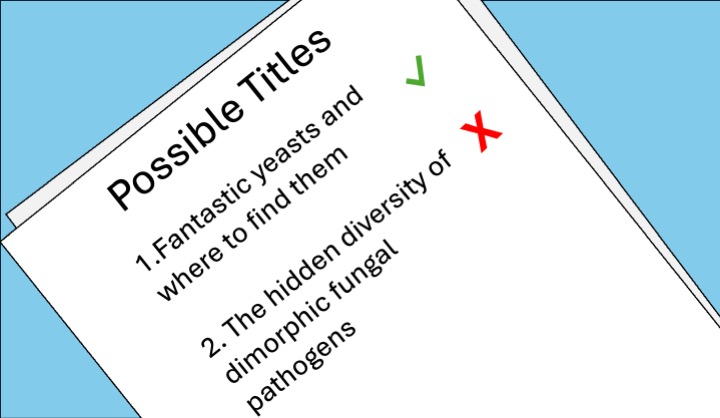
Titles are the first thing readers see, yet often they are addressed at the end of a project and receive comparatively little attention, despite their disproportionate influence on how a manuscript is perceived and discovered [1,2]. Creating a title may take no more time than summarising the work in a single sentence, yet its value is considerable [1]. Strong titles tend to incorporate three key elements: appropriate keywords, emphasis, and impact. A well-constructed title attracts attention, aids recall, and encourages readers to explore the article further, whereas a weak or vague title can lower expectations and negatively bias readers against the work, regardless of its scientific quality [2,3].
Titles directly influence the number of people who ultimately read an article [4]. With the increasing reliance on electronic databases and search engines for literature retrieval, discoverability has become a critical consideration. Titles that accurately reflect article content and include relevant search terms are more likely to be retrieved and selected by readers searching online [5]. The specific wording of a title affects whether an article is located through keyword-based searches and whether a potential reader chooses to engage with it or ignore it [4,5]. Conciseness is particularly important; excessive length may obscure the central message and reduce readability. Several studies suggest that brevity is associated with higher citation rates, potentially reflecting greater clarity or accessibility of the research question [6,7].
Empirical analyses of scientific publishing have demonstrated associations between title characteristics and citation frequency. Studies examining large datasets of biomedical and scientific articles have shown that shorter titles and those avoiding unnecessary punctuation or excessive detail tend to receive more citations [6–8]. Longer titles may convey ambiguity or complexity in the research question, which could discourage readers or citing authors [7]. While citation count is an imperfect proxy for scientific importance, these findings highlight the practical influence of title construction on scholarly visibility.
Ultimately, regardless of stylistic approach, an effective title should be concise, informative, and clearly communicate the main findings and significance of the accompanying article [1,2]. In an era of rapidly expanding electronic literature, careful attention to title writing is time well spent. The title shapes the first impression formed by readers, reviewers, and editors, and plays a critical role in determining whether the work is read, reviewed favourably, or cited [2,4].
References
- Day RA, Gastel B. How to Write and Publish a Scientific Paper. 7th ed. Cambridge: Cambridge University Press; 2012.
- Hartley J. To attract or to inform: What are titles for? J Tech Writing Commun. 2007;37(2):203–213.
- Goodman NW. Survey of active verbs in the titles of medical journals. BMJ. 1991;302(6778):163–164.
- Jamali HR, Nikzad M. Article title type and its relation with the number of downloads and citations. Scientometrics. 2011;88(2):653–661.
- Falagas ME, Zarkadoulia EA, Samonis G. Characteristics of highly cited articles in medical journals. FEMS Immunol Med Microbiol. 2009;55(1):1–8.
- Haslam N, et al. What makes an article influential? Predicting impact in social and personality psychology. Scientometrics. 2008;76(1):169–185.
- Paiva CE, Lima JP, Paiva BSR. Articles with short titles describing the results are cited more often. Clinics (Sao Paulo). 2012;67(5):509–513.
- Lewison G, Hartley J. What’s in a title? Numbers of words and the presence of colons. Scientometrics. 2005;63(2):341–356