Navigating Good Publication Practice

Integrity of the scientific literature is founded on good publication practices. Guidelines have been developed to ensure that contributions to the literature are interesting, accurate, relevant and transparent. What are the standards, and how should they be applied to your writing?

Learn about:
Transparency: Disclose funding sources
Authorship Integrity: Only substantial contributors
Accurate Reporting: Present data honestly
Reproducibility: Provide important details
Ethical Dissemination: Avoid duplication
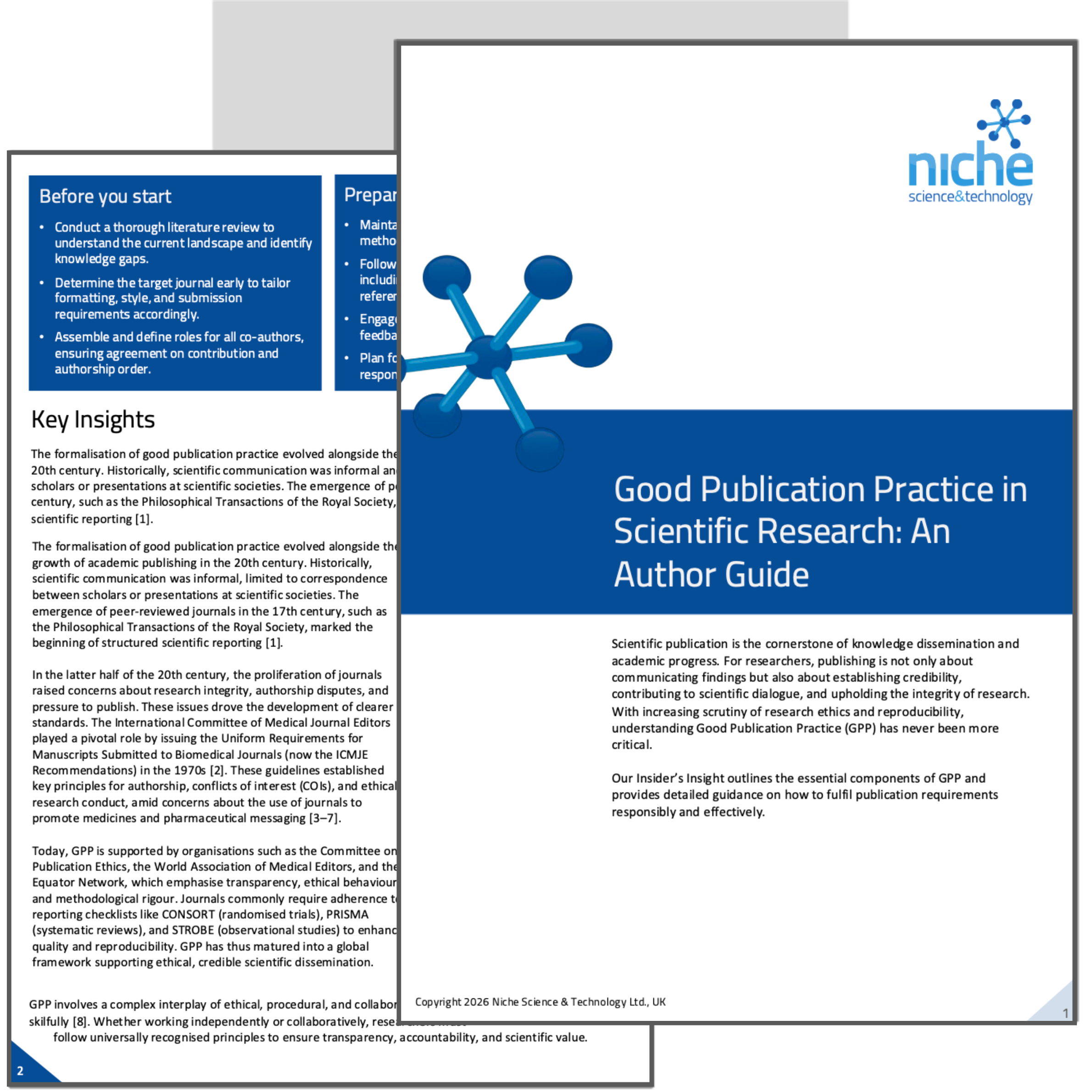
A guide cover and page showing Good Publication Practice in Scientific Research: An Author Guide with blue design elements, key insights text, and preparation steps.
Join the other 20,000+ pharma colleagues who have downloaded our Insider’s Insights.

Get your Insider's Insight

* indicates required

Frequently Asked Questions about the Insider’s Insight: Good Publication Practice

To help you get the most out of our resource library, we have compiled answers to the most common questions regarding the development, application, and distribution of our specialist guides.

At Niche Science & Technology, we believe that sharing expertise is the first step toward industry-wide excellence.
GPP refers to the ethical, transparent, and rigorous standards that guide how scientific research should be reported. The article explains that “scientific publication is the cornerstone of knowledge dissemination and academic progress” and that increasing scrutiny of research ethics makes understanding GPP “more critical” than ever.
Readers will learn how GPP evolved, why it underpins research credibility, and how modern frameworks like ICMJE, COPE, and CONSORT shape responsible publication.
The guide provides a clear explanation of ICMJE authorship criteria, noting that authors must contribute substantially to the work, approve the final version, and accept accountability. It states: “Authorship is a formal acknowledgment of scholarly contribution and carries both credit and accountability.”
The FAQ highlights how the article helps teams avoid disputes, document contributions early, and prevent ghost or honorary authorship.
The article addresses plagiarism, COI disclosure, data integrity, duplicate publication, and salami slicing. It warns that “fabrication, falsification, and selective reporting undermine scientific credibility and are grounds for retraction.”
This FAQ positions the guide as a practical roadmap for navigating ethical grey zones and maintaining trust in the scientific record.
The document emphasises that reproducibility depends on clear methods, accessible data, and transparent reporting. It notes that “transparent access to data prevents selective reporting and hidden biases” and that journals increasingly require code, datasets, and detailed methodology.
This FAQ promotes the article’s actionable guidance on data sharing, reporting standards, and computational reproducibility.
The guide explains how journal scope, audience, and ethical standards influence publication success. It states that selecting a journal aligned with your research “maximises visibility… and helps avoid desk rejection for being out of scope.”
This FAQ highlights the article’s practical advice on journal selection tools, open‑access considerations, and compliance with submission requirements.

Get our latest news and publications

Sign up to our news letter

© 2025 Niche.org.uk     All rights reserved

HomePrivacy policy Corporate Social Responsibility
chevron-down