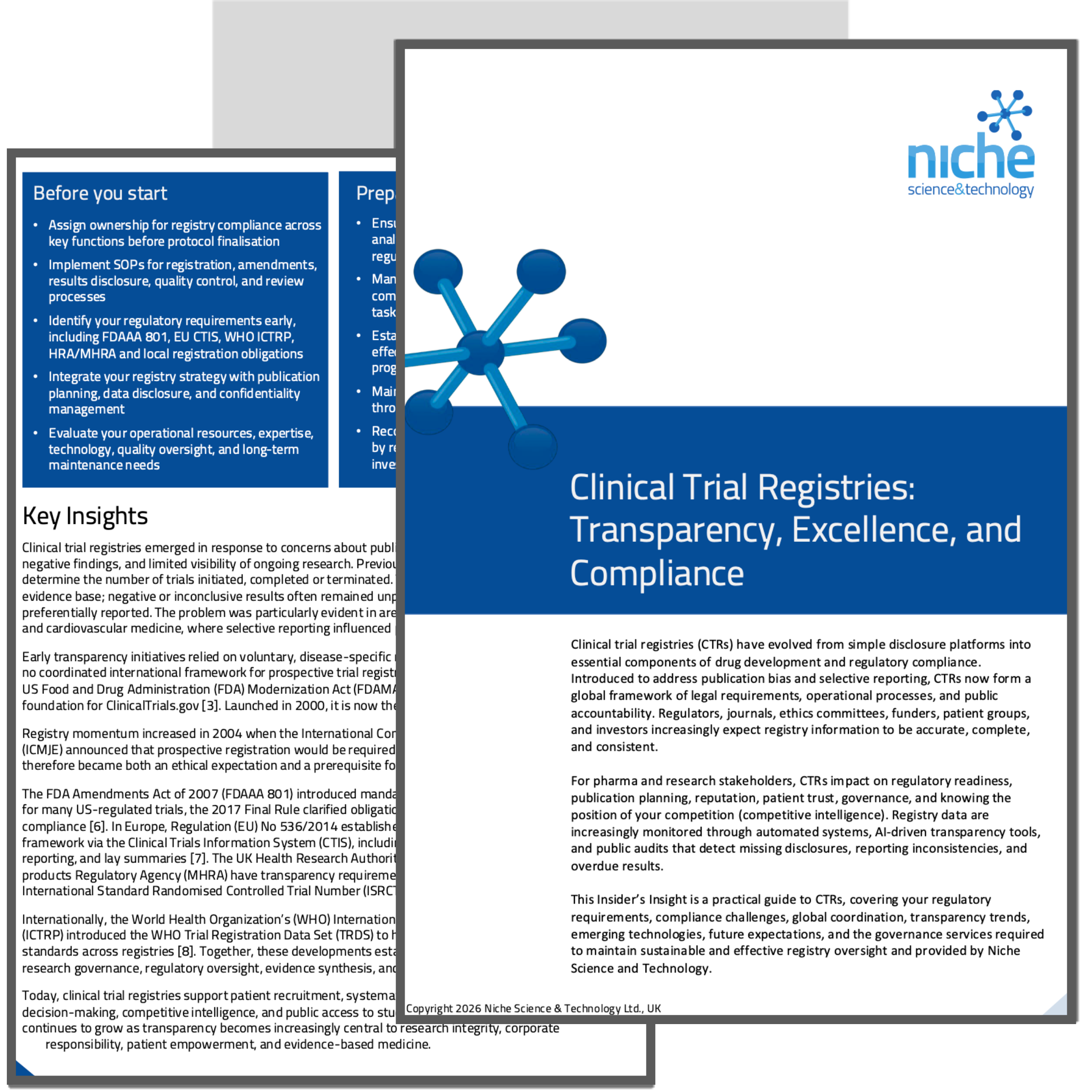
Clinical Trial Registries: Transparency, Excellence, and Compliance

Clinical trial registries have evolved from simple disclosure platforms into essential components of drug development and regulatory compliance. Registry compliance is not a one off administrative task.

Learn how to:

Meet your regulatory requirements under FDAAA 801, EU CTIS, WHO ICTRP and HRA/MHRA
Manage results reporting as a continuous compliance activity
Maintain consistency across protocols, registries, publications and submissions
Navigate global registry duplication and terminology differences
Build governance that survives amendments, transitions and team turnover
Insider's Insight: CTR | Niche
Join the other 20,000+ pharma colleagues who have downloaded our Insider’s Insights.

Get Your Insider's Insight

* indicates required

Frequently Asked Questions about the Insider’s Insight: Clinical Trial Registries

To help you get the most out of our resource library, we have compiled answers to the most common questions regarding the development, application, and distribution of our specialist guides.

At Niche Science & Technology, we believe that sharing expertise is the first step toward industry-wide excellence.
A clinical trial registry is a public database where trials are recorded to address publication bias and selective reporting. Regulators, journals, ethics committees, funders and patients now expect registry information to be accurate, complete and consistent throughout a study's lifecycle.
Requirements vary by jurisdiction and include FDAAA 801 in the US, the EU Clinical Trials Regulation via CTIS, WHO ICTRP, and HRA/MHRA rules in the UK. Most frameworks mandate registration shortly after first participant enrolment and results reporting within a set timeframe after primary completion.
Non-compliance is common because organisations often treat registry management as an isolated administrative task rather than an integrated operational discipline. Compliance rates differ significantly between large commercial sponsors and academic or non-industry sponsors, largely due to fragmented governance and limited resources.
CTIS operates on a principle of transparency by default, meaning documents submitted during regulatory review may become publicly accessible unless a deferral or redaction applies. This means sponsors must consider public disclosure implications from the earliest stages of protocol drafting.
AI can support repetitive tasks such as deadline monitoring and discrepancy detection, but experienced human oversight remains essential for judgement calls around commercial confidentiality, publication timing and cross jurisdictional obligations. Registry governance still requires scientific and regulatory expertise that technology cannot fully replace.

Get our latest news and publications

Sign up to our news letter

© 2025 Niche.org.uk     All rights reserved

HomePrivacy policy Corporate Social Responsibility
chevron-down