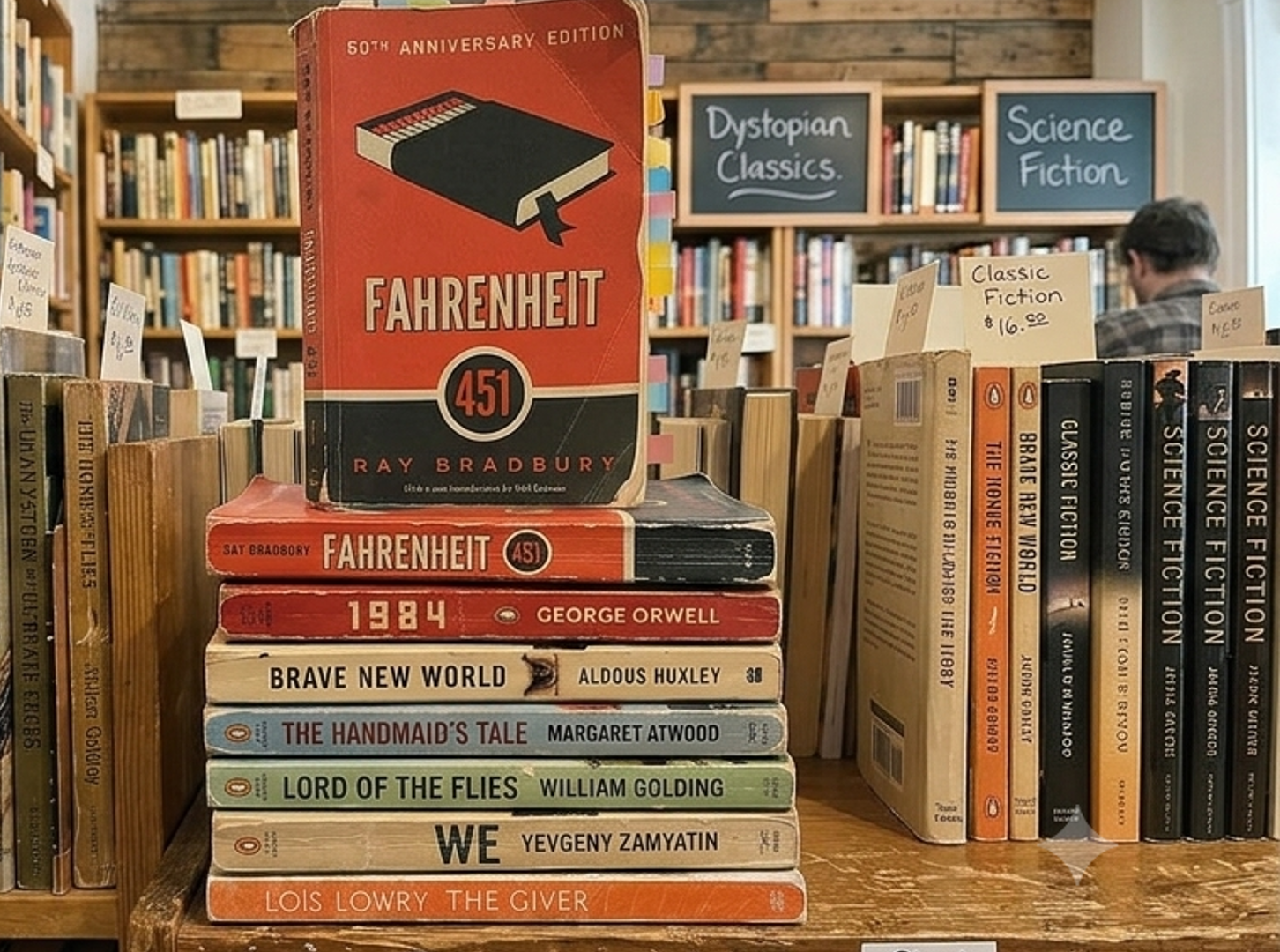
For me, there is something gut-churning and terrifying about the act of burning books. It represents that sickening sense of the world gone mad, perhaps reflected best in William Golding’s Lord of the Flies. In 1821, the poet Heinrich Heine penned a line that would echo through centuries: "Where they burn books, they will also ultimately burn people" [1]. Heine understood what historians of knowledge have since documented extensively: the deliberate destruction of books has rarely been about destroying paper. It has been a technology of power, a method for eliminating inconvenient ideas, suppressing competing worldviews, erasing collective memory, and controlling what future generations could know [1][2].
So how should we feel about the latest rumour that AI companies are purchasing millions of physical books, digitising them through ‘destructive scanning’, industrial guillotining of spines, high-speed page feeding, and subsequent pulping or recycling of the originals, and using the extracted text to train large language models with no consideration of copyright [3][4][5]. Court documents reveal that Anthropic's Project Panama, involved buying millions of second-hand books that were then sliced, diced and discarded. That the ISBNdb database now markets bulk book procurement services to AI developers, acknowledging candidly on its website that "'AI company destroys two million books” is not something they feel great about [3][4]. For me that is somewhat reminiscent of the betrayal of Julius Caesar by Marcus Brutus in William Shakespeare's Julius Caesar or Mordred's destruction of King Arthur's realm. Who cares if they are spending tens of millions of dollars on the initiative, whatever they pay, for me it will never be enough [3][6][7].
The AI companies insist that this is not ideological censorship. Accountants would argue that the objective is simply efficient data extraction, not the suppression of ideas. Some might even argue that it is potentially the democratisation of knowledge – though their resource is not freely available to all.
The symbolic act of destroying physical repositories of human knowledge after leaching out their informational value demands deeper reflection. Is this a modern parallel to one of history's oldest methods of controlling knowledge, or is it something fundamentally different?
Book destruction is a recurring theme across millennia. I remember Carl Sagan’s despair when he recounted the loss of the Library of Alexandris in his 1980’s television series, Cosmos. Fernando Báez's A Universal History of the Destruction of Books documents acts of biblioclasm (the intentional destruction of books) from ancient Sumer to modern Iraq. It highlights how these vandals have consistently targeted not merely objects but the knowledge, identity, and memory they embody. Richard Ovenden, director of the Bodleian Library, traces similar patterns in Burning the Books, arguing that libraries support not just literature but the rule of law, citizenship rights, and collective memory [8].
The burning of books during the Qin Dynasty (213 BCE) sought to eliminate competing historical narratives and philosophical traditions, establishing a single orthodox ideology [8]. Alexandria’s destruction symbolises the fragility of accumulated knowledge, though historians debate the precise extent of the loss [1]. The Spanish Inquisition, Savonarola’s Bonfire of the Vanities, and the Nazi book burnings of 1933 each targeted texts deemed dangerous or corrupt [1][2]. The Cultural Revolution's assault on libraries, the destruction of archives during the Bosnian war, and ISIS's systematic obliteration of manuscripts in Mosul and Timbuktu each demonstrated that destroying books is a form of symbolic violence, an assertion that certain ideas, identities, and memories have no place in the future [1][8].
A consistent logic runs throughout: books are destroyed not because they are flammable, but because they are dangerous [9]. The physical artefact is a vessel; destroying it is a means of killing the ideas it contains. Therefore, does it matter why people say they are doing it?
Should we see today's AI-driven book destruction as following a different logic? In the present sense, books are valuable not for their content per se but as training data. At least we can celebrate that our present-day miscreants recognise books as carefully edited, human-authored text. This is because it remains uncontaminated by AI-generated material [4][10]. The repository of human knowledge (estimated by Google circa. 2010 as 130 million printed books and now 150 million; 12 quadrillion words) is becoming contaminated with ‘AI slop,’ soulless, low-quality machine-generated content that devalues what they see as training datasets. Physical books published before 2022 have acquired a new kind of value [3][4][5]. They are ‘structurally guaranteed’ to be free of AI contamination [3][4].
The destruction is industrial in scale [3][5][7]. Booksellers in the US, Canada, and Europe report bulk orders that don't make sense for normal customers, one seller reported sales jumping from approximately 20 books weekly to hundreds since April 2026 [4][5]. Some targeted titles are out-of-print with almost no surviving copies elsewhere [5].
A US federal judge ruled that digitising legally purchased books and using them internally for AI training qualified as fair use, distinguishing this from the separate infringement of maintaining what would be pirated digital copies [3][6]. In contrast, the German Publishers and Booksellers Association has called the practice "a clear and serious violation of copyright," noting that under German law, scanning books, for whatever purpose, is not permitted [11].
But the legal question of copyright is not the only question worth asking.
The parallels between historical book destruction and modern AI digitisation are more symbolic than literal, but they are not trivial. In both cases, books become valued primarily as information containers. The physical artefact loses intrinsic cultural significance; its worth lies in the data it holds. Knowledge becomes centralised, once inside proprietary AI systems, access depends upon corporations rather than libraries [12]. Cultural memory becomes mediated by algorithms, and rare works may disappear from public circulation despite surviving digitally. They become accessible only through black‑box models whose training data is opaque and whose outputs are probabilistic rather than authoritative.
The optics problem, as ISBNdb's website candidly terms it, seems to have seen wider public debate ignored. Non-disclosure agreements, outsourcing of destruction to third-party vendors, and framing the process as digitisation rather than destruction seem to have kept the practice under the radar [3][4]. Anthropic's internal planning documents explicitly stated: "We don't want it to be known that we are pursuing this project" [3]. Yet as booksellers report unprecedented bulk purchases, and as enquiries for rare and out-of-print titles multiply across Europe, Canada, and the United States, the scale of the phenomenon is becoming visible [3][4][7][11].
A deeper paradox seems to be emerging. AI systems require enormous quantities of human-authored, carefully edited text because AI-generated material is increasingly contaminating online datasets. Research on model collapse shows that recursive training on synthetic data degrades output quality [3][10]. Communications of the ACM reports that "AI models training on data generated by previous AI models experience progressive quality degradation. Each generation learns from increasingly corrupted signals, inheriting and amplifying the artifacts and failure modes of its predecessors" [10]. This has created a secondary anomaly: the very success of generative AI is exhausting the supply of high-quality human-generated content needed to train future models [10][13]. Physical books have become a last reservoir of ‘clean’ data, precisely because they predate the synthetic contamination [13].
Simultaneously, concerns are growing about human cognitive engagement with AI. Research on cognitive offloading and the extended mind thesis suggests that reliance on AI for memory and reasoning tasks may reduce the frequency with which humans practise difficult cognitive skills [12]. A neuroscience-based theory has linked documented declines in IQ scores across high-income countries since the 1970s to the growing prevalence of cognitive offloading and pedagogical trends that minimise direct knowledge acquisition and retention [14]. The theory argues that underuse of the brain's declarative and procedural systems has weakened internal representations essential for reasoning, intuition, and expertise [14].
The convergence is striking. Machines become stronger through consumption of humanity's accumulated knowledge, while humans increasingly externalise memory, reasoning, and writing to machines. Whether this creates a perfect storm, where machines grow more knowledgeable as humans become less intellectually able, remains an open question [12][14]. But it is a question worthy of serious attention.
When books become disposable raw material, something more than paper disappears. Libraries and archives support not just literature but the rule of law and the rights of citizens [8]. The physical artefact embodies provenance, material history, and the tangible presence of human intellectual labour. Digitisation cannot fully replace these qualities. It captures informational content while discarding context, texture, and the physical traces of use and preservation.
Our loss extends beyond the destruction of individual volumes. As physical books gradually disappear from everyday life, we also risk losing a distinctive way of thinking. Reading a printed book is an embodied experience: the weight of the volume, the texture of the paper, the visible progress through its pages, and the absence of digital distractions all encourage slower, deeper and more reflective engagement. Studies consistently show that readers of printed books often demonstrate better concentration, comprehension and long-term recall than those reading equivalent digital texts.
More subtly (for me at least), physical books become part of our personal and collective history. For example. the first time I read Lord of the Rings, and my occasional re-reading of David Copperfield. My books carry inscriptions, annotations, coffee stains, pressed flowers, library stamps, and the wear of repeated reading, evidence of lives lived alongside ideas. Books are lent, inherited and discovered serendipitously on shelves in homes, libraries and bookshops, creating social and intellectual connections that algorithms struggle to reproduce. A digital copy may preserve the words, but it cannot preserve the rich material culture that surrounds them or the memories, relationships and sense of identity that physical books accumulate over time. And the smell of a library! This is what we are losing.
Should destructive scanning be regulated? Should rare books receive stronger protection? These are policy questions that have barely begun to be discussed. The German Publishers and Booksellers Association has called for stronger regulatory frameworks and transparency requirements that would mandate the citation of sources for AI input [3]. But they point to a larger philosophical question: does knowledge possess value independent of its informational content? If physical artefacts embody something irreplaceable, cultural heritage, material history, the psychology of deep reading, and the social lives of books, then destroying them, even after digitisation, represents far more than a technical act of preservation. It constitutes the irreversible loss of part of our intellectual and cultural ecosystem.
History shows us that book destruction has almost always reflected changing relationships between knowledge and power. The claim is that today's AI-driven destruction is motivated primarily by technological efficiency rather than censorship, a means of extracting data from the last uncontaminated reservoir of human writing. Yet it raises profound questions about how societies value knowledge, who controls access to it and at some point who controls a centralised source of knowledge – what do you have to pay to access it?
There is also the question of whether human intellectual independence will weaken as AI becomes increasingly capable [12][14]. It certainly feels like we are entering some kind of dystopian Bradburyian world (cf. Fahrenheit 451). With no books we have no independent route of escape. What could possibly go wrong?
Heine's warning was about the link between destroying ideas and destroying people. But we are dismantling libraries to feed machines, and asking whether we are also, in the process, dismantling something of ourselves. Perhaps the greatest lesson history offers is not that books were burned, but that less cultured and educated aspects of our society temporarily forgot why they mattered and ended up being associated with atrocities.
References

Get our latest news and publications
Sign up to our news letterResources
Social


Contact us
Address
Niche Science & Technology
Unit 26 Falstaff House
Bardolph Road
Richmond TW9 2LH
United Kingdom