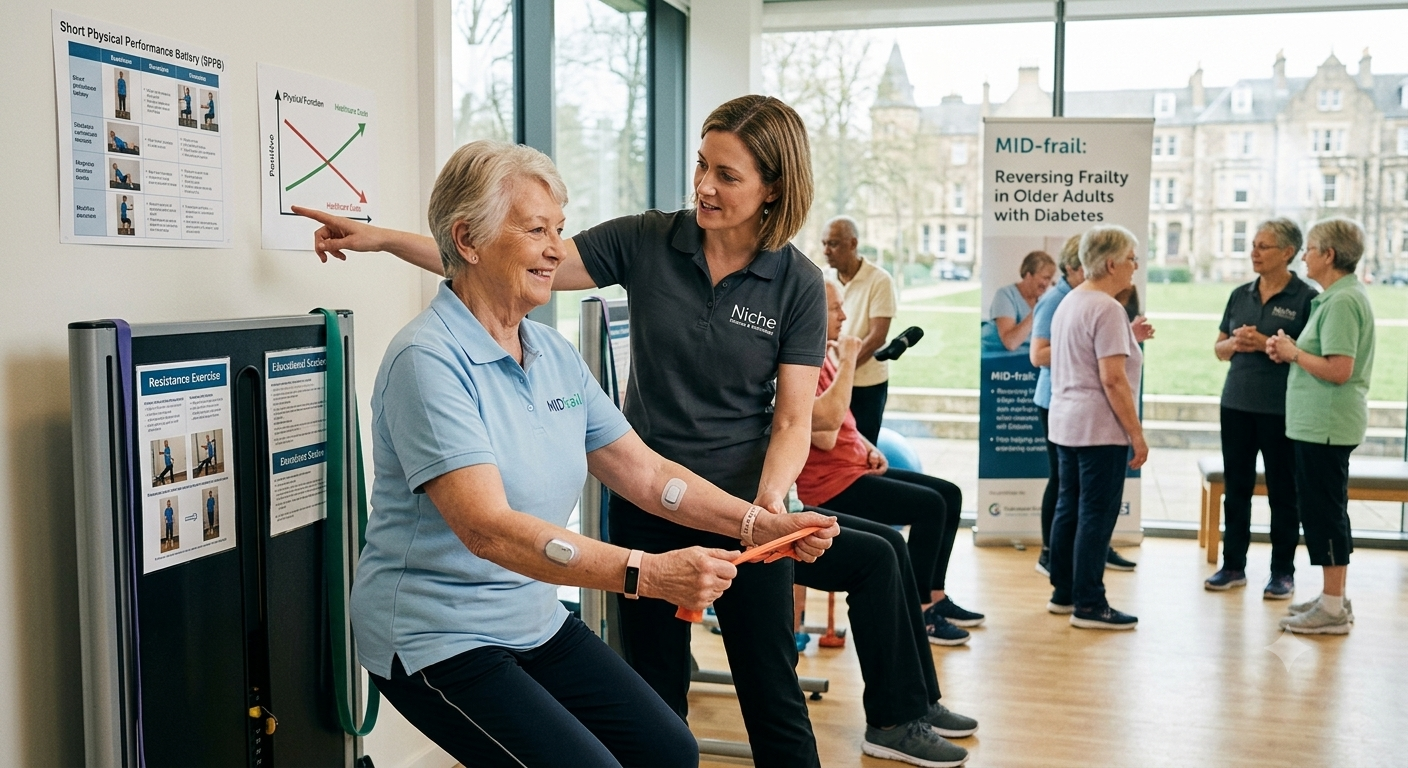
The publication of the second major paper from the European MID-Frail programme marked an important milestone in the management of older people living with type 2 diabetes. Published in the Journal of Cachexia, Sarcopenia and Muscle in 2019, the study moved beyond describing the relationship between diabetes and frailty to demonstrate that a carefully designed multimodal intervention could produce clinically meaningful improvements in physical function while simultaneously reducing healthcare costs [1].
For Niche Science & Technology Ltd., which coordinated the international consortium responsible for the study, the publication represented the culmination of almost a decade of scientific collaboration involving academic institutions, hospitals and clinical investigators across Europe.
Addressing an overlooked consequence of diabetes
Frailty has increasingly become recognised as one of the most significant complications of ageing with diabetes. Older adults with type 2 diabetes are considerably more likely to experience muscle weakness, impaired mobility, falls, loss of independence and hospitalisation than their non-diabetic peers. Yet despite the growing recognition of this problem, evidence for effective interventions had remained limited.
The MID-Frail consortium set out to determine whether frailty was an inevitable consequence of ageing with diabetes or whether it could be modified through a structured intervention combining exercise, education and optimisation of routine diabetes care [2].
A uniquely ambitious European clinical trial
MID-Frail became one of the largest multinational intervention studies ever undertaken in this patient population.
The cluster randomised clinical trial recruited 964 participants aged over 70 years from 74 clinical sites across seven European countries including Belgium, Czech Republic, France, Germany, Italy, Spain and the United Kingdom. All participants had established type 2 diabetes and met recognised criteria for either frailty or pre-frailty [3]. Rather than relying upon a single therapeutic approach, investigators developed a multimodal intervention consisting of three integrated components.
Participants received an individually tailored progressive resistance exercise programme delivered over sixteen weeks, a structured diabetes and nutritional education programme comprising seven educational sessions, and enhanced investigator training to optimise diabetes management according to contemporary European clinical guidance. The intervention recognised that maintaining functional independence requires far more than simply controlling blood glucose concentrations.
Functional performance was assessed using the validated Short Physical Performance Battery (SPPB), an internationally recognised measure incorporating balance, walking speed and chair-rise performance.
Clinically meaningful improvements
The results exceeded expectations.
After twelve months, participants receiving the intervention achieved SPPB scores that were, on average, 0.85 points higher than those receiving usual care, a highly statistically significant improvement (P < 0.001). Sensitivity analyses confirmed that these benefits remained robust despite participant withdrawals during the study. Nearly half of intervention participants improved by at least one SPPB point, representing a clinically meaningful improvement in functional ability. Among participants who adhered fully to the intervention, the average improvement exceeded one SPPB point.
Importantly, these improvements persisted long after the supervised exercise programme had ended, suggesting that the intervention produced lasting behavioural and physiological benefits rather than merely transient gains.
Although secondary outcomes including mortality, hospitalisation and quality of life did not reach statistical significance over the twelve-month observation period, favourable trends were observed across several measures. Investigators concluded that a longer duration of follow-up may have revealed additional benefits.
Better outcomes at lower cost
Perhaps one of the most influential findings of the study was its economic analysis. Despite the additional costs associated with delivering exercise and educational programmes, overall healthcare expenditure was lower in the intervention group. Average healthcare costs fell by approximately €428 per patient annually, largely through reductions in hospitalisation costs. Cost-effectiveness analyses consistently demonstrated that the intervention dominated usual care by delivering improved functional outcomes while simultaneously reducing overall healthcare expenditure.
At a time when healthcare systems across Europe face increasing pressures from ageing populations and rising diabetes prevalence, these findings carried important implications for policymakers and healthcare providers.
Coordinating a complex international collaboration
Large multinational academic studies require extensive coordination beyond traditional clinical trial management.
As consortium coordinator, the Niche Science & Technology team played a central role in managing communications across participating countries, supporting regulatory activities, coordinating reporting to the European Commission, overseeing dissemination activities and helping to ensure consistency throughout the programme. The company also contributed directly to the scientific publication, with Dr Tim Hardman serving as one of the manuscript authors and contributing to both study interpretation and manuscript preparation.
Delivering a harmonised intervention across 74 sites in seven healthcare systems presented substantial logistical and regulatory challenges. The experience demonstrated the importance of effective project coordination in enabling complex multinational research programmes to achieve their scientific objectives.
The MID-Frail legacy
The MID-Frail publications have helped reshape thinking around frailty in older adults with diabetes. Rather than viewing functional decline as an unavoidable consequence of ageing, the study demonstrated that targeted interventions can preserve mobility, maintain independence and potentially reduce healthcare utilisation.
The programme also highlighted the value of combining expertise from geriatric medicine, diabetology, rehabilitation science, nutrition, health economics and clinical trial management within a single coordinated European research consortium.
For Niche Science & Technology Ltd., MID-Frail remains an important example of how effective scientific coordination extends beyond regulatory compliance or project administration. By bringing together investigators from multiple disciplines and countries, the consortium generated evidence that continues to influence clinical practice and supports a more holistic approach to caring for one of the fastest growing patient populations in modern healthcare.
As Europe continues to grapple with the dual challenges of population ageing and increasing diabetes prevalence, the legacy of MID-Frail demonstrates that preserving function may be every bit as important as controlling disease.
References
Get our latest news and publications
Sign up to our news letterResources
Social


Contact us
Address
Niche Science & Technology
Unit 26 Falstaff House
Bardolph Road
Richmond TW9 2LH
United Kingdom