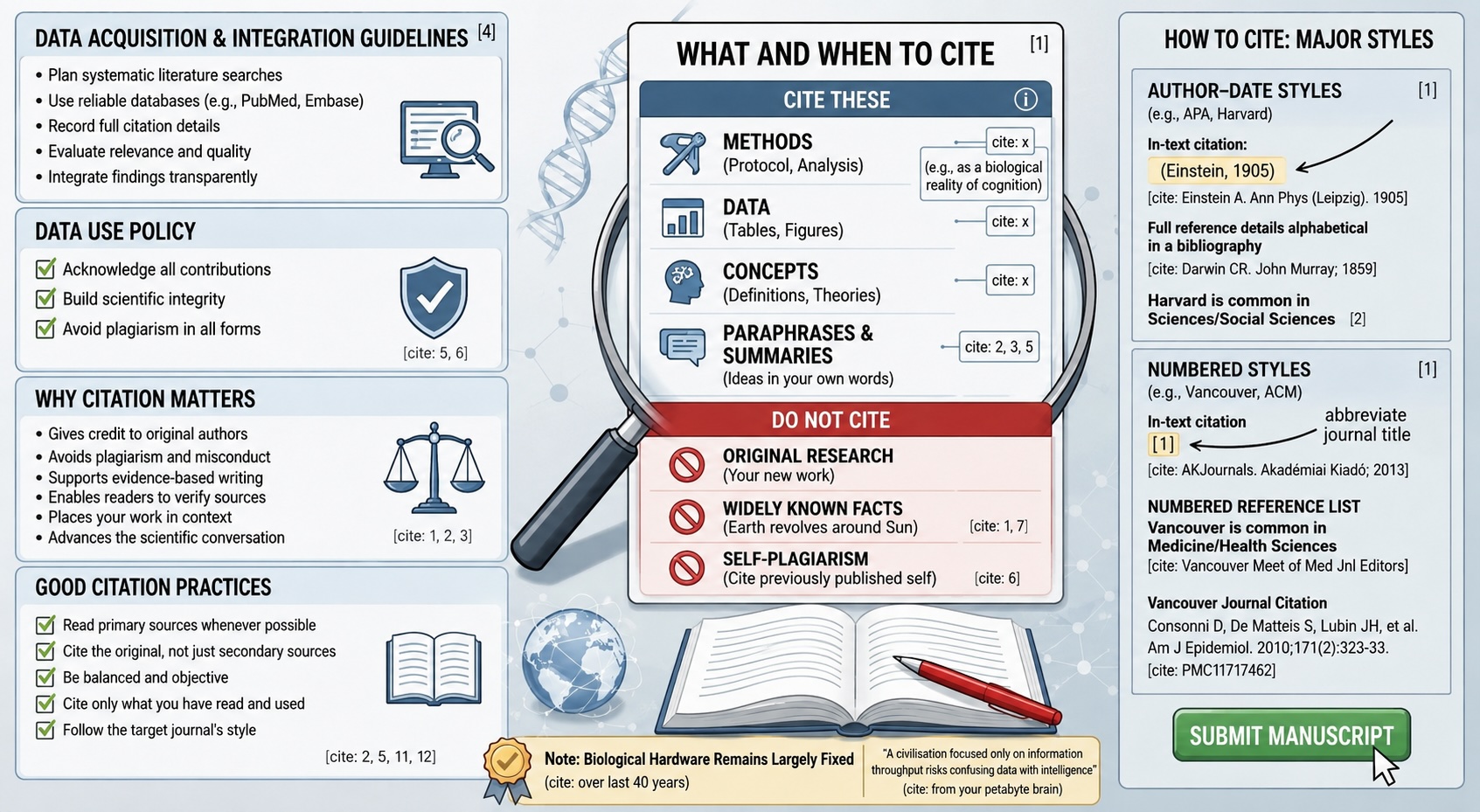
Scientific knowledge is not created in isolation. Every new experiment, review article, dissertation, textbook chapter, or editorial builds on the discoveries of others. Collectively, these publications form an ongoing scholarly ‘conversation’ that stretches across generations of researchers and disciplines. When we write about science or medicine, we enter that conversation. To contribute with integrity, credibility, and authority, we must do more than present our own ideas and acknowledge the work that came before us through accurate and appropriate citation of the scientific literature [1][2][3][4].
Citation is far more than an editorial formality. It is the mechanism by which scientific discoveries are attributed, evidence is verified, and readers are guided to the original sources. Proper referencing demonstrates respect for intellectual property while enabling others to evaluate the strength of the evidence on which an argument is based [2][5]. Without reliable citation, scientific communication loses much of its transparency, reproducibility, and its cumulative value.
One of the principal reasons for citing sources is to uphold academic integrity. Presenting another author’s ideas, data or words without acknowledgement constitutes plagiarism, one of the most serious forms of scientific misconduct [6][7]. Equally important is the need to distinguish clearly between what is established knowledge and one’s own original observations or interpretations. Readers should never be left wondering whether a statement represents accepted evidence or the your own conclusions.
Citations also demonstrate familiarity with the scientific literature. Every research project begins by identifying what is already known, where uncertainties remain, and how a new investigation will further existing knowledge. A carefully referenced introduction places a study within its scientific context, allowing readers to appreciate both the rationale for the work and its potential contribution to the field [8][9]. Authors who fail to acknowledge relevant previous studies risk giving a misleading impression of novelty or overlooking evidence that may contradict their conclusions.
Scientific references perform another essential function, they enable verification. Medicine is founded upon evidence that must be open to scrutiny. By providing complete citations, we allow readers to consult the original publications, evaluate our methodology, examine statistical analyses, and judge whether conclusions have been interpreted appropriately [2][10]. Such transparency is fundamental to evidence-based medicine and to the reproducibility of scientific research.
Citing correctly not only includes direct quotations but also ideas, hypotheses, experimental methods, diagnostic criteria, statistical techniques, clinical guidelines, definitions, illustrations, tables, and numerical data [2][11]. Even when information has been paraphrased into entirely new wording, the underlying intellectual contribution remains that of the original author and must be acknowledged appropriately [6].
Particular care must be taken when citing primary research. Whenever possible, authors should consult and reference the original publication rather than relying upon secondary citations provided in review articles or textbooks [5]. Secondary sources may inadvertently perpetuate errors or omit important methodological limitations present in the original work. Reading the primary literature also enables authors to interpret findings within their proper scientific context.
Not every statement requires a reference. Widely accepted facts that are considered common scientific knowledge generally need no citation. For example, few biomedical authors would reference the statement that DNA carries genetic information or that blood circulates through the cardiovascular system. Similarly, original observations arising directly from the author’s own research often doesn’t require citation, provided they have not been published previously. Nevertheless, whenever uncertainty exists about whether information is considered ‘common knowledge’, it is usually preferable to provide an appropriate reference [2].
Authors should also avoid excessive or inappropriate citation. References should support scientific statements rather than simply increase the length of a bibliography. Citing articles that have not been read, selectively citing only studies that support a preferred conclusion, or including unnecessary self-citations will distort the scientific record and diminish the credibility of the manuscript [5][12]. Good scholarship begins with balanced, representative citation of the available evidence.
Medical journals employ several referencing systems, but the Vancouver style seems generally accepted as the international standard throughout biomedical publishing. Developed by a group of medical journal editors in 1978 and subsequently adopted by the International Committee of Medical Journal Editors (ICMJE), Vancouver uses sequentially numbered references cited in the order in which they first appear in the text [1]. The corresponding reference list presents complete bibliographic details, enabling readers to identify every cited source quickly and accurately.
A typical Vancouver citation for a journal article includes the authors’ surnames and initials, article title, abbreviated journal title as listed in the National Library of Medicine catalogue, year of publication, volume number, issue number where appropriate, and page range [2]. Increasingly, Digital Object Identifiers (DOIs) are also included because they provide permanent electronic links to published articles. Consistency is essential; every citation should follow exactly the style required by the journal to which the manuscript is being submitted.
Modern reference management software such as EndNote, Reference Manager and RefWorks has greatly simplified the organisation and formatting of references. Nevertheless, no software can determine whether an author has selected the most appropriate citations or interpreted the literature correctly. Authors remain responsible for ensuring that every reference is accurate, relevant and genuinely supports the statement for which it has been cited [13].
Ultimately, citation is an expression of scientific integrity. Every reference acknowledges the intellectual achievements of previous investigators while demonstrating that scientific progress is a collaborative enterprise rather than an individual accomplishment. Careful referencing strengthens the credibility of your manuscripts, assists peer reviewers, enables readers to verify evidence, and preserves the continuity of scientific knowledge. As every experienced researcher appreciates, good science depends not only upon discovering new knowledge, but also upon recognising the shoulders upon which every discovery stands [3][4].
References

Get our latest news and publications
Sign up to our news letterResources
Social


Contact us
Address
Niche Science & Technology
Unit 26 Falstaff House
Bardolph Road
Richmond TW9 2LH
United Kingdom