Who remembers the line: "If it doesn't fit, you must acquit." Famously used by Johnny Cochran in the 1995 O.J. Simpson trial, it stuck powerfully with jurors and the public. We may never know whether it resulted in OJ getting acquitted, but it is a great example of what is called the Rhyme-as-Reason Effect. Also known as the Eaton-Rosen Phenomenon, it is a cognitive bias in which people perceive rhyming statements as more truthful, memorable, and persuasive than non-rhyming statements [1][2]. I am sure you know some other common examples:
"An apple a day keeps the doctor away."
"Birds of a feather flock together."
"Early to bed and early to rise, makes a man healthy, wealthy, and wise."
The use and efficacy of rhyme are so rooted in communication that the effect has been widely studied in psychology and linguistics, revealing its impact on advertising, politics, legal rhetoric, education, and everyday communication. Researchers have identified how oral traditions use rhyme for memorization, a principle applicable to modern education [3]. For instance, children learn the alphabet through rhyming songs, which enhances recall [4]. The effect was first demonstrated empirically by McGlone and Tofighbakhsh in 2000, revealing how people judge rhyming aphorisms as more accurate than non-rhyming ones, even when their semantic content is identical [5][6] Subsequent studies have underscored the interplay between form and content in communication.
Cognitive fluency refers to the ease with which the brain processes information (Reber and Schwarz 1999) [7]. When a phrase rhymes, being phonologically predictable, it is easier to read (reduced cognitive load), recall, and understand. Rhyming improves recall by creating acoustic encoding a phenomenon where similar sounds are easier to remember. This is why nursery rhymes often use rhyming structures [3]. For example, the phrase "Red sky at night, sailor's delight; red sky in morning, sailor's warning" has most likely been passed down for generations due to its rhyming structure rather than its weather forecasting potential alone. Research confirms that poetic meter and rhyme function as cognitive schemas that aid verbal memory and recall [8].
Rhymes create a predictable auditory pattern, allowing the brain to anticipate and reinforce connections between words. This structured repetition strengthens memory encoding and retrieval [9]. It fosters a sense of familiarity and credibility [5], making statements seem more 'true' [10]. The brain perceives fluently processed information as more reliable and credible, leading to an increased belief in rhyming statements. This fluency misattribution has been supported by recent eye-tracking studies, which show that rhyme-induced differences in reading time predict the perceived meaningfulness of a statement [11].
Because rhymes create a pleasing rhythmic quality, they generate positive emotions that enhance the perceived credibility and impact of a message [12][13]. Known as the Affect Heuristic, this refers to how emotional responses influence decision-making [12]. Studies have shown that people rate rhyming arguments as more persuasive than non-rhyming ones [35]. This effect is widely used in legal rhetoric, politics, and advertising, as O.J. Simpson's legal team can attest. Rhyming also fosters a sense of unity and connection in group settings. Chanting slogans is often used to create collective identity, from protest movements to sports fan culture. While the impact of rhyme is widespread, cultural nuances exist; research has shown that collectivist cultures with strong oral traditions exhibit stronger rhyme-based persuasion effects compared to individualist societies [14].
One must presume that pre-literate societies relied on rhyme for sharing knowledge [3]. This evolutionary predisposition would go some way to explaining why rhymes feel intuitively credible, even in written communication. The effect has been exploited widely in advertising and marketing. Rhyming slogans (e.g., "Snap, Crackle, Pop") are more memorable and persuasive. Slogans are effective because they are catchy, easy to remember, and create a subconscious preference for the brand [15]. Researchers have observed that consumers perceive rhyming brand slogans as catchier and more trustworthy, further driving consumer behaviour [12].
Relatively recently, we have experienced how simple, memorable, emotionally resonant messaging can be valuable during health emergencies. Rhyming public service announcements have increased the recall of preventive measures [16]. In contrast, complex scientific nuance does not spread well at scale, especially when quick public action is needed. For example:
"Catch it, bin it, kill it" (UK flu campaigns)
"Stay home. Protect the NHS. Save lives." (UK COVID-19)
"Flatten the curve" (global COVID-19 messaging)
If all else fails, there is always "An apple a day keeps the doctor away."
The effect is boosted even further by what is known as 'The Power of Three.' This is a rhetorical, literary, and psychological principle suggesting that information presented in groups of three is inherently more satisfying, effective, and memorable. From storytelling ("beginning, middle, end") to slogans ("life, liberty, and the pursuit of happiness") to advertising ("Just do it, own it, love it"), it taps into our cognitive preference for patterns and completeness. As with 'Rhyme-as-Reason,' it exploits cognitive fluency the ease with which information is processed to enhance memorability, persuasiveness, and perceived truth. Both rely on simplicity and fluency to increase believability through familiarity. Both are often used in slogans and soundbites because they appeal to pattern-recognition and satisfaction heuristics.
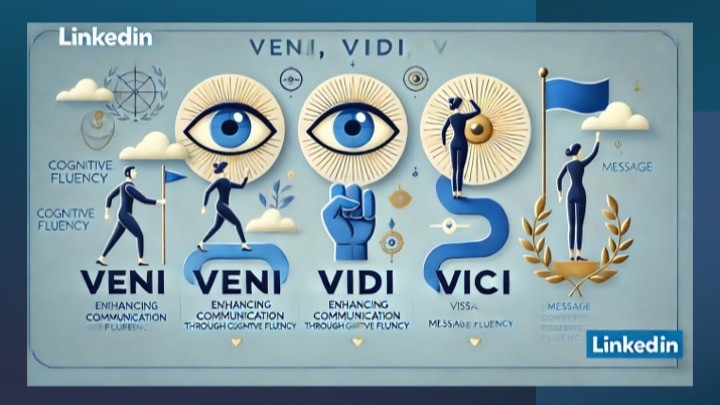
Politicians and their speechwriters have long used rhymes to amplify their slogans. "Veni, vidi, vici"("I came, I saw, I conquered") is probably the most famous slogan-like phrase from ancient Rome, though it was not originally a political campaign slogan in the electoral sense. Julius Caesar is credited with saying (or writing) this in 47 BCE after his swift and decisive victory over King Pharnaces II of Pontus at the Battle of Zela. He reported his success to the Roman Senate with those three punchy words a brilliant example of brevity, rhetorical rhythm, and confident dominance. It is a kind of proto-modern soundbite, and in some ways, it served as propaganda to consolidate his image as an unstoppable military genius and effective leader. It conveyed:
And it became one of the most famous phrases in history precisely because of its simplicity, cadence, and psychological impact classic Rhyme-as-Reason Effect territory, even though it does not rhyme, it has that triadic, rhythmic structure that makes messages memorable. It took nearly 2000 years for modern science to identify what clever old Julius knew instinctively: that rhythmic phrases in speeches heighten emotional appeal and perceived legitimacy, swaying voter attitudes [17].
In an era where information overload is prevalent, understanding how rhetorical devices like rhyme enhance persuasiveness is critical for effective messaging. For example, President Trump's communication strategy is a masterclass in exploiting cognitive fluency effects, whether through rhyme, repetition, or simplicity phenomena closely related to the Eaton-Rosen Phenomenon using simplistic, repetitive slogans like "Build the wall", "Lock her up", and "Make America Great Again" [18].
It is believed that over-reliance on rhyme can trigger scepticism if audiences detect manipulative intent [19]. However, this scepticism is not always present, as seen in the case of Trump's supporters. It has been suggested that rhyme cannot salvage factually flawed messages. Claims that although rhyme enhances perceived truth, it does not override the logical evaluation of content seem misplaced [5]. For example, the rhyme "I before E except after C" is widely remembered but linguistically inaccurate.
The Rhyme as Reason Effect illustrates how you can use form to shape perception in your communication. By leveraging cognitive fluency, rhyme enhances memorability, persuasion, and emotional engagement across diverse contexts. Rhyming phrases can reduce complex issues to simplistic statements that will be remembered. Rhymes are fundamental to early language acquisition and literacy. Studies show that children who learn through rhymes develop better phonological awareness, aiding in reading and writing skills [4].
The persuasive power of rhyme raises ethical questions. Its use in misinformation campaigns (e.g., political propaganda) exploits cognitive biases. Right-wing messages, particularly in populist or nationalist forms, often succeed in public discourse because they are simple, emotionally potent, morally absolutist and easily visualised. This makes them highly compatible with the Eaton-Rosen-like effects where cognitive fluency, rhetorical simplicity, and emotional charge override analytic reasoning.
Understanding must go some way to identifying efforts at rhetorical manipulation and misinformation through repetition and catchiness:
As a communicator, it is essential to balance rhetorical appeal with factual accuracy and ethical responsibility. Understanding this phenomenon allows you to use it responsibly, leveraging its benefits while being mindful of its potential for misinformation. Whether in advertising, politics, law, or education, rhymes continue to shape the way we process and believe information. Understanding this effect equips us to craft messages that resonate deeply while fostering critical awareness of their persuasive power for the betterment of us all. If speech writers for the Democratic Party need some guidance, they might start with, "The man's a crook, lock him up." I think everyone on the planet understands that one.
References

Get our latest news and publications
Sign up to our news letterResources
Social


Contact us
Address
Niche Science & Technology
Unit 26 Falstaff House
Bardolph Road
Richmond TW9 2LH
United Kingdom