Innovation in health communications is often misunderstood as a synonym for technology. Yet, innovation is about one thing: connection… finding novel ways to get people the information they need in ways that resonate. In this sense, innovation is a strategic, ethical, and human‑centred endeavour, one that redefines how scientific knowledge is translated, disseminated, and acted upon.
Traditional communication models, linear, document‑heavy, and slow, are increasingly misaligned with the realities of modern healthcare. Scientific knowledge is expanding at unprecedented speed, digital platforms are reshaping how people seek information, and patients are more empowered than ever. Meanwhile, misinformation proliferates across social channels and AI‑mediated environments, creating new challenges for trust and comprehension.
This shift demands a move toward audience‑centred, digitally mediated, and intent‑driven communication. Intent‑driven scientific communication, as described previously [1], emphasises an understanding of why audiences seek information, not merely what they ask [1]. It reframes communication as a dynamic, context‑aware process that aligns scientific content with user motivations, cognitive load, and decision‑making needs.
Innovation, therefore, is not merely about adopting new tools. It encompasses new ways of listening, designing, validating, and engaging, ensuring that communication remains meaningful, equitable, and scientifically robust.
Generative AI has transformed the production of health‑related content. Large language models can now generate articles, summaries, patient materials, and even scientific‑style narratives in seconds. This capability offers enormous potential for scaling communication, but it also introduces profound risks.
AI systems can produce hallucinated information, fabricate citations, or generate plausible‑sounding but incorrect scientific claims [2]. Without rigorous human oversight, these outputs may undermine trust, particularly in high‑stakes domains such as medicine. We should be aware and afraid that people are increasingly turning to social platforms and AI to ask questions about health and medicines, highlighting the urgency of ensuring accuracy and balance.
Other risks frequently raised in the post-AI era include:
The obvious result is information abundance but epistemic uncertainty, a landscape where more content certainly does NOT equate to more knowledge. For healthcare professionals and patients alike, distinguishing credible data sources and insights from gibberish (unqualified content) and noise (paraphrasing) becomes increasingly difficult.
To navigate this environment, communicators must pair AI‑enabled scale with rigorous validation frameworks, transparent sourcing, and human‑in‑the‑loop governance. Innovation must enhance, not erode, trust.
In health communications, veracity and evidence validity are non‑negotiable. The challenge is no longer access to information but the ability to identify what is credible, relevant, and actionable. Emerging AI‑assisted discovery tools are reshaping this landscape. Semantic search engines, retrieval‑augmented generation (RAG) systems, and voice‑enabled search interfaces allow users to navigate scientific knowledge more intuitively. Instead of relying on keyword matching, these systems interpret meaning, context, and intent: aligning with our framework’s emphasis on understanding the user’s underlying purpose [1].
This evolution transforms search from a static retrieval process into intent‑aware knowledge navigation. For example:
For communicators, this shift reinforces the need to design content that is structured, machine‑readable, and semantically rich. High‑value insights must be easy to access for both humans and algorithms to find, interpret, and trust. Innovation should augment knowledge and understanding, not merely introduce novelty. This aligns directly with the pursuit of veracity: innovation must elevate clarity, accuracy, and scientific integrity.
One of the most transformative trends in health communications is the shift from text‑dominant formats to multimedia, multimodal experiences. Advances in digital tools and AI have dramatically lowered the barriers to producing:
Previously, these formats required specialised production teams and significant budgets. Today, AI‑assisted platforms can generate storyboards, voiceovers, visualisations, and even 3D models at a fraction of the time and cost, effectively democratising dissemination.
Multimedia formats enhance:
Evidence from cognitive psychology shows that dual coding, combining verbal and visual information, significantly improves comprehension and recall [6]. Similarly, narrative‑driven multimedia supports emotional engagement, which is essential for behaviour change and patient empowerment.
Learning Science and the Multimodal/Dimensional Omnichannel Approach
Modern healthcare audiences are made up of clinicians, patients, policymakers, and industry professionals, all learning in fragmented, high‑pressure environments. Effective communication must therefore align with evidence‑based learning principles, including:
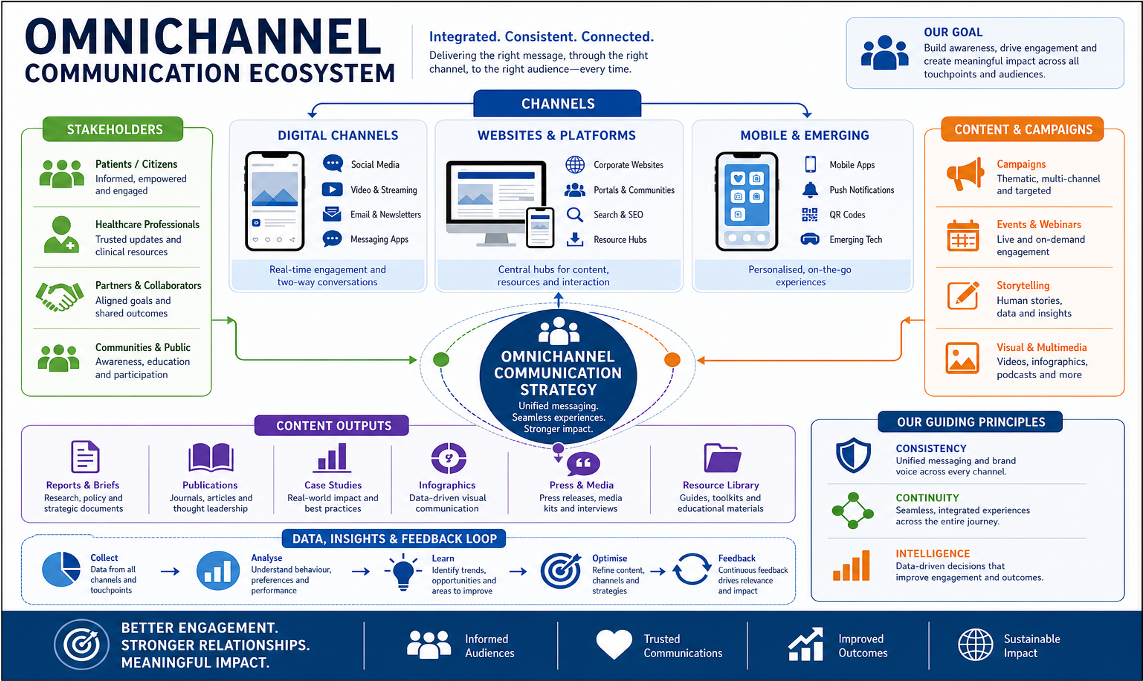
Multimodal/dimensional approaches integrate text, visuals, audio, interactivity, and social engagement into a cohesive learning ecosystems. This approach mirrors how people naturally consume information across platforms. The omnichannel model extends this further by ensuring that messages are consistent, adaptive, and reinforced across contexts, scientific meetings, social media, medical education platforms, field medical interactions, and AI‑mediated search environments.
Adaptive learning systems, powered by AI, can personalise content based on user behaviour, knowledge gaps, and intent. This aligns with tour proposed framework’s emphasis on tailoring communication to cognitive and emotional needs [1].
Innovation in learning science is therefore not about producing more content, but about designing smarter, more resonant, and more personalised learning journeys.
We still have some way to go. Beyond technology and learning science, several structural considerations will shape the future of health communications:
Innovation in health communications is not about chasing novelty. It is about purposeful, evidence‑based, human‑centred progress. But with these new technologies the future is full of potential. It is time for us to experiment to find what works best for us as humans and as individuals. The future will belong to communicators who balance:
By embracing intent‑driven strategies, multimedia storytelling, learning science, and ethical AI governance, the field can evolve toward a more inclusive, impactful, and resilient model of scientific communication.
Innovation is not a buzzword. It is a responsibility.
References

Get our latest news and publications
Sign up to our news letterResources
Social


Contact us
Address
Niche Science & Technology
Unit 26 Falstaff House
Bardolph Road
Richmond TW9 2LH
United Kingdom