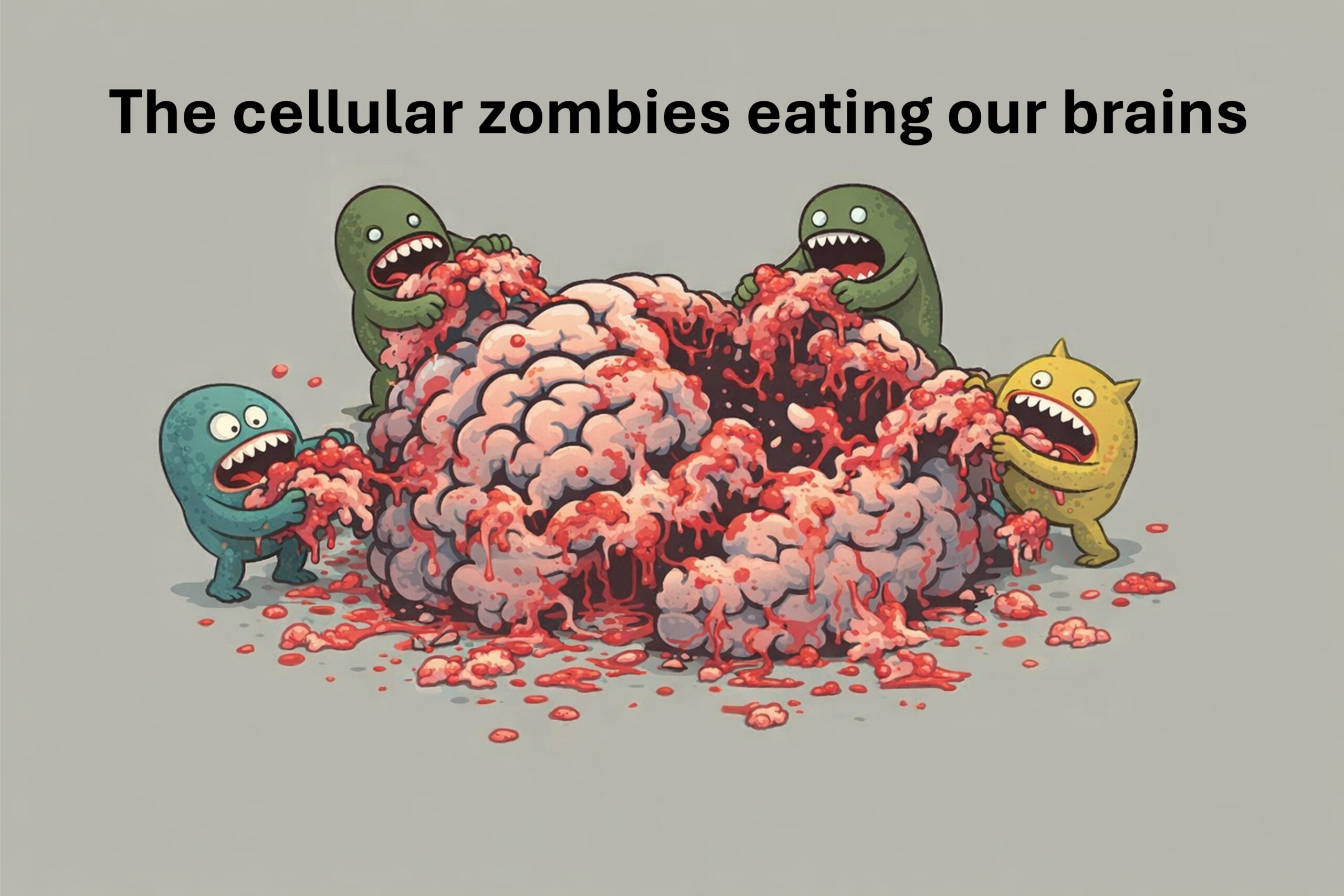
Welcome to the science of “cellular senescence”, where the monsters are real, and they're living inside you right now.
Let's be clear about what we're dealing with. Unlike vampires, who at least have the decency to transform into bats and sleep in coffins, zombie cells are far more insidious. These are normal cells that have stopped dividing, usually due to stress or damage, but ‘refuse to die.’ Instead of taking a peaceful exit (apoptosis, in scientific terms), they linger in your tissues like uninvited houseguests who've overstayed their welcome [1].
And they don't just sit there quietly.
These cellular zombies begin ‘releasing inflammatory chemicals’ into surrounding healthy tissue. Scientists have given this sinister secretion profile an appropriately clinical name: the ‘senescence-associated secretory phenotype’, or ‘SASP’ [2]. Think of it as the zombie's toxic breath, instead of infecting you with a bite, they poison everything around them through sheer proximity. The SASP includes pro-inflammatory cytokines (like interleuking (IL)-6 and IL-8), chemokines, proteases, and growth factors [3].
This isn't metaphor. It's biology.
Researchers first described cellular senescence in the 1960s, when Leonard Hayflick observed that human fibroblasts stop dividing after a limited number of population doublings, a phenomenon now called the Hayflick limit [4]. For decades, senescence was viewed as a protective tumour-suppression mechanism. Only recently have we recognized its dark side: these cells accumulate with age and actively promote tissue dysfunction [5].
In 2017, the field of senescence research matured dramatically. Laboratories like the Mayo Clinic led by Dr James Kirkland published findings that read less like gerontology and more like monster-hunting.
Here's what they discovered: when you ‘remove senescent cells in mice’ (using a clever transgenic model called INK-ATTAC, which allows drug-induced elimination of p16-positive senescent cells), remarkable things happen. Physical function improves. The animals run faster on treadmills. Their grip strength increases. Multiple age-related conditions, from frailty to metabolic dysfunction, are delayed or reduced [6].
Most strikingly, ‘treated mice lived healthier, longer lives.” In one landmark 2016 study, post-treatment survival increased by approximately 36%, with median lifespan extended and mortality hazard significantly reduced [7]. Another 2017 study showed that clearing senescent cells in aged mice restored physical function and reduced markers of systemic inflammation [8].
This evidence fundamentally shifted how researchers think about aging. It's not just passive ‘wear and tear,’ like a rusting car. Aging is actively driven by specific, targetable cell populations, and we now have the weapons to eliminate them.
The potential weapons have a name: senolytics [9]; a biological Rick Grimes (from the Walking Dead TV series).
These are drugs designed to selectively kill senescent cells while leaving healthy cells alone. The term was coined in 2015 by the Kirkland lab. The most promising early combination paired dasatinib (a leukemia drug) with quercetin (a plant flavonoid found in apples and onions) [10]. In animal models, this cocktail cleared zombie cells, reduced SASP factors, and alleviated age-related dysfunction.
Other senolytic candidates identified by 2017 include navitoclax (an anti-cancer drug that inhibits BCL-2 family proteins) and fisetin (another plant flavonoid) [11].
The goal is straightforward: reduce the chronic inflammation linked to aging, a phenomenon scientists call "inflammaging," first described by Claudio Franceschi in 2000 [12]. Zombie cells are now considered a primary driver of inflammaging [13].
This represents nothing less than a revolution in how we approach aging itself. Instead of asking "How do we slow down decline?", researchers started asking: "Can we remove the specific cells that make tissues behave old?"
Zombie cells are now linked to an expanding list of horrors: osteoarthritis (where senescent chondrocytes degrade joint cartilage) [14], atherosclerosis (senescent endothelial cells promote plaque formation) [15], neurodegenerative diseases (senescent glial cells contribute to neuroinflammation) [16], and general frailty [17]. Their presence could explain why inflammation rises with age, each zombie acting like a tiny inflammatory factory.
Before you rush to order dasatinib and quercetin from some dodgy online/overseas pharmacy (please don't), understand the limitations. Most results remain in animals, not humans. As of late, the first small human trials are only just beginning, with a handful of proof-of-concept studies in patients with diabetic kidney disease or osteoarthritis [18].
Moreover, completely removing senescent cells might have downsides—they also play beneficial roles in wound healing (where transient senescence helps recruit immune cells and promote tissue repair) and cancer suppression (senescence acts as a barrier against malignant transformation) [19].
Every good horror story has a twist, and this one is no exception: sometimes, you need the monsters.
Nevertheless, the buzz around "zombie cells" marked a turning point in medical thinking. The shift, from passive decline to active intervention, is why the idea stuck. In October we had the first international conference on senolytics which drew standing-room-only crowds. Major pharmaceutical companies have begun screening for novel senolytic compounds [20].
Halloween 2017 arrives with a new kind of scary story. This one doesn't feature haunted houses or cursed artifacts. It features your own cells, refusing to die, poisoning your tissues, and accelerating your decline. But unlike traditional horror, this story has hope: we're learning to fight back.
The monsters aren't under your bed. They're inside you. And for the first time, science is learning how to destroy them.
References

Get our latest news and publications
Sign up to our news letterResources
Social


Contact us
Address
Niche Science & Technology
Unit 26 Falstaff House
Bardolph Road
Richmond TW9 2LH
United Kingdom