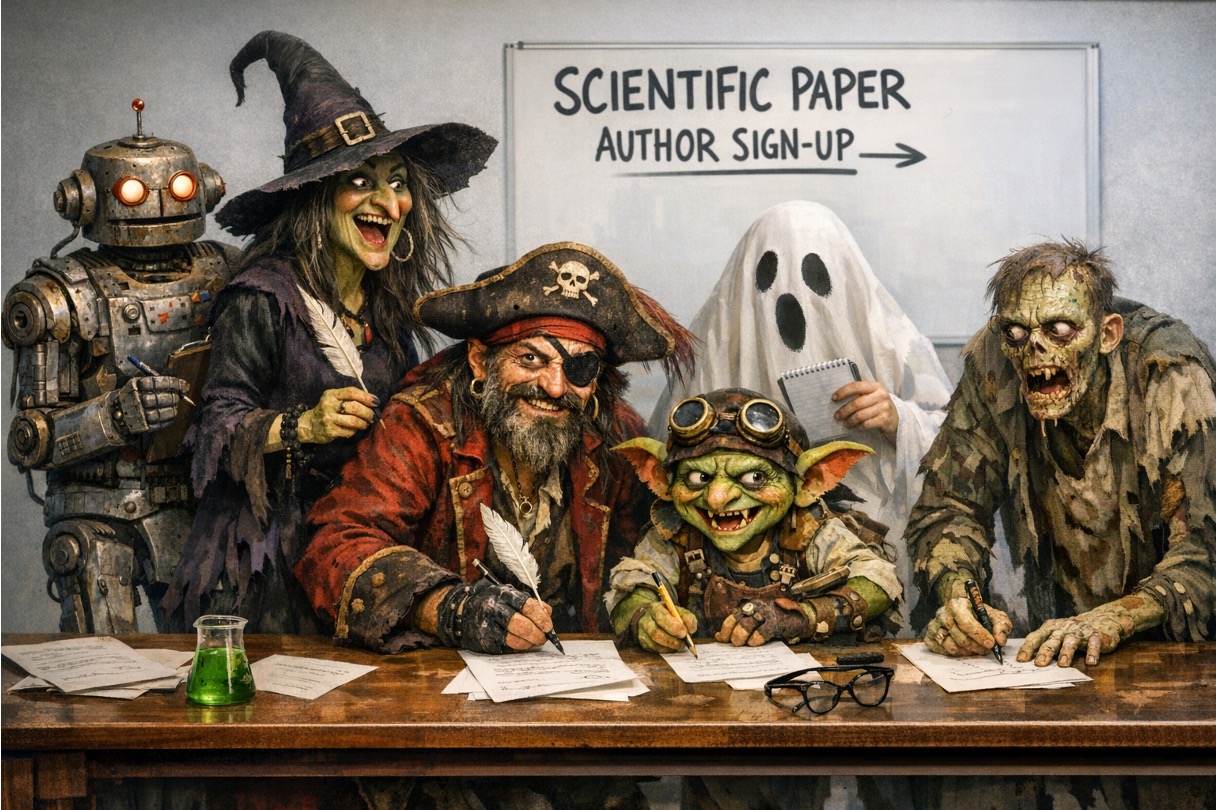
I began my career as a junior scientist in the 1980s, in what might be termed the twilight of the era of gentleman science, where academic enquiry was less a formal occupation than a social identity, rooted in privilege, curiosity, and a sense of intellectual duty. Research was slower, more manual, and often deeply personal in its intellectual ownership. Authorship on publications was not a reflection of contribution. My role was to generate data, repeat experiments, and address the failures. Academic recognition (aka authorship) was reserved for those higher up the academic food chain.
As I advanced into roles coordinating laboratory research, the dynamics became more complex rather than more equitable. Collaboration was encouraged, but it came with implicit expectations. Senior clinical figures, sometimes only marginally engaged, were routinely included as authors. Their presence on manuscripts reflected influence and network positioning as much as intellectual input. This pattern was not anomalous; it was structural.
My subsequent work in medical communications revealed a further layer. Ghostwriting manuscripts highlighted how some clinicians could become hyperprolific authors, with implausible publication rates (without substantial unseen support). This was before the widespread adoption of transparency frameworks such as those promoted by Good Publication Practice. Disclosure was limited, and the separation between those who wrote and those who were credited was often obscured.
Looking back, these experiences reflect not isolated practices but an early manifestation of a broader shift, from craft-based, individually attributable science to a more distributed, industrial model of knowledge production.
The transition to what might be termed 'industrial science' has been driven by digitalisation, global collaboration, and intensified competition. Leading research is now conducted across networks rather than within isolated laboratories. While this has enabled remarkable advances, it has also fundamentally altered the meaning of authorship.
Empirical evidence demonstrates a consistent increase in the number of authors per paper across multiple disciplines. Analysis showed that team-based research has come to dominate knowledge production, with collaborative work associated with higher impact outputs [1]. We have seen a steady expansion of team size and its correlation with citation impact across fields [2]. This growth is not confined to specific domains but is pervasive throughout modern science.
Manuscripts have also become longer, citing ever-more references and delivering increasingly elaborate abstracts—features that may signal complexity but not necessarily clarity or originality. In response, the International Committee of Medical Journal Editors attempted to define authorship citing qualifications such as substantive intellectual contribution and accountability. However, the practical application of these criteria is often inconsistent.
Key drivers of authorship inflation include:
The rise of hyperprolific authorship further complicates the picture. Observers identified a subset of researchers producing papers at extraordinary rates, sometimes exceeding one publication every few days [3]. Such productivity in no sensible world reflects any deep engagement with individual projects but rather points to a system in which authorship can be distributed strategically across multiple collaborations.
Gift authorship, where individuals are included despite limited contribution, remains a persistent issue. Analysis of data from six high-impact medical journals and found that 21% of articles contained honorary authors, while 11% had ghost authors [4]. Others reported similar figures, noting that many honorary authors neither reviewed the final manuscript nor took responsibility for its contents [5]. These practices are not merely ethical lapses but adaptations to an environment where authorship functions as both currency and credential.
A notable case: The Merck/Vioxx scandal (2008) revealed that the pharmaceutical giant had drafted dozens of research studies and review articles, then recruited prestigious academic physicians to attach their names as authors. Internal documents showed one draft with the lead author field marked "External author?"—a placeholder for a prominent researcher yet to be recruited. This ghostwriting practice misled readers and concealed conflicts of interest for years.
The inflation of authorship has significant implications for how scientific contribution is measured and valued. Bibliometrics such as the h-index and field-weighted citation impact rely on authorship as a proxy for intellectual input [6]. When authorship becomes diluted, these metrics risk misrepresenting both productivity and influence.
Such distortion is particularly problematic when evaluating academic contribution, where hiring, promotion, and funding decisions are closely tied to publication records. Moher et al. (2018) argued that current assessment practices overemphasise quantitative metrics at the expense of qualitative evaluation of contribution [7]. In these cases, the incentive is not merely to publish, but to be seen to publish, preferably often and widely.
Yet the lived reality of scientific work remains stubbornly resistant to such simplification. Experimentation remains slow, iterative, and frequently unsuccessful. It involves extensive background reading, repeated experimentation, and the accumulation of data that may never be published. The path from concept to manuscript is rarely linear and often extends well beyond formal working hours and efforts of core authors.
Faced with these demands, some researchers adopt a strategy of distributed engagement, participating minimally in multiple projects to ensure a continuous flow of publications. While rational within the current system, this approach further weakens the link between effort and authorship. We now have the movement for 'contributorship' (CRediT taxonomy; [8]), but there is no saying where the threshold for inclusion lies within individual projects (see our recent Insider's Insight on the rules of authorship: [9]).
The journal system compounds these challenges. Peer review, while central to quality assurance, is highly variable. Reviewers differ in expertise, thoroughness, and intent. Some provide constructive guidance; others focus on identifying grounds for rejection. Delays are common, with manuscripts often taking months or years to publication.
There is also a pervasive conservatism within the system. Innovative or speculative work may struggle to gain acceptance, as reviewers and editors favour incremental advances that align with established paradigms. Some have argued that aspects of the research ecosystem may be fundamentally flawed, with systemic biases affecting what is published and how it is evaluated [11]. For authors, the process can feel less like a pathway to dissemination and more like a prolonged negotiation with an opaque and sometimes resistant system.
At its core, the issue of authorship is not simply procedural but philosophical. In the era of craft science, authorship implied ownership—a clear association between individual intellect and published work. In the era of industrial science, that association has become diffuse. Knowledge is produced collectively, often across large and geographically dispersed teams. Authorship, in this context, may reflect participation rather than ownership.
This raises fundamental questions. Who owns knowledge generated by large collaborations? Does authorship still signify intellectual contribution, or has it become a form of academic currency? If the latter, then the erosion of its meaning has implications not only for individual careers but for the integrity of the scientific record itself.
What has changed in 40 years:
Superficially, much has changed since the 1980s: more authors, more references, more output. Yet the underlying tensions, between contribution and credit, effort and recognition, remain unresolved. If anything, they have intensified. It has impacted on my own approach to the scientific narrative. Recently, my focus has shifted from learned journals to blogging on our company website. Where it previously took me 40 years to publish 120+ articles where the content was stifled by the establishment, I can now express my own opinion 120+ times in a year, and the content is not locked behind journal paywalls.
The emergence of artificial intelligence introduces a further layer of uncertainty. Tools such as ChatGPT are already reshaping how manuscripts are drafted and refined. While they offer efficiencies, they also risk further distancing the author from the text [9][12]. Language may become more standardised, voices more homogenised, and the boundary between human and machine contribution increasingly blurred.
There is also a risk that AI systems, trained on existing literature, will reinforce prevailing norms and biases, making it more difficult for unconventional ideas to emerge. In this sense, the adoption of AI may not resolve the ambiguities of authorship but deepen them.
Just as the transition from craft to industrial science transformed the scale and structure of authorship, the integration of AI may redefine it once again. Whether this transformation will enhance clarity and accountability, or further erode them, remains uncertain. The trajectory so far offers little reassurance. What is clear is that without systemic reform, embracing contributorship models, enforcing transparency, and rethinking how we evaluate researchers, the signal in our scientific literature will continue to be lost to noise.
References

Get our latest news and publications
Sign up to our news letterResources
Social


Contact us
Address
Niche Science & Technology
Unit 26 Falstaff House
Bardolph Road
Richmond TW9 2LH
United Kingdom