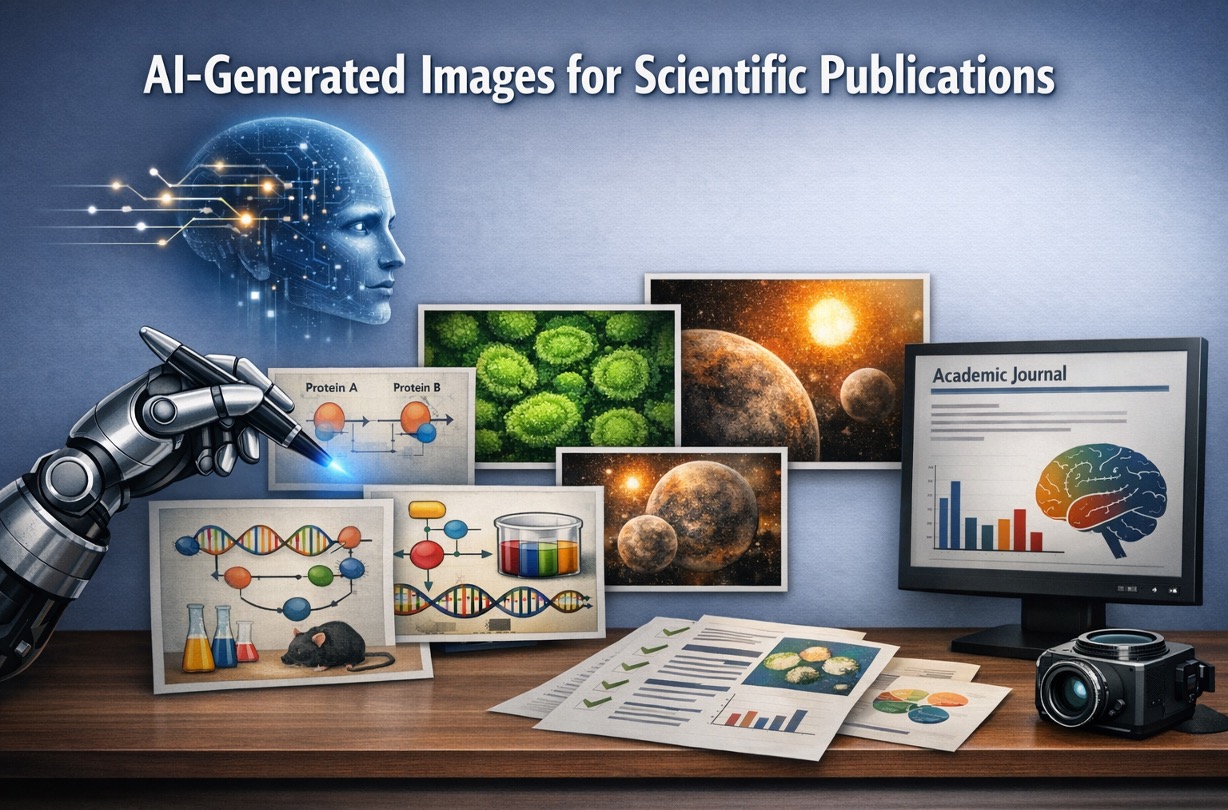
For me, generating test has never been an issue. My biggest challenge has always been how best to illustrate my point (and yes, I used AI to create the image above). It is a critical communication skill for scientists and it just got easier. The integration of generative artificial intelligence (AI) into scientific workflows continues at pace [1][2]. It has moved rapidly beyond text generation and has begun to reshape how we present information visually. Conceptual diagrams, graphical abstracts, and even simulated microscopy images are now easy to generate [3][4][5].
This shift represents a significant transformation in how scientific knowledge is communicated, bringing both opportunities and threats [6][7]. The adoption of AI tools to generate images seems to have outpaced the development of coherent governance frameworks for responsible use [3][6][8]. Journals, publishers, and research communities are now engaged in an ongoing effort to define acceptable use, establish transparency requirements, and mitigate the risks associated with automated image generation [6][9][10][11][12].
Generative AI tools such as diffusion and multimodal large language models can readily translate textual prompts into detailed scientific illustrations [1][13][14]. These tools are being used increasingly to create diagrams and schematics (ever more complex conceptual diagrams, illustrations of biological pathways), and data derived images (microscopy, cells, and graphical summaries) that have, in the past, required specialist illustration skills [3][4][5][15]. As such, they democratise access to high-quality visualisation. Their adoption can only serve to enhance the clarity of interdisciplinary communications. Win-win!
Yet, these benefits are accompanied by epistemic concerns. Unlike traditional data visualisation techniques, AI-generated figures may not always be directly traceable to empirical data or reproducible workflows [7][16]. This introduces ambiguity regarding their evidentiary status, whether they correctly represent data or their outputs are no more than illustrative abstraction [17][18]. It is particularly important for data-derived images that might be mistaken for empirical evidence.
It is testament to how fast the field is moving that policies governing AI-generated imagery are inconsistent [3][6][7]. Major publishers, like Nature Portfolio, Elsevier, PLOS, and Cell Press, have taken divergent approaches, ranging from outright prohibition to conditional acceptance with disclosure. For example, Nature journals have taken a relatively conservative stance, explicitly prohibiting AI-generated artwork in certain contexts due to unresolved copyright and legal concerns [6][12][19]. In contrast, Elsevier and PLoS currently permit AI-generated content provided that authors clearly disclose its use and retain full responsibility for accuracy and integrity [9][10][11]. Currently it seems that AI‑generated figures are not equally controversial across fields:
A recent analysis noted that the current situation is fragmented and insufficiently harmonised, arguing that disclosure alone is inadequate without mechanisms for accountability and verification [3][7]. Moreover, empirical studies suggest that even where policies exist, compliance is low. One large-scale analysis found that only 0.1% of papers explicitly disclosed AI use despite widespread adoption, highlighting a significant transparency gap [8][20].
The debate around AI-generated figures is underpinned by several recurring ethical and scientific concerns [2][6][7][17].
Finally, there remains the unresolved issue of copyright and data provenance. Many generative models are trained on large, heterogeneous datasets that may include copyrighted or ethically sensitive material, raising unresolved legal and ethical issues [6][12][19].
A 2026 review of scientific visualisation tools identifies a growing suite of AI native platforms intended to support authors of scientific papers. These include systems capable of generating biological pathway diagrams, microscopy style images, and graphical abstracts that require minimal user input [2][4][5][15]. Some tools integrate domain specific constraints to ensure scientific plausibility, while others provide code based outputs to maintain numerical accuracy. Platforms such as SciDraw, Scillus, Illustrae, and PaperBanana enable users to generate diagrams aligned with disciplinary conventions [15].
More general-purpose tools, such as diffusion-based image generators, are also widely available, although they often require more substantial human involvement to create images that meet scientific standards [1][13][14]. These tools excel at conceptual illustration but may struggle with precision, scale, and adherence to domain-specific visual norms [4][5].
To the ethical and responsible scientist, AI tools should be viewed as assistive technologies rather than autonomous creators. Human oversight remains essential to ensure that generated figures accurately reflect the underlying science [2][6][7][17].
Emerging guidance converges on several practical principles for the responsible use of AI-generated figures in academic publishing [6][7][17].
Appropriateness must be considered. Not all figures are suitable for AI generation; data-driven visualisations, for example, require direct linkage to empirical data and should not be replaced by synthetic approximations [5][8][12][18]. And finally, we shouldn't only focus on fully generated images. We should also be concerned about the use of AI tfor image 'enhancement' (denoising, in-painting, automated segmentation). These tools blur the line between legitimate pre- and post-processing an unethical manipulation.
Toward Standardisation and Future Directions
The current trajectory suggests that AI-generated figures will become an increasingly common feature of scientific publications. However, whether or not they become acceptable for use will depend on the development of coherent and enforceable standards [3][6][7]. There is growing recognition that journal policies must evolve from simple disclosure requirements toward more robust frameworks incorporating verification, documentation, and accountability [3][7][8].
Standardisation efforts may include harmonised reporting guidelines, integration of AI metadata into publication workflows, and the development of tools for detecting or auditing AI-generated imagery [3][7][8][20]. At the same time, the scientific community must engage in a broader epistemological reflection on the role of visual representation in science. As AI blurs the boundary between illustration and evidence, maintaining clarity about what figures represent, and how they were created, will be essential to preserving trust in the scientific record [2][4][5][6][7][17].
Most scientists appreciate the value of the ‘killer’ figure. An image that captures the attention of our audience. Techniques available to scientists have evolved from hand drawing, to photography, to dot-matrix printouts, to ever-more complex PowerPoint slides. It seems that AI is the next step [4][5].
Figures generated by AI represent both a powerful innovation and a significant challenge for academic publishing. While they offer clear benefits in terms of speed and accessibility, they also introduce risks related to reproducibility, transparency, and visual integrity [6][7][16][17]. Science requires traceable provenance for any tool used in reporting findings but most generative models provide no dataset disclosure.
The landscape is scattered with fragmented policies, uneven compliance, and evolving best practices. The responsible integration of AI into scientific visualisation will depend on a combination of clear guidelines, rigorous oversight, and a continued commitment to the principles of scientific integrity [3][6][7][8][16][17].
Ultimately, AI should augment, not replace, the critical judgement and accountability of researchers. The future of scientific communication will likely be shaped not by whether AI is used, but by how thoughtfully and transparently it is integrated into the research process [2][6][7][17].
References

Get our latest news and publications
Sign up to our news letterResources
Social


Contact us
Address
Niche Science & Technology
Unit 26 Falstaff House
Bardolph Road
Richmond TW9 2LH
United Kingdom