A Guide To Navigating Ethical Authorship

As the workplace becomes increasingly virtual, the art of conducting productive online meetings has never been more crucial. This shift is not just technological; it demands changes in behaviour, communication style, and leadership dynamics.

Learn how to:
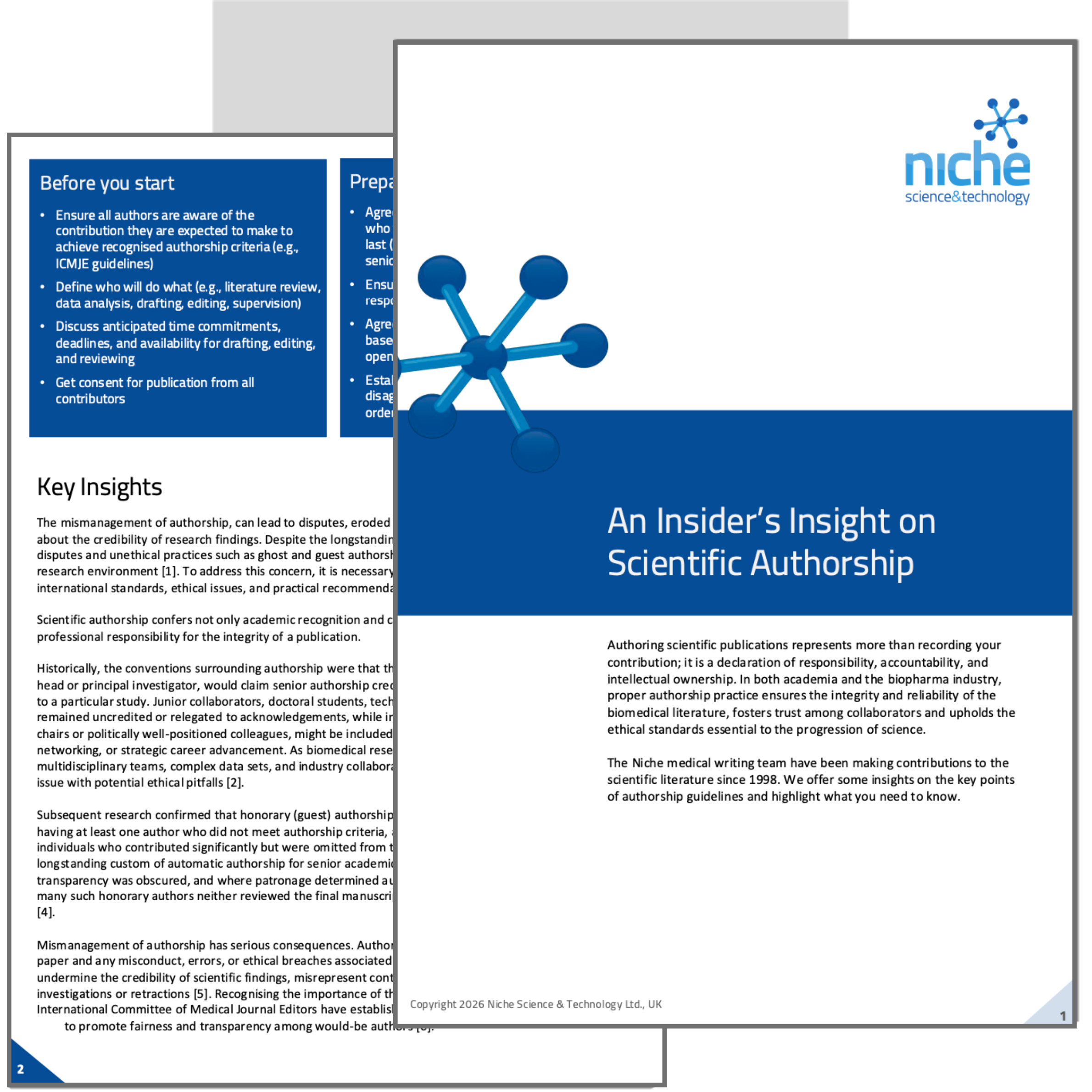
Plan for success
Build effective agendas
Manage time keeping
Maintain focus
Achieve outcomes
Authorship Insider's Insight Display | Niche
Join the other 20,000+ pharma colleagues who have downloaded our Insider’s Insights.

Get your Insider's Insight

* indicates required

Frequently Asked Questions about the Insider’s Insight: Authorship

To help you get the most out of our resource library, we have compiled answers to the most common questions regarding the development, application, and distribution of our specialist guides.

At Niche Science & Technology, we believe that sharing expertise is the first step toward industry-wide excellence.
Authorship requires substantial intellectual contribution, not just involvement. According to the ICMJE criteria cited in the document, authors must contribute meaningfully to the study design, data acquisition or interpretation, participate in drafting or revising the manuscript, approve the final version, and accept accountability for the integrity of the work. The guide emphasises that many listed authors in modern research still fail to meet these standards.
The top recurring problems include:
- Honorary (gift) authorship — crediting individuals who did not contribute.
- Ghost authorship — omitting contributors such as medical writers.
- Salami slicing — splitting one dataset into multiple minimal papers.
- Hyper‑prolific authorship — implausibly high publication rates without meaningful involvement.
- Paper mill involvement — purchasing fabricated manuscripts or authorship slots.

These practices undermine transparency and distort academic credit.
We identify early, proactive planning:
- Agree authorship order at project initiation.
- Document expected contributions and revisit them regularly.
- Use formal authorship agreements, especially in multi‑centre or industry‑funded studies.
- Adopt contributorship frameworks like CRediT to clarify roles.
- Clear communication and documentation are the strongest safeguards.
The document is explicit: LLMs cannot be authors because they lack accountability, intent, and consent. Their use must be transparently disclosed, including what aspects of drafting or analysis they assisted with. Risks include factual inaccuracies, bias, and fabricated references (“AI hallucinations”). Journals increasingly require AI‑use statements and are deploying AI tools to detect image manipulation and paper‑mill activity.
Industry publications must follow GPP 2022 and emphasise transparency. This includes:
- Disclosing sponsor involvement.
- Acknowledging medical writing support and funding sources.
- Ensuring authorship reflects genuine intellectual contribution, not commercial influence.
- Aligning contractual obligations with ethical authorship standards.

We note that industry settings are particularly vulnerable to ghost authorship and sponsor‑controlled narratives if not carefully managed.

Get our latest news and publications

Sign up to our news letter

© 2025 Niche.org.uk     All rights reserved

HomePrivacy policy Corporate Social Responsibility
chevron-down