Producing Perfect Press Releases

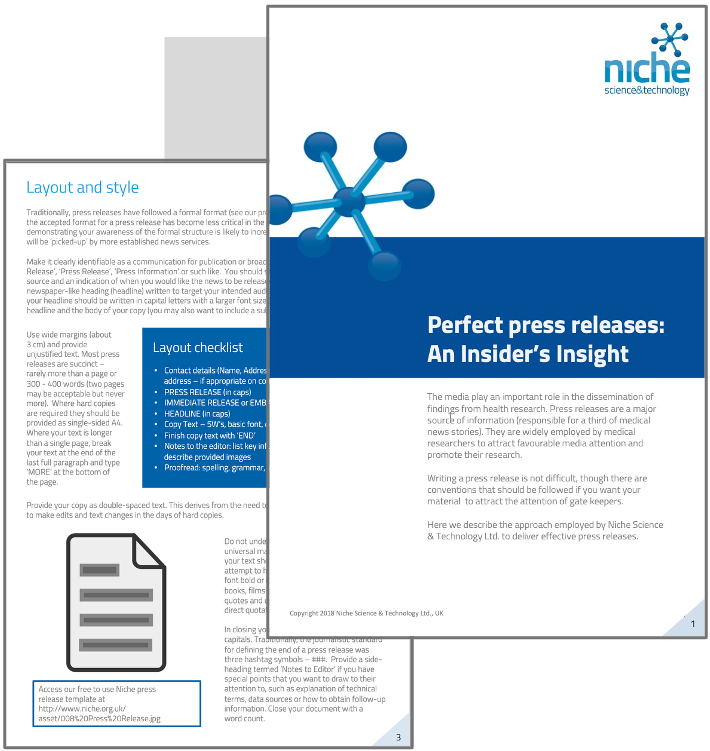
The media play an important role in the dissemination of findings from health research. Press releases are widely employed by medical researchers to attract favourable media attention and promote their research.

Conventions to follow include:
Telling your story
Providing basic information
Following the layout
Layout and copy checklists
Inverted pyramids
Join the other 20,000+ pharma colleagues who have downloaded our Insider’s Insights.

Get your Insider's Insight

* indicates required

Frequently Asked Questions about the Insider’s Insight: Perfect Press Releases

To help you get the most out of our resource library, we have compiled answers to the most common questions regarding the development, application, and distribution of our specialist guides.

At Niche Science & Technology, we believe that sharing expertise is the first step toward industry-wide excellence.
An effective press release provides useful information, originality, and a clear message that can be quickly absorbed by busy journalists. It must highlight what is new, unusual, or unexpected, and present the story in a succinct, engaging structure that answers the who, what, where, why, and when early in the document.
Press releases traditionally follow a formal format that includes contact details, a clear headline, release timing (immediate or embargoed), concise double‑spaced copy, and a closing marker such as “END.” The text should be factual, avoid bold/italics, use wide margins, and follow an inverted pyramid style—most important information first.
Avoid clichés, jargon, opinionated language, “puffs” (thinly disguised advertisements), grammatical errors, overly long sentences, and crowded paragraphs. Overstating findings or misrepresenting research is also a major risk, as press releases strongly influence how studies are reported in the media.
Quotes bring life, context, and a human voice to the story. They should come from key stakeholders, reflect real opinions, avoid technical jargon, be clearly attributed with dates, and support the central message. We recommend only one or two short, meaningful quotes
A press release should be timely—old news gets ignored. Distribution is usually electronic, and it’s best not to send at predictable times (e.g., exactly on the hour). Embargoes should be used sparingly and stated clearly. Tailoring the release to the audience or channel and following up with targeted journalists increases the likelihood of coverage.

Get our latest news and publications

Sign up to our news letter

© 2025 Niche.org.uk     All rights reserved

HomePrivacy policy Corporate Social Responsibility
chevron-down