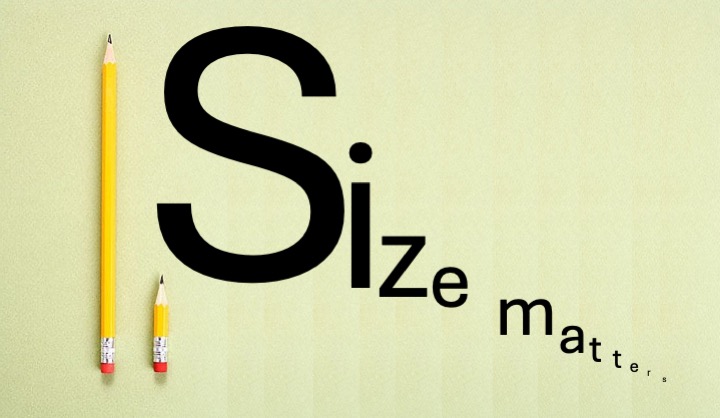
Does being brief in writing matter? Do people who read your work care how long or hard your words are to understand?
Writing that is short is vigorous. Every sentence and paragraph should have no extra words or sentences. This is similar to how a picture should not include any extra lines and a machine should not have any additional parts. This doesn't mean that an author should ONLY write short sentences or skip all the details and only talk about the main points. It just means that every word has to count – Strunk and White, The Elements of Style [1].
It is generally understood that shorter sentences are better, and this is also true of scientific writing [2,3,4]. People who speak English as a second language are often thought to need to pay extra attention to sentence length as they tend to use too many words [5,6]. Because of this, a lot of people who write science manuscripts in English as a second language struggle with cutting their sentences short when they go back and edit them [6,7].
But scientific papers are renowned for having long sentences [8,9,10]. One article about writing the first draft of a science paper estimated the average length of a sentence in a scientific manuscript as 12–17 words [11]. Another source says the average length of a sentence in peer-reviewed literature is 25–30 words, and some sentences in the sample studied were over 60 words long [8,9]. In contrast, J.K. Rowling's average sentence length for her Harry Potter books, considered a typical modern English writer serving a wide audience [2], is around 12 words – did you notice that the first half of this sentence has 20+ words? To make manuscripts easier to read, many guides tell researchers to cut their sentences down to no more than 20 words [2,4,12].
On occasion, sentences written by authors whose first language is not English may be shorter in pieces that have been submitted or accepted for publication than those written by authors whose first language is English [6,13]. The lines and words (measured in syllables) used by people who speak English as a second language are (statistically) significantly shorter than those who spoke English as a first language [13,14]. This is because native English speakers tend to use longer, more complicated sentences [6,13]. Also, because they don't have to worry as much about the quality of their work, first-language speakers might not be as careful to avoid being too wordy [6].
Instead of trying to make each sentence fit a certain word count, you might want to focus on how much information each of your lines convey. Many authors can't remember how their sentence started by the time they get to its end. That means the sentence is too long [15,16]. People who write often focus on ensuring that each line only conveys one idea [12,17]. But it can be hard to figure out what that ‘one idea’ should be, especially when reporting complex results [17]. You should also think of the spaces between words as ‘understanding checkpoints’ for your reader. These are points in the story where the reader should pause and figure out what was being shared before moving on [15,16].
You must also keep in mind that an average sentence length is just that: an average. There should be a mix of long and short sentences to every piece of writing [12], even if the average sentence length is 20 to 25 words. It is good' to use long sentences when you want to capture your reader's focus, because they flow better, though they need more concentration from the reader. Short words get people's attention and are great for keeping the reader interested, but too many short ones in a row can result in confusion (as shorter words tend to express less detail). Using both types of sentences together allows you to dictate the pace of your narrative and retain the reader’s interest [2,12,15,16].
So, the phrase "shorter is better" may be considered too much of a cliché when it comes to sentence length in science papers. Instead, both first language and second-language English speakers should ensure that each sentence is an appropriate length for the idea it expresses [2,4,12].
In scientific writing, clarity is not achieved by brevity alone, nor by complexity for its own sake. Sentence length should serve meaning, not constrain it. Effective documents, manuscripts or reports, balance concision with completeness, using sentences that are long enough to convey necessary detail yet short enough to respect the reader’s cognitive limits. Rather than aiming for a particular word count, authors should focus on whether each sentence advances understanding. In doing so, scientific communication becomes not only more readable, but more precise, inclusive, and ultimately more effective.
-
References
-
Strunk W, White EB. The Elements of Style. 4th ed. New York: Longman; 2000.
-
Gunning R. The Technique of Clear Writing. New York: McGraw-Hill; 1952.
-
Flesch R. A new readability yardstick. J Appl Psychol. 1948;32(3):221-233.
-
McLaughlin GH. SMOG grading: A new readability formula. J Read. 1969;12(8):639-646.
-
Flowerdew J. Writing for scholarly publication in English: The case of Hong Kong. J Second Lang Writ.1999;8(2):123-145.
-
Hyland K. Disciplinary Discourses: Social Interactions in Academic Writing. Ann Arbor: University of Michigan Press; 2004.
-
Cho DW. Science journal paper writing in an EFL context. English Specif Purp. 2009;28(4):230-239.
-
Plavén-Sigray P, Matheson GJ, Schiffler BC, Thompson WH. The readability of scientific texts is decreasing over time. Elife. 2017 Sep 5;6:e27725.
-
Ley P, Florio T. The use of readability formulas in health care. Psychol Health Med. 1996;1(1):7-28.
-
Hartley J. Academic writing and publishing. A Practical Handbook. (2008).
-
Kallestinova ED. How to write your first research paper. Yale J Biol Med. 2011 Sep;84(3):181-90.
-
Lang T. How to Write, Publish, and Present in the Health Sciences. Philadelphia: ACP Press; 2010.
-
Hinkel E. Second Language Writers’ Text. Mahwah, NJ: Lawrence Erlbaum; 2002.
-
Biber D, Conrad S, Reppen R. Longman Student Grammar of Spoken and Written English. London: Pearson; 2002.
-
Baddeley A. Working Memory. Oxford: Oxford University Press; 1992.
-
Mayer RE. Multimedia Learning. Cambridge: Cambridge University Press; 2001.
-
Day RA, Gastel B. How to Write and Publish a Scientific Paper. 7th ed. Cambridge: Cambridge University Press; 2012.