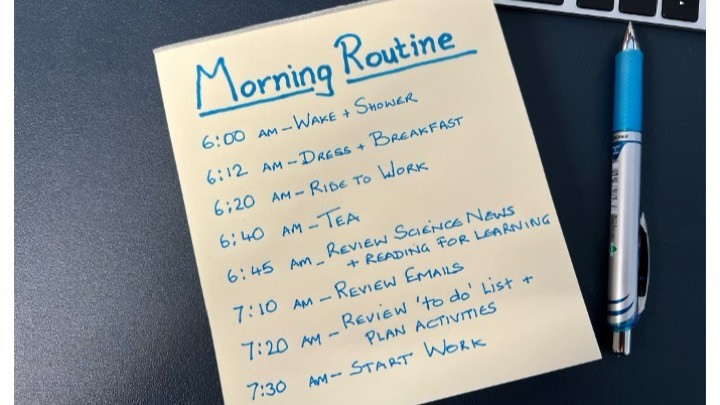
In a world saturated with constant demands, information overload, and competing priorities, routine tasks can often seem mundane and uninspiring. Yet, the humble routine may be one of the most powerful and underappreciated tools for enhancing productivity, combating cognitive overload, and fostering emotional resilience in modern work environments. Defined as a sequence of actions regularly followed, often unconsciously, routines are far more than mere habit. They are cognitive scaffolding, automating the mundane to liberate the mind for the meaningful. Whether in personal work habits or organisational protocols, routines play a pivotal role in helping individuals and businesses navigate the complexities of contemporary professional life.
Human cognition is fundamentally constrained. Working memory, your mental ‘workspace’ for conscious thought and decision-making, has severe capacity limitations [1][2]. Psychologists and neuroscientists estimate that our working memory can typically hold around four to seven discrete ‘chunks’ [3]. Cognitive Load Theory proposes that learning and performance suffer when the total cognitive load exceeds your memory’s capacity [4][5]. Decision-making itself is metabolically expensive, heavily reliant on the prefrontal cortex (PFC), and susceptible to fatigue – a state known as "decision fatigue" or "ego depletion" [6][7].
Business has long recognised that routines help address this challenge by automating decision processes. Habitual behaviours require less conscious deliberation, allowing individuals to reserve cognitive resources for novel or complex tasks [8]. Through repetition, complex sequences of actions and decisions become encoded in procedural memory and the basal ganglia, bypassing the need for constant PFC oversight [9]. This automation markedly reduces extraneous and intrinsic cognitive load associated with the how of a task.
By pre-determining the sequence of actions for recurring situations, routines eliminate countless micro-decisions throughout the day ("What should I do first?", "How should I format this report?", "Where do I save this file?"). This conservation of decision-making energy preserves precious cognitive resources for novel, complex, or strategic problems that genuinely require conscious deliberation [7]. This mechanism, known as cognitive offloading, improves efficiency by embedding predictable patterns into daily schedules. For example, routinely beginning the day by prioritising tasks or closing it with a review ritual reduces the mental load associated with planning and retrospection.
Although distinct from multitasking, frequent shifting between different types of tasks also incurs cognitive switching costs [10][11]. A well-defined routine for a specific type of work (e.g., email processing, weekly reporting) minimises the cognitive overhead of constantly reorienting to the task's requirements and tools. A recent study demonstrated that people who adhered to structured routines reported lower levels of mental fatigue and decision-related stress [6]. The predictability of routine reduces the number of decisions you need to make, freeing cognitive bandwidth for more meaningful endeavours.
Surprise! Newton's first law also applies psychologically: an object (or person) at rest tends to stay at rest. I am sure you fully appreciate that beginning a new task, especially a complex one, requires significant application of ‘activation energy.’ This is the domain of inertia and procrastination – the gap between intention and action [12].
Procrastination, the voluntary delay of an intended course of action despite expecting negative consequences, remains one of the most common self-regulation failures in the workplace [12]. Inertia, or the psychological tendency to resist initiating tasks, is a closely related phenomenon. Routines act as pre-commitment mechanism to lower your activation barriers, bumping you out of your energy well. By establishing a specific time, place, and sequence for an action ("I write reports every Monday morning from 9 until 11 am"), the routine removes the need for deliberation at the moment of initiation. The question shifts from "Should I do this now?" to "It's time to do this now." This significantly lowers the energy required to start [13].
Routines offer an antidote to both tendencies by creating momentum through behavioural automaticity. Once a task becomes habitual, it requires less motivational energy to begin and sustain. Researchers found that when behaviours are ‘routinised’, they occur with minimal conscious intent and are less influenced by fluctuating emotional states or motivation levels [14]. Moreover, micro-routines, small, ritualistic behaviours like starting a work session with a brief stretch or reviewing a checklist, serve as a behavioural cue that primes individuals for task engagement. These cues trigger associative links in memory, making it easier to transition from inaction to productive activity [15].
At their core, strong routines become habits. Habits operate through a neurological loop: a cue (e.g., a specific time, location, preceding action) triggers an automatic routine (the sequence of behaviours), leading to a reward (e.g., completion, satisfaction, reduced anxiety) [16][17]. This loop, embedded in the basal ganglia, drives behaviour with minimal conscious effort, directly counteracting procrastination which often stems from the unpleasant anticipation of effort or failure [18]. In addition, successfully initiating a routine task creates momentum. The act of starting, even a small part of the routine, reduces anxiety and increases the likelihood of continuing, termed the progress principle [19]. Completing the routine reinforces the habit loop, making initiation easier the next time.
Organisations face amplified versions of individual cognitive challenges, compounded by the need for coordination, consistency, and quality control across multiple agencies. This is of particular importance in the pharmaceutical industry where virtually every routine eventually evolves into formal structures such as standard operating procedures (SOPs). Essentially meticulously documented routines, SOPs prescribe the exact sequence of steps, responsibilities, and standards for completing a specific task or process (e.g., processing an invoice, addressing a customer complaint, conducting a quality check). Routines may also take of the form of instructional guides and process documents that reduce the likelihood of omissions in high-stakes environments like healthcare, aviation, and pharmaceuticals [20]. Their core functions directly address the issues routines solve individually, but at an organisational level:
Business processes represent larger sequences of interconnected routines (often individual SOPs) performed by different actors or departments to achieve a defined outcome. Well-designed processes create organisational-wide efficiencies by streamlining handoffs and ensuring routine tasks are handled predictably [26].
Routines also carry important social and psychological functions within organisational culture. Work routines offer employees a sense of predictability and control, both of which are closely tied to psychological safety and well-being [27]. The predictability inherent in structured workflows reduces anxiety associated with role ambiguity and uncertainty. Furthermore, shared routines foster group cohesion by synchronising team activities and expectations, promoting open communication – even if it is just complaining about state of the SOPs [28].
From a psychosocial perspective, routines also mitigate social comparison anxiety and the cognitive strain of constant interpersonal negotiation. By embedding equitable practices within routines (such as rotating meeting chairs or standardising performance reviews), organisations not only conserve resources but also promote fairness and inclusion [29]. Employees who engage in structured daily routines report lower levels of burnout and emotional exhaustion [30]. Ritualistic behaviours, such as consistent start and end-of-day practices, create psychological boundaries that facilitate work-life balance, especially in hybrid and remote work settings where boundaries are often blurred. Furthermore, routines support emotional regulation by providing a stable scaffold against which transient emotions can be managed. When individuals face workplace adversity, established routines offer a grounding structure that facilitates coping and recovery [31].
My dad was a routine monkey, and in my teens, we often fought over his early morning rituals. I would arrogantly tell him that his rigidity frustrated creativity. This was nothing new, youngsters (roughly 18–29) will often equate creativity with spontaneity and novelty-seeking behaviours, seeing structure and routine as stifling [32]. They will prioritise exploration and identity formation over stability [33]. This cultural script primes them to associate routine with conformity. One large study found that younger employees were significantly more likely to perceive routines as restrictive and creativity-limiting, compared to older cohorts [34]. Yet paradoxically, those who reported adhering to daily routines also experienced higher levels of creative output, implying a misalignment between belief and reality.
Creative ideation relies on the interplay between the default mode network (associated with spontaneous thought) and the executive control network (associated with focus and goal management) [35]. The generation of novel and useful ideas – demands significant cognitive resources, particularly fluid intelligence, working memory, and focused attention in the PFC [36]. When the brain is preoccupied with managing low-level decisions, remembering procedural steps, or battling procrastination on essential but uninspiring tasks, few resources remain for deep, imaginative thinking. By automating routine tasks, employees can dedicate greater mental effort to complex problem-solving and innovative activities, serving as a platform for controlled improvisation, balancing the need for stability with adaptability [37][38].
Chaos and constant uncertainty are enemies of deep focus. Routines provide a stable, predictable framework for the day or for specific work blocks. Knowing that essential tasks are handled systematically (e.g., admin in the afternoon, emails batched) reduces anxiety about forgotten responsibilities and creates psychological safety, a known enabler of creativity [28]. This stability allows individuals to enter a state of "flow" deep, immersive engagement, more readily during creative periods [39].
Many renowned writers, artists and scientists attribute their productivity to strict routines. Tchaikovsky composed in the morning, walked at 2 pm. Maya Angelou rented a sparse hotel room to write daily. These rituals weren't about the content of the work, but about creating the conditions, the reliable structure and minimised distractions, that allowed creativity to emerge consistently [40]. The routine itself becomes a cue to enter a creative mindset.
In sum, routines, whether personal or institutional, are far from trivial. They play a vital role in optimising cognitive efficiency, combating procrastination, standardising organisational operations, and supporting psychological resilience. By reducing decision fatigue, creating behavioural momentum, and providing emotional scaffolding, routines allow individuals and organisations to function more effectively in high-pressure, information-rich environments.
Believe it or not, as workplaces become increasingly dynamic and technology-driven, the need for thoughtfully designed routines grows ever more urgent. Leaders should recognise the value of integrating both formal SOPs and informal behavioural routines into workplace culture. Doing so not only enhances productivity and quality assurance but also supports employee well-being, inclusivity, and creativity. Rather than viewing routines as monotonous constraints, organisations and individuals alike should embrace them as indispensable tools for thriving amid the complexities of contemporary work, transforming the predictable into the engine of progress.
References:

Get our latest news and publications
Sign up to our news letterResources
Social


Contact us
Address
Niche Science & Technology
Unit 26 Falstaff House
Bardolph Road
Richmond TW9 2LH
United Kingdom