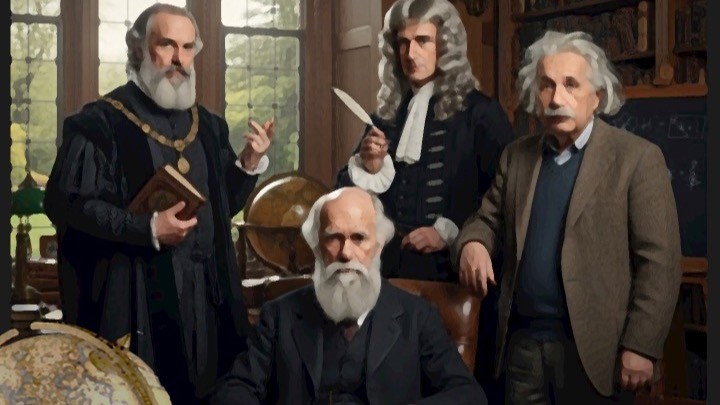
Science has no single point of origin. It has evolved through the gradual accumulation of new concepts, experimentation, and intellectual discourse, constantly reshaping how we understand the world. Along our path to enlightenment, a few figures stand out. Not merely for their discoveries, but for the conceptual revolutions they catalysed. One of the lesser-known innovators was Theophrastus von Hohenheim, better known as Paracelsus (1493–1541). Celebrated by some as the father of toxicology and dismissed by others as a mystic and proto-alchemist, Paracelsus occupies a liminal space between medieval natural philosophy and enlightened science.
It has been argued that Paracelsus represents one of the earliest true scientists, and that his intellectual contributions centuries before Newton, Darwin, or Einstein helped shape the worldview that made their revolutions possible. His philosophy was one of observation over authority, his challenge to the scholastic establishment of his age, and his methodological innovations in medicine and chemistry formed a conceptual scaffold for modern scientific thinking. And yet, he rarely features in scientific histories. To overlook him is to risk misunderstanding the nonlinear, often uncomfortable origins of scientific rationality itself.
When Paracelsus began teaching medicine in the early sixteenth century, European intellectual life remained dominated by scholasticism, an Aristotelian system based on ancient texts and rejecting empirical inquiry. Learning for medical students was based on the teachings of Galen (129–216 AD) and Ibin Sina (Avicenna, 980–1031 AD). Natural philosophers read Aristotle. Deviation from established thinking was not only discouraged, it might be considered terminal for more than just your career. Ironically, Ibn Sina was himself an empirical philosopher, someone who integrates observation and experience.
Paracelsus rejected the established orthodoxy with unusual boldness. He famously burned the works of Avicenna and Galen in the public square at Basel, declaring, “You will no longer rule in my universities.” His gesture was theatrical, but it represented an intellectual rupture: declaring that knowledge was to be derived from nature itself, not from the repetition of inherited doctrine. He urged physicians to “walk the hospitals, visit the sickbeds, and learn from the book of nature,” a methodological shift that aligned closely with the later empirical movements of the seventeenth century.
Modern historians are increasingly viewing this commitment as an early precursor to modern scientific thinking, the very foundation of Newtonian natural philosophy. The American science historian, Debus, argued that Paracelsus “attempted nothing less than a complete reformation of natural science” by grounding knowledge in observation rather than tradition [1]. In an era when experimentation was neither standard nor prestigious, this represented a profound conceptual leap.
If Paracelsus anticipated the empirical shift of the Enlightenment, he also laid groundwork for the chemical world view that would later shape modern physics and biology. He rejected the classical four-element system (earth, air, fire, water) and replaced it with a triadic model — salt, sulphur, and mercury — representing their identifiable properties of solidity, combustibility, and volatility. OK, its not chemically accurate, but it represent one of the first attempts to build a systematic explanatory framework based on the behaviour of matter rather than dogmatic metaphysical categories.
More importantly, Paracelsus integrated chemical principles into medicine, arguing that disease resulted from chemical imbalances and should be treated with chemically prepared remedies. You could argue that this laid the conceptual foundations for later iatrochemical movements and for chemical pathology, ideas that would eventually influence Lavoisier, Boyle, and the mechanistic conception of the body.
Paracelsus’s emphasis on dosage, encapsulated in his enduring insight — “All things are poison, and nothing is without poison; only the dose makes a thing not a poison” — remains one of the cornerstones of modern pharmacology and toxicology [2]. His articulation of dose–response relationships predates any formal toxicological science by centuries yet aligns precisely with principles used today in regulatory pharmacology, risk assessment, and drug development.
Isaac Newton’s revolution rested on the combination of mathematical reasoning, physical observation, and the belief that nature operates according to consistent laws. Although Newton is often viewed as the originator of this approach, historians have argued that the Paracelsian worldview helped shape the intellectual environment in which Newton worked based on his thinking [3,4]. Newton’s own writings have Paracelsian echoes.
Paracelsus’s emphasis on nature as a lawful, knowable system, one accessible through experiment rather than doctrine, was reflected through the later adoption of natural philosophy. The iatrochemical and ‘chymical’ traditions that emerged from his writings informed Boyle’s The Sceptical Chymist (1661), which directly influenced Newton’s own alchemical and physical investigations. Whether Newton actually read Paracelsus is less important than the fact that Paracelsian ideas permeated the intellectual networks that Newton inhabited.
Moreover, Paracelsus’s belief that natural processes could be understood through underlying principles rather than mystical correspondences marked a shift toward mechanistic explanations, crucial for the later development of classical physics. Newton’s key innovations like gravity, optics, action and distance, rely on the idea that “unseen forces follow definite mathematical laws.”
At first glance, Charles Darwin’s nineteenth-century theory of natural selection seems somewhat removed from Paracelsus’s sixteenth-century formulations. Yet both thinkers shared a deep conviction that nature contains its own logic, one that can be uncovered through observation rather than metaphysics.
Paracelsus viewed nature as a dynamic, evolving system shaped by internal processes. He described the “semina rerum,” seeds of thing, which bear conceptual resemblance to what would later become ideas of heredity and biological development [5]. While Paracelsus did not propose anything like evolution by natural selection, his rejection of fixed Aristotelian categories and his emphasis on the transformative capacity of nature must have served to lay the intellectual groundwork for later biological thinking.
Darwin’s methodological naturalism, his insistence that complex phenomena arise from natural causes, rests on a worldview that Paracelsus helped inaugurate: nature as an empirical, law-governed system open to investigation. Just as one final aside, Paracelsus was an early advocate for the concept that diseases arose from specific agents and not from humoral imbalance.
So far, so good! But to link Paracelsus with Albert Einstein may seem extraordinary. One might argue that the connection lies not in direct influence but in intellectual temperament. Einstein based his learning on thinkers who challenged orthodoxy and reimagined the conceptual foundations of science. Paracelsus was such a figure: disruptive, iconoclastic, and willing to recast the intellectual frameworks of his age. And like Paracelsus, Eistein was German.
Einstein famously wrote that “imagination is more important than knowledge,” a sentiment remarkably compatible with Paracelsus’s blend of visionary speculation and empirical insistence. Both held that progress sometimes demands the abandonment of accepted truths in favour of new conceptual structures.
I appreciate that I am stretching the connection but Einstein’s revolution in physics, his redefinition of space, time, and gravitation, required the same intellectual courage that Paracelsus exhibited when he rejected Galenic authority. Both thinkers exemplify the scientific imagination necessary to see beyond established paradigms.
When we define science narrowly as quantification, controlled experimentation, and mathematical formalism, it is clear that Paracelsus fails to qualify as a modern scientist. But if we consider science as a methodological attitude, the rejection of authority, the primacy of observation, the search for cause and effect, and the willingness to challenge inherited frameworks, then Paracelsus emerges as one of sciences earliest architects. He:
In doing so, it seems fair to observe that he helped create the epistemological conditions necessary for scientific revolution.
Paracelsus was both a young radical and, later in life, an elder critic of younger scholars who clung to dogma. His trajectory mirrors a timeless truth: scientific progress thrives when generations learn from each other.
Today’s young scientists often work in hyper-competitive environments where novelty is prized, and the wisdom of older scientists is undervalued or overlooked. Yet older researchers offer indispensable insights. At Niche we have several team members that have been working with our clients for over 20 years delivery:
Whether celebrated or unrecognised, senior researchers like ours carry intellectual capital that cannot be replicated quickly. As Paracelsus himself drew upon medieval, alchemical, and folk traditions to build new frameworks, so too can younger team members draw on the accumulated wisdom of their elders to accelerate innovation and project delivery.
Paracelsus occupies an essential yet underappreciated place in the history of science. His rejection of authority, his devotion to observation, and his radical rethinking of natural processes helped establish the intellectual foundations upon which later visionaries built scientific revolutions. His legacy is not a set of correct theories but a scientific attitude that runs through everything we do at Niche: curious, critical, imaginative, and dedicated.
For today’s young scientists, the lesson extends beyond Paracelsus’s ideas to the value of learning from those who preceded them. Older scientists, irrespective of recognition or status, embody the lived history of scientific progress. Their insights, like Paracelsus’s, will always have the potential to spark the next intellectual revolution. Come and see what we can do for you.
References
Get our latest news and publications
Sign up to our news letterResources
Social


Contact us
Address
Niche Science & Technology
Unit 26 Falstaff House
Bardolph Road
Richmond TW9 2LH
United Kingdom