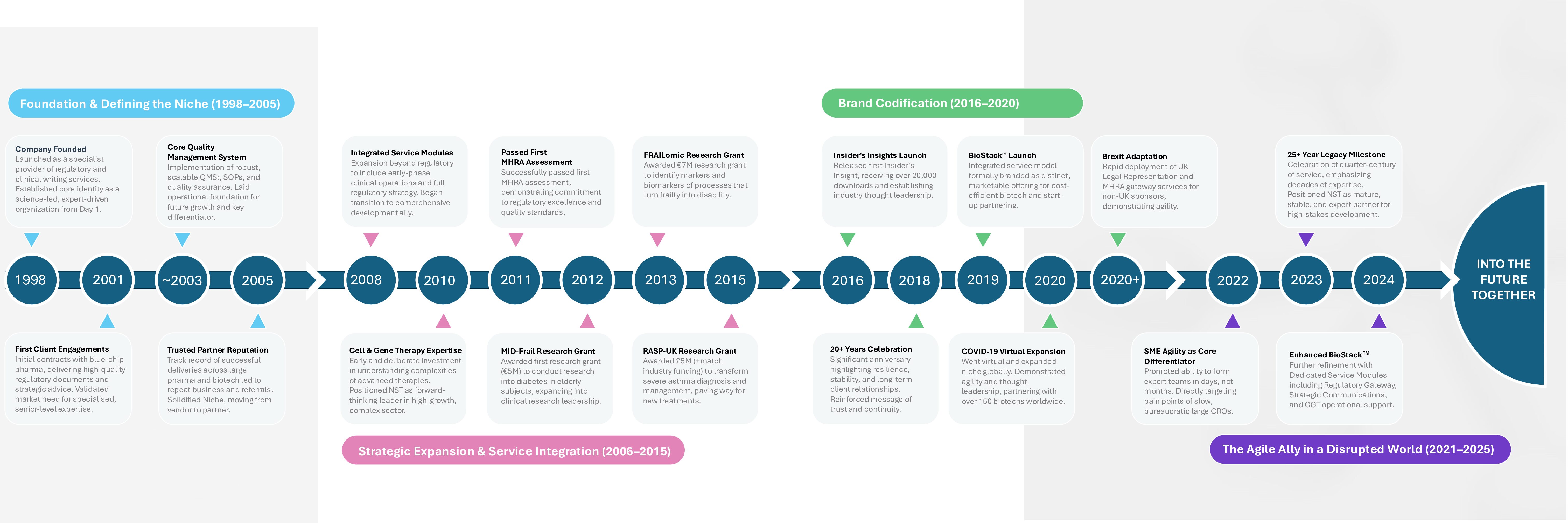
Today marks 28 years since the incorporation of Niche Science & Technology, a milestone that invites both reflection and reappraisal. At 21 years, our symbolic ‘coming of age,’ I wrote about the mechanics of building a successful business, emphasising clarity of purpose, resilience, and disciplined execution. Yet, as the organisation moves beyond survival into longevity, a more subtle question emerges: not how to build a business, but how to remain intellectually and emotionally invested in it over decades.
The scientific literature provides an unexpected but reassuring insight, work engagement does not necessarily diminish with age. On the contrary, a systematic review of workers aged over 40 found that engagement often increases, driven largely by improved emotional regulation and a deeper alignment between personal values and professional roles [1]. This aligns with my own lived experience. The early years of a company are characterised by urgency and uncertainty; later years, by perspective and selective focus. What changes is not the intensity of effort, but its quality.
Over 28 years, Niche has endured external shocks that have tested both structure and spirit: the global disruption following the September 11 attacks, the 2008 financial crisis, and most recently the COVID-19 pandemic (and currently the downturn in UK/EU biotech). Each event reshaped our operating environment, but more importantly, each required a recalibration of motivation. Passion, as entrepreneurship research shows, is not a static trait but a renewable psychological resource that sustains long-term engagement and performance [2]. It is not simply enthusiasm; it is the capacity to re-engage after disruption.
Why, then, continue? Why resist acquisition offers, particularly as one enters their 60s? The answer may lie in the distinction between extrinsic and intrinsic motivation. While financial incentives can drive behaviour, intrinsic motivation, rooted in autonomy, mastery, and purpose, has a stronger and more durable association with sustained engagement and retention [3]. I feel it! For the long-term founder, the enterprise becomes less a vehicle for financial gain and more an intellectual ecosystem: a place where ideas are tested, relationships evolve, and identity is expressed.
Indeed, remaining at the helm of a company over decades has transformed my leadership into a form of longitudinal experiment. The team of people I work with today (in and out of the company) is not that of 1998. Demographic shifts, technological acceleration, and changing expectations of work-life balance have created a more heterogeneous and dynamic employee base. Research indicates that age-diverse workforces can enhance innovation and inventive output, precisely because they combine accumulated expertise with fresh perspectives [4]. However, such diversity also demands adaptive leadership, an ability to manage differing motivations, communication styles, and career expectations.
This evolving workforce may, paradoxically, be one of the most powerful sources of sustained engagement for long-serving leaders. The necessity to continually reinterpret organisational culture, to integrate new generations of employees, and to respond to shifting societal norms prevents stagnation. Engagement, in this sense, is not merely an individual psychological state but an emergent property of interaction between leader, team, and environment. Surprisingly (or perhaps not), the functioning of the company today is closer than ever to the concept of a science-focused company that I originally imaged all those years ago. The only reason we are here is because of the amazing contributions made by others, for which I am eternally grateful. I have greatly enjoyed sharing our journey with you.
At a more personal level, the concept of ‘work engagement’ is defined as a state of vigour, dedication, and absorption [5]. These qualities are not guaranteed by longevity; they must be actively maintained. The challenge is not burnout in the conventional sense, but attenuation, a gradual loss of curiosity or energy. Yet the evidence suggests that older professionals often compensate for declining physical or cognitive resources through strategic selection and optimisation of tasks, focusing on areas of highest value and meaning [1]. This may explain why many continue to lead, create, and contribute well beyond traditional retirement thresholds.
There is also a broader societal context. Increasing numbers of individuals over 60 (like me) are choosing to remain economically active, often driven not by necessity but by a desire for continued relevance and fulfilment. I am forever grateful for this as I feel loss every time a colleague tells me they are planning to retire. Happily, the boundary between ‘career’ and ‘post-career’ is becoming increasingly blurred. In this light, resisting the sale of a company is not an act of defiance but of continuity, a decision to remain engaged in a process that still generates intellectual and social value.
Ultimately, the 28-year milestone is less about endurance and more about adaptation. A business that survives multiple global disruptions, technological revolutions, and generational shifts does so not through rigidity but through sustained responsiveness. For its leader, the task is similar: to continually rediscover meaning in familiar work, to remain open to change, and to recognise that motivation is not a finite resource but a dynamic interplay between self, work, and world. And that brings me to my team who are one of the key reasons I keep going, they still inspire me.
If the 21-year reflection was about how to build a successful business, the 28-year reflection may be about how to remain successfully engaged within it. The science suggests that such engagement is not only possible with age, it may, in fact, deepen. That I can get behind.
References
Get our latest news and publications
Sign up to our news letterResources
Social


Contact us
Address
Niche Science & Technology
Unit 26 Falstaff House
Bardolph Road
Richmond TW9 2LH
United Kingdom