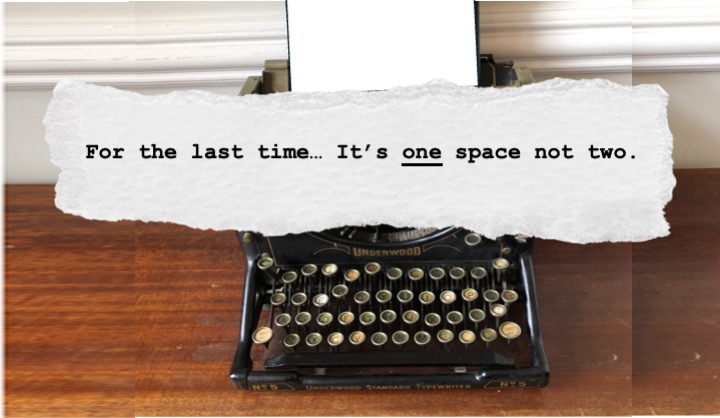
There are people everywhere who use two spaces after a full stop. I often read documents and emails from people that include the two-space habit, particularly outside formal scientific publishing. In biomedical and pharmaceutical writing, however, this practice is seen less frequently, reflecting the stronger influence of professional editorial standards and journal style guides [1,2].
So where did this practice originate? Until the early twentieth century, printers and publishing houses often used wider spacing between sentences, sometimes inserting more than one space to enhance legibility in metal typesetting [3]. Following the invention and widespread adoption of the typewriter, typists were trained to use two spaces after periods to visually separate sentences in monospaced fonts, mimicking the conventions of traditional print [4]. Although professional printers gradually abandoned wide sentence spacing during the mid-twentieth century, the habit persisted through typewriters and early word processors and was transmitted into modern computing through training and convention rather than evidence [3–5]. As a result, many writers continue to ask, “Who says using two spaces is wrong?”
Arguments in favour of single spacing are often framed in terms of readability, yet it is important to note that empirical evidence directly comparing one versus two spaces for reading comprehension is limited. Reviews of readability research in medical communication show that typographic clarity depends more on font choice, line length, and layout consistency than on sentence spacing alone [6]. Editorial preference has therefore tended to rely on professional judgement and accumulated publishing experience rather than controlled trials [1,7].
Modern typesetting standards
Proportional fonts: Typewriters used monospaced fonts, in which every character occupied identical horizontal space, producing visually loose text and necessitating extra spacing between sentences for clarity [4]. Modern digital typography, including nearly all fonts used in biomedical journals, relies on proportional fonts, where character widths vary. This naturally increases readability and makes additional sentence spacing redundant, while excessive spacing can introduce awkward visual gaps [3,7].
Readability and aesthetics
Uneven spacing and visual disruption: In digital typesetting, inserting two spaces after a period can interfere with automated spacing algorithms, leading to uneven justification and disrupted text flow. Studies of scientific document design emphasise consistency and visual economy as contributors to perceived professionalism and reader confidence [6,8].
Style guide recommendations
Industry standards: Major biomedical journals and editorial organisations, including those aligned with the International Committee of Medical Journal Editors (ICMJE), explicitly recommend a single space after punctuation. These standards promote uniformity, reduce editorial intervention, and facilitate electronic publishing workflows [1,2].
Digital display and compatibility
Web and email formatting: In electronic publishing, including web-based journals and email communication, extra spaces can generate unpredictable line breaks and spacing artefacts across devices. Guidance on electronic manuscript preparation consistently advises single spacing to ensure cross-platform consistency [2,7].
Evolving typographic practices
Historical transition: As printing and typesetting technologies evolved, the functional need for extra sentence spacing disappeared. Contemporary biomedical editors and publishers therefore favour a single space as part of modern, efficient, and internationally standardised scientific communication [1,3].
So now you know: while two spaces may be a historical artefact rather than an outright error, current medical publishing standards strongly favour one space—and clinging to two is unlikely to win you any friends with journal editors.
References
- International Committee of Medical Journal Editors. Uniform requirements for manuscripts submitted to biomedical journals. N Engl J Med.1997;336(4):309–315.
- Glasziou P, Chalmers I, Rawlinson S, et al. What is missing from descriptions of treatments in trials and reviews?Lancet. 2008;372(9654):114–119.
- Bringhurst R. The elements of typographic style.3rd ed. Vancouver: Hartley & Marks; 2004.
- Tinker MA. Legibility of print.Ames (IA): Iowa State University Press; 1963.
- Hartley J. Designing instructional and informational text. Br J Educ Technol.1987;18(2):110–120.
- Hartley J. What makes a scientific article easy to read? Psychol Bull.1980;87(3):492–504.
- Day RA, Gastel B. How to write and publish a scientific paper.7th ed. Cambridge: Cambridge University Press; 2012.
- Gopen GD, Swan JA. The science of scientific writing. Am Sci.1990;78(6):550–558.