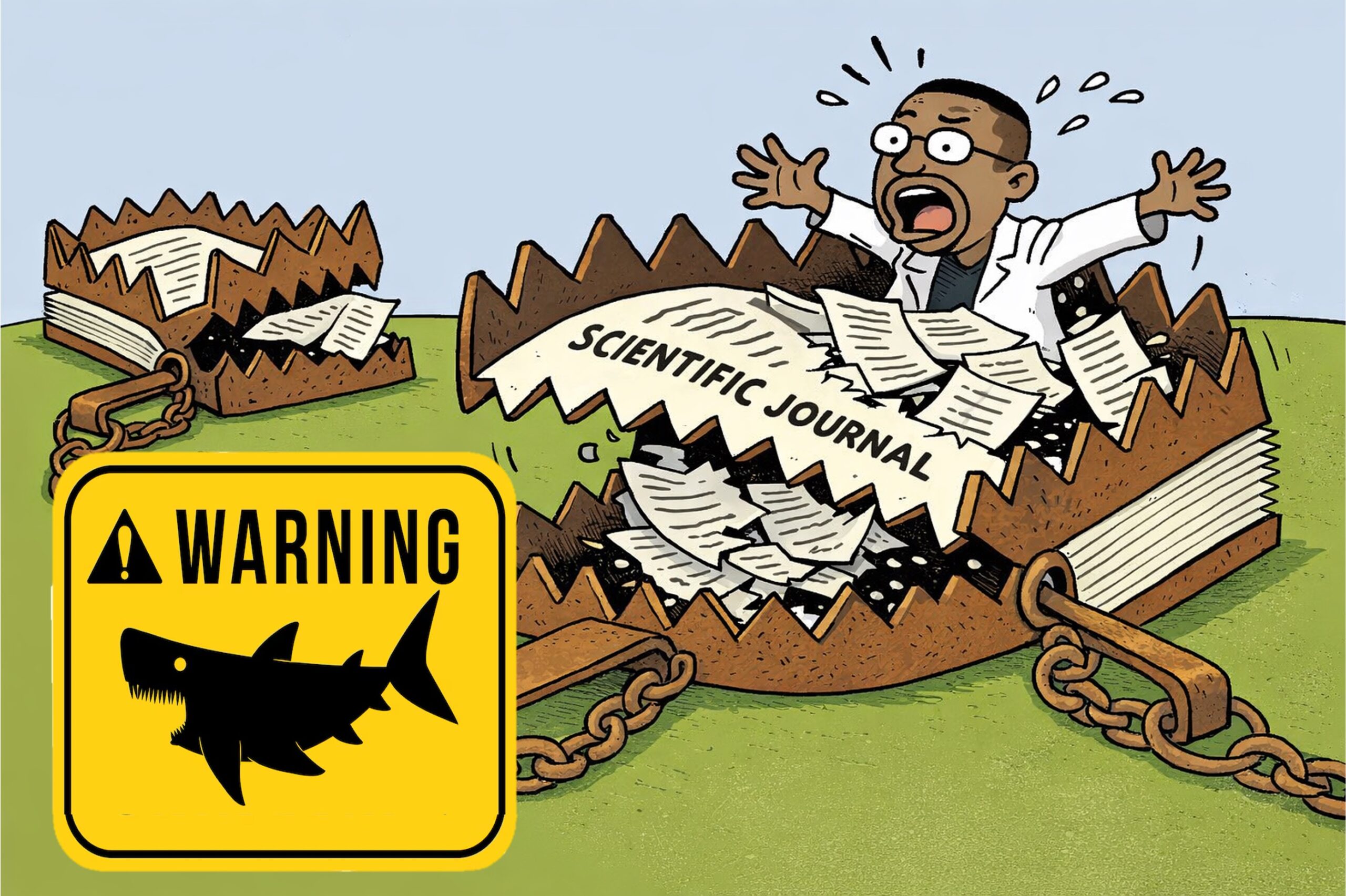
The rapid growth of online publishing has opened remarkable opportunities for researchers to share their work with a global audience. At the same time, it has given rise to a troubling phenomenon: so-called predatory journals [1]. These publications present themselves as legitimate scholarly outlets but often fail to provide proper editorial oversight, peer review, or long-term archiving. Instead, they primarily exist to collect publication fees from unsuspecting authors.
For early-career researchers and established scholars alike, publishing in such outlets can damage reputations, reduce the visibility of important research, and undermine the credibility of the scientific record. As the academic publishing landscape evolves, particularly with the rise of open-access models, it is increasingly important to recognise warning signs before submitting your work.
Below are 10 common indicators that a journal may not be operating according to accepted scholarly standards.
Predatory journals frequently send unsolicited emails inviting researchers to submit manuscripts. These messages often contain spelling mistakes, awkward grammar, excessive formatting, or exaggerated praise of the recipient’s expertise. While legitimate journals occasionally solicit submissions, they usually do so in a professional and targeted manner.
Some journals adopt titles that closely mimic well-known publications in order to create confusion. A slight change in wording, such as adding ‘International’ or ‘Global’ can make a questionable journal appear legitimate at first glance.
Poor design, distorted images, broken links, and inconsistent formatting are common signs of a hastily assembled website. While not every reputable journal has a sophisticated web presence, serious publishers usually maintain clear and functional platforms.
Many legitimate journals use dedicated manuscript submission systems. Predatory journals may instead request that manuscripts be sent directly via generic email addresses, sometimes hosted on free email services rather than institutional domains.
Transparency is essential in academic publishing. If the website does not clearly describe the submission process, copyright policies, or editorial procedures, authors should proceed with caution.
Quality peer review takes time. Journals that promise acceptance and publication within days, or even a few weeks, may be bypassing the rigorous review process that ensures scholarly standards.
Some questionable journals claim to conduct peer review but provide little evidence of it. In some cases, authors are even asked to suggest reviewers who will almost certainly approve the manuscript.
Predatory journals often advertise impressive-sounding metrics from obscure organisations. These numbers may resemble established impact factors but are not recognised by major indexing services or citation databases.
If a journal cannot be found in reputable academic databases, institutional libraries, or recognised indexing services, it may lack the credibility expected of scholarly publications.
Researchers increasingly rely on some of the curated lists that track publishers suspected of unethical practices. If a journal appears on such a list, it is wise to investigate carefully before submitting work.
Publishing in a predatory journal can have significant consequences. Articles may receive little or no visibility, may not be indexed in scholarly databases, and may not be preserved for long-term access. For researchers building a career, this can mean lost opportunities for recognition and collaboration. More broadly, the spread of poorly reviewed publications risks diluting the quality and reliability of the academic literature.
Yet the rise of these journals also raises a more complicated question. The academic publishing market has long been dominated by a relatively small number of large publishers who control many prestigious titles and the mechanisms through which research is disseminated. As digital platforms lower barriers to entry, it is perhaps inevitable that new actors would attempt to claim a place in this ecosystem.
Are all of these new journals simply opportunistic ventures seeking to profit from inexperienced authors? Or are some of them not-so-perfect attempts to carve out space in a market that has historically been difficult for newcomers to enter?
The answer may lie somewhere in between. While many operations appear clearly exploitative, others may represent the chaotic early stages of a rapidly changing publishing landscape. As researchers, the best defence remains informed scepticism: evaluating journals carefully and ensuring that our work is shared through venues that uphold the standards of scholarly communication.

Get our latest news and publications
Sign up to our news letterResources
Social


Contact us
Address
Niche Science & Technology
Unit 26 Falstaff House
Bardolph Road
Richmond TW9 2LH
United Kingdom