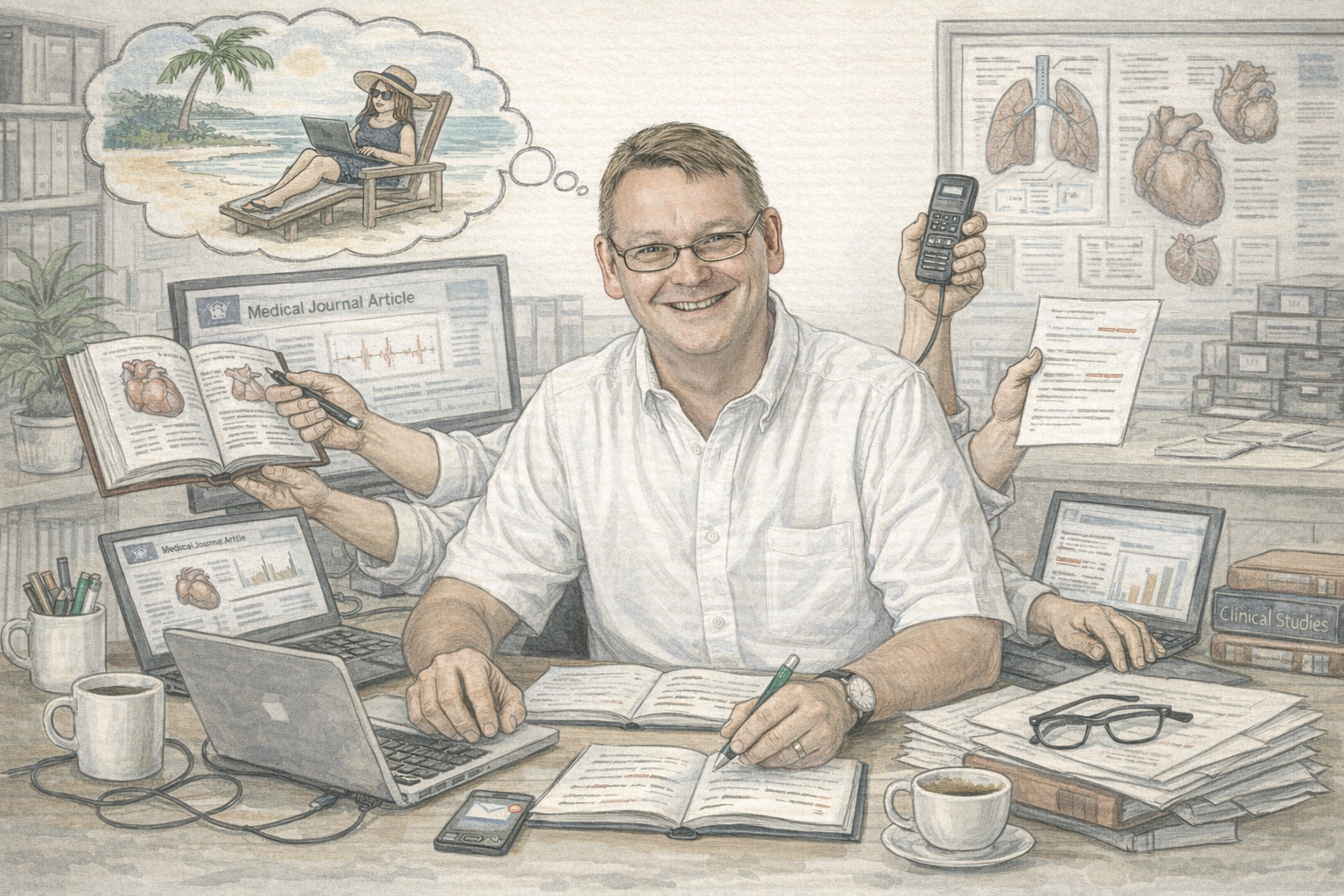
How do you become a good medical writer?
Although I have been involved in writing scientific articles and grant applications since leaving university in 1985, I only got any formal medical writing training when I joined an agency in the mid-1990s. It might be argued that this was too late. I had already built up over a decade of bad habits.
In the landscape of biomedical communication, the medical writer occupies a paradoxical position: indispensable yet often invisible, authoritative yet perpetually learning. Having navigated this terrain for years, I have come to recognise that successful medical writing demands far more than grammatical precision or statistical fluency. It requires a host of traditional scientific competencies, robust self-management, and, perhaps most critically, the diplomatic dexterity to coordinate multidisciplinary parties toward a common literary goal. You could argue that the effective medical writer must become a master of all trades and a jack of none, a transient expert who acquires deep knowledge rapidly, deploys it judiciously, and discards it without sentiment before embracing the next therapeutic frontier.
At its foundation, medical writing is an applied science. Employers consistently seek candidates with a science background, familiarity with therapeutic area experience and scientific writing technique, the ability to comprehend complex concepts, and the capacity to author quality documents [1]. These skills are non-negotiable. A medical writer who cannot interpret a Kaplan-Meier curve or critique a study’s internal validity is a liability, irrespective of their rhetorical skill.
Beyond raw comprehension, a writer is required to master the mechanics of three distinct literary domains. First, publication writing demands intimate familiarity with journal-specific requirements, the International Committee of Medical Journal Editors (ICMJE) recommendations, the CONSORT guidelines for randomised trials, and the PRISMA statement for systematic reviews [2]. Second, regulatory writing requires precision of an entirely different order: adherence to International Council for Harmonisation (ICH) guidelines, Good Publication Practice (GPP) standards, and the structured formats of clinical study reports, investigator brochures, and common technical documents. Third, educational writing, continuing medical education materials, patient leaflets, slide decks, demands accessibility without dumbing down, a balance harder to strike than many assume.
Yet proficiency in these domains alone does not a successful writer make – as Yoda might say. The literature reveals that while technical skills appear prominently in job adverts, essential attributes such as statistical proficiency and knowledge of publication guidelines are rarely mentioned, implying they are either assumed or undervalued by employers who do not fully understand the role [1]. The wise writer cultivates these overlooked competencies proactively.
The stereotype of the solitary writer labouring in an attic garret could not be further from medical writing reality. Our work is fundamentally collaborative. A typical regulatory submission involves clinical research associates, biostatisticians, data managers, pharmacovigilance scientists, medical directors, and legal reviewers, each with competing priorities, differing timelines, and distinct personalities. The medical writer sits at the centre of this web, not as the ‘author’ in the traditional sense but more as an orchestrator.
Success demands an extraordinary understanding of and ability to apply (and exploit) soft skills. You need to be able to negotiate diplomatically when a statistician refuses to clarify a methodology section because "it is not my responsibility." One must cajole a busy clinical lead into reviewing a document that has sat untouched for 3 weeks. One must mediate when the pharmacokineticist and the clinical team offer contradictory interpretations of the same data. In my experience, the ability to build trust, communicate clearly under pressure, and maintain professional equanimity has served me equally as well as any scientific credential. Technical expertise opens the door; emotional intelligence keeps you in the room (and get your meetings done in under 3 hours).
Furthermore, writers must master the logistics of project management: tracking version control across multiple contributors, managing conflicting feedback, meeting immovable regulatory deadlines, and maintaining a single source of truth when documents exist in seven different inboxes. These are not ancillary duties; they are central to the role [3].
Perhaps the most disorienting aspect of medical writing is the demand for rapid, deep, and disposable learning. A writer may spend 2 weeks immersed in the mechanisms of monoclonal antibodies for rheumatoid arthritis, only to be reassigned to an asset on gene therapy for haemophilia. Within a month you are an expert on angiotensin converting enzyme inhibitors; the next, you are learning the intricacies of gastro-oesophageal reflux disease. This is not superficial dabbling. To write credibly, you are expected to achieve (and display) genuine understanding, enough to challenge a subject matter expert, to anticipate regulatory questions, to identify logical gaps in a study design. If the team doesn’t trust in your abilities it is going to be very hard to get them onboard. But this expertise has a half-life. After the project concludes, the knowledge is archived (dumped), not nurtured. There is little career progression through deepening specialisation in a single therapeutic area. Instead, progress comes from breadth and from the meta-skill of learning how to learn. Mental flip-flop!
This stands in stark contrast to the traditional scientific career, where researchers build cumulative expertise over decades. The medical writer, by contrast, is a professional generalist, the opposite of the old adage "a jack of all trades, master of none." We must be masters of the process of becoming a subject specialist, if not masters of the subject itself. We learn to identify the key papers, the pivotal trials, the principal investigators, and the unresolved controversies in days. We learn which questions expose genuine expert understanding and which reveal superficial acquaintance. And then, when the assignment ends, we let it go.
This requires intellectual humility and a tolerance for ambiguity. One must accept that perfect understanding is unattainable and that "good enough for a first draft" is a legitimate milestone. It also requires rigorous systems for knowledge capture and retrieval, so that if the same topic returns some months later (for example, when a journal finally responds to your submission), you are not picking up again from zero.
Medical writing is solitary, deadline-driven, and unforgiving of error. A misplaced comma in a regulatory document can change meaning. Nothing pleases a team member more than pointing out when a medical writer misses a full-stop in your first draft of a document. A missed citation can trigger a plagiarism query. A delayed submission can derail a product launch. This pressure demands exceptional self-management. The successful writer cultivates discipline without external supervision, maintains motivation through the tedious portions of a project, and develops strategies to recover from the inevitable rejection letters that are familiar to every writer [4].
Resilience is paramount. The writer must absorb critical feedback, sometimes delivered brusquely, without becoming defensive. They must persist when a manuscript is rejected by three journals before finding a home. They must maintain ethical standards even when pressured to cut corners, knowing that their professional reputation and, ultimately, patient safety depend on it [5].
In my humble opinion, the successful medical writer is a synthetic creature: part scientist, part editor, part diplomat, part project manager, and part rapid-learning machine. But don’t expect to be recognised for any contribution you have made to science – you are usually perceived as the lowest life-form in the team. Technical writing skill is the price of entry, but soft skills, self-management, and the ability to orchestrate collaboration determine who thrives and who merely survives.
We are the heroic journeymen and women, carrying our toolkit from project to project, acquiring local knowledge quickly and without ego, and leaving it behind when we move on. As with the heroic labours of Hercules which, according to legend, spanned about 10 years and required incredible strength, and divine guidance, it is a demanding path. But for those suited to it, it offers an unparalleled ringside seat at the frontier of medical science.
References

Get our latest news and publications
Sign up to our news letterResources
Social


Contact us
Address
Niche Science & Technology
Unit 26 Falstaff House
Bardolph Road
Richmond TW9 2LH
United Kingdom