Recent updates to the ICH E6 (R3) guidelines reflect the evolving complexities of modern clinical research and the increasing demand for clarity, transparency, and relevance in how we design and report trials [1]. These changes don’t just bring new expectations—they bring new language. And in clinical research, wording matters.
Take, for example, the concept of estimands. When I entered the field nearly 40 years ago, estimands didn’t exist—not as a formal framework, anyway. At the time, we studied healthy volunteers who later became subjects and are now, quite rightly, referred to as participants. This evolution in terminology mirrors a deeper shift: a recognition that how we define the treatment effects we are studying—and how we handle the inevitable complexities of real-world research—must also mature.
In the evolving landscape of clinical research, the concept of the estimand has emerged as a vital methodological advancement that promises to enhance the precision and relevance of treatment effect assessments. Estimands provide a structured framework for defining the specific treatment effect of interest in a clinical trial, ensuring alignment between the trial objectives, design, conduct, and statistical analysis. This approach has gained prominence, particularly in light of regulatory guidance such as the ICH E9 (R1) addendum on estimands and sensitivity analysis in clinical trials, which emphasises the necessity of explicitly defining what is being estimated to make clinical research more interpretable and actionable [2].
An estimand provides a formal description of the treatment effect that a clinical trial is intended to estimate. It answers the question: "What is the precise quantity that the clinical trial aims to learn about?" Rather than simply applying a statistical method and interpreting the outcome, the estimand framework insists on a pre-specified, detailed articulation of the treatment effect [3]. This shift in perspective fosters greater clarity in how treatment benefits and risks are understood and communicated to stakeholders, including regulators, clinicians, and patients.
Five estimand attributes
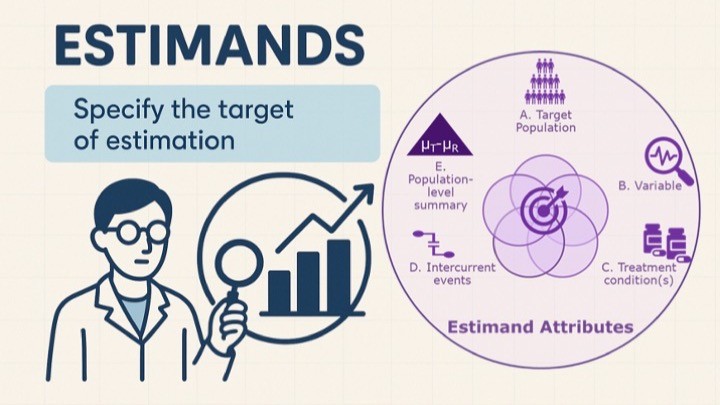
According to the ICH E9 (R1) guidance, an estimand is characterised by five core attributes [2]:
- Treatment – The intervention or comparison of interest in the clinical study.
- Population – The patient group to whom the scientific question applies.
- Variable (or Endpoint) – The outcome or measure used to assess the effect of treatment.
- Population-level summary – The method of aggregating the individual patient outcomes (e.g., difference in means, hazard ratio).
- Handling of intercurrent events (ICEs) – Strategies for addressing events that occur after treatment initiation and may affect the interpretation or measurement of the endpoint.
Each of these elements must be discussed and defined during the trial's planning phase through interdisciplinary collaboration involving clinical, statistical, and regulatory stakeholders.
Clarifying the research question
The estimand framework enhances the alignment between the clinical question, study design, and analysis approach. Traditionally, mismatches between objectives and analyses have been common, with some studies providing ambiguous or difficult-to-interpret results due to inconsistent handling of events occurring after randomisation. By clearly specifying the estimand, researchers explicitly state the objective of the study, reducing the risk of ambiguity and enhancing the interpretability of findings.
For example, in oncology trials, progression-free survival (PFS) might be affected by intercurrent events such as treatment discontinuation due to toxicity or initiation of alternative therapy. A well-defined estimand will clarify whether such events are part of the treatment effect or should be treated as censoring or adjustments. This avoids misleading conclusions and ensures that the results reflect the intended scientific question.
The role of intercurrent events
One of the most innovative aspects of the estimand framework is its systematic approach to intercurrent events (ICEs). These are events that occur after the initiation of treatment that can influence either the observation or interpretation of the outcome. Examples include treatment discontinuation, switching to rescue therapy, or death from unrelated causes. These events complicate the estimation of treatment effects, and inconsistent handling across studies can lead to incomparable or biased results.
The estimand framework prescribes that ICEs be anticipated and strategies for their handling be explicitly stated. Common strategies include:
- Treatment policy: Include all data regardless of the ICE, reflecting a real-world effectiveness perspective akin to the intention-to-treat (ITT) principle.
- Hypothetical: Consider what the outcome would have been had the ICE not occurred, useful in efficacy-focused analyses.
- Composite: Integrate the ICE into the definition of the endpoint, such as combining death and hospitalisation in a cardiovascular outcome.
- While-on-treatment: Analyse only data collected prior to the ICE, which might be aligned with a per-protocol perspective but must be carefully justified.
- Principal stratum: Restrict the analysis to the subpopulation for whom the ICE would not occur, though this approach is limited in generalisability and often complex.
By selecting and justifying these strategies during the trial planning phase, researchers ensure that the analysis reflects the true intent of the study, and that stakeholders understand what the results mean in practical terms [4].
Estimands and regulatory expectations
The increasing emphasis on estimands is reflected in regulatory trends. The European Medicines Agency (EMA) and U.S. Food and Drug Administration (FDA) have embraced the ICH E9 (R1) framework, and guidance documents now encourage or require clear articulation of estimands in clinical trial protocols and statistical analysis plans [5, 6].
For instance, the EMA's Reflection Paper on Estimands notes that estimands are especially important for benefit-risk assessment, where understanding how different ICEs affect outcomes is critical. A poorly defined estimand could lead to regulatory concerns, particularly when interpreting secondary endpoints or subgroup analyses.
Per-protocol analyses and estimands
While the ITT principle is often congruent with the treatment policy strategy under the estimand framework, per-protocol analyses pose challenges. These analyses, which exclude data from patients who deviate from the protocol, are susceptible to selection bias and do not align well with estimands unless conducted with stringent methodological justification. They can be useful as sensitivity or supplementary analyses but should not be the primary basis for estimating treatment effects.
Instead, estimand-aligned approaches allow for a nuanced understanding of what effect is being estimated and under what assumptions. This level of transparency is critical for interpreting efficacy and effectiveness in a consistent and reproducible manner.
Practical implementation and challenges
Despite its theoretical elegance, the implementation of estimands in clinical trials faces practical challenges. It requires a cultural and procedural shift, particularly in early protocol development. Protocol templates, statistical analysis plans, and case report forms must all reflect the chosen estimand(s), and trial teams must be trained to think in estimand terms from the outset.
Moreover, defining appropriate strategies for ICEs often involves assumptions that must be justified through sensitivity analyses. Simulation studies and real-world case studies are increasingly used to test the robustness of estimand choices under various scenarios [7]. To support implementation, organisations such as the DIA, PSI, and industry consortia have developed training programs and tools, and academic literature continues to grow, providing applied examples in oncology, rare disease, and chronic disease settings.
Communication with stakeholders
One of the significant benefits of the estimand framework is its capacity to improve communication of trial results. When stakeholders, including regulatory authorities, patients, payers, and prescribers, clearly understand what effect is being measured—and under what conditions—they are better equipped to interpret the findings and apply them in decision-making. This transparency becomes especially important in comparative effectiveness research, health technology assessment, and shared decision-making processes. An estimand-centred report can delineate the conditions under which a treatment works, helping tailor interventions to specific patient populations or clinical scenarios.
Conclusion
The estimand framework represents a paradigm shift in clinical trial methodology. By requiring an explicit, structured definition of the treatment effect, it enhances the alignment of study objectives, design, and analysis. It particularly addresses the complexity introduced by intercurrent events, providing predefined strategies to maintain the relevance and interpretability of results. Estimands promote clarity, precision, and transparency, ultimately contributing to more meaningful evidence generation in clinical research. As regulatory agencies, industry sponsors, and academic researchers continue to embrace and refine this framework, its role in shaping robust, decision-ready clinical evidence will only grow. However, I am (yet) to fully comprehend how changing the word "subject" to "participant" will hugely affect clinical study quality or operations.
References
-
- International Council for Harmonisation. (2025). ICH harmonised guideline: Integrated addendum to E6(R2) – Good clinical practice (GCP) E6(R3).
- ICH E9 (R1): Addendum on Estimands and Sensitivity Analysis in Clinical Trials to the Guideline on Statistical Principles for Clinical Trials. International Council for Harmonisation, 2019.
- Pohl M, Baumann L, Behnisch R, Kirchner M, Krisam J, Sander A. Estimands-A Basic Element for Clinical Trials. Dtsch Arztebl Int. 2021 Dec 27;118(51-52):883-888.
- Kahan B C, Hindley J, Edwards M, Cro S, Morris T P. The estimands framework: a primer on the ICH E9(R1) addendum BMJ 2024; 384 :e076316 doi:10.1136/bmj-2023-076316
- EMA. Reflection Paper on the Use of Estimands in Clinical Trials. European Medicines Agency, 2020.
- FDA. Estimands Framework: Considerations for Clinical Trials. U.S. Food and Drug Administration, 2021.
- Akacha, M., Bretz, F., Ruberg, S. (2016). "Estimands in clinical trials: Broadening the perspective." Statistics in Medicine, 36(1), 5–1.9