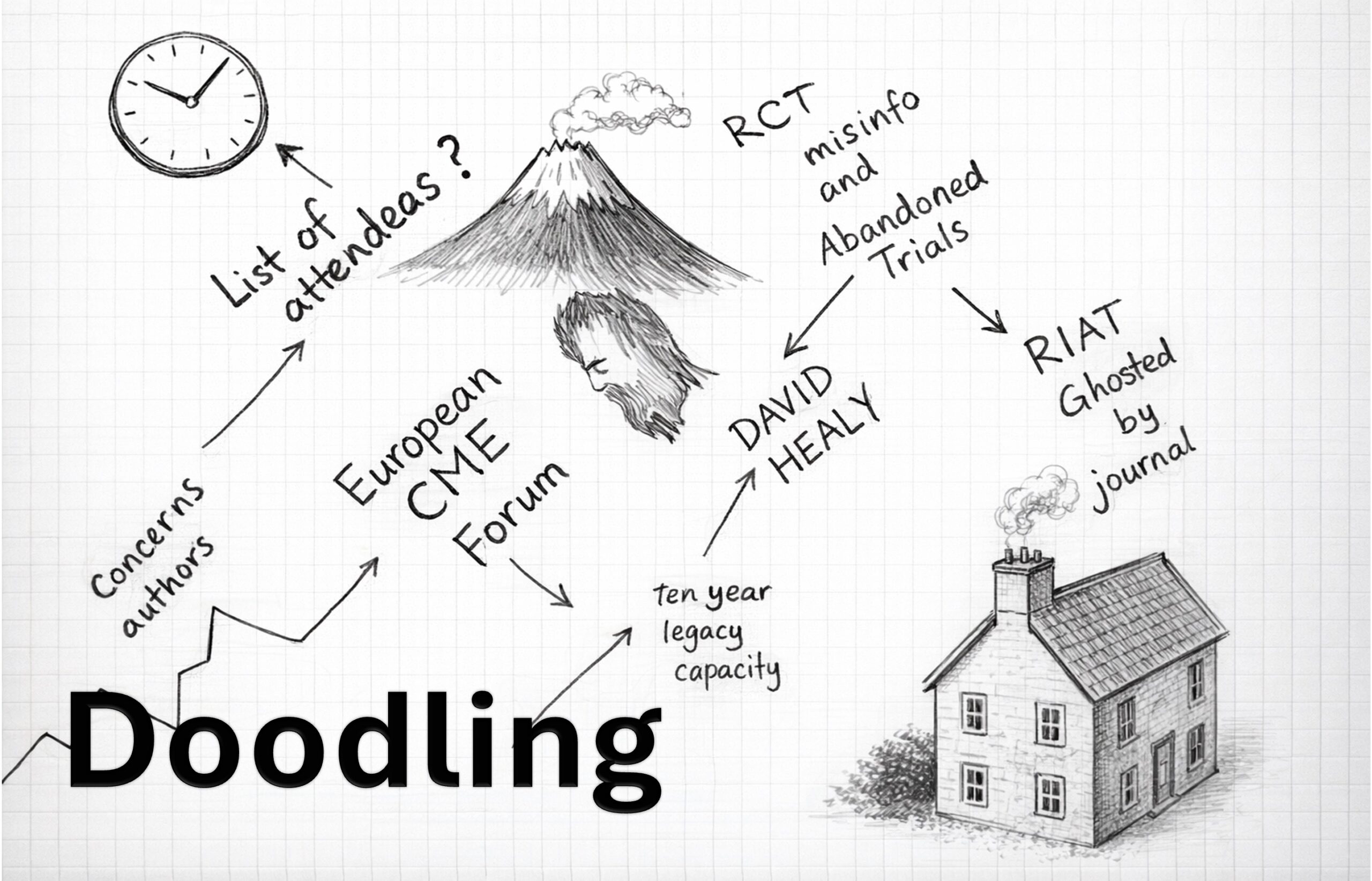
We spend so much of our lives sitting in meetings, conferences, training etc. Not something we are built for. Our inner child lies just below the surface of our modern-day consciousness. They are not equipped to sit quietly for hours. What are your options? You can stare intently at the speaker, though that often makes them (and you) uncomfortable. You can daydream or take copious notes, though this tends to prevent your engagement.
I doodle. I have always doodled. My old schoolbooks are filled with stick figures and curiously misshapen animals. I am not alone. I often see people doodling in meetings. Their pages include faces, their words grow legs and the margin becomes a decorative border.
Doodling is nothing new. People doodled in medieval times. You can find fantastical images in the rough workings of medieval scholars translating texts from Arabic to Latin. More recently, the notebooks of Russian poet Alexander Pushkin (1799–1837) are celebrated for their doodles. It has been said that 26 of 44 American Presidents doodled.
I first heard the term in one of my favourite films, Frank Capra’s Mr Deeds goes to town (1936). The eponymous hero, played by Gary Cooper, talks about people doing ‘things’ while thinking. He introduces the word ‘doodler’ to describe someone who makes absent-minded designs on paper.
In the past, doodling has been frowned upon professionally despite its prevalence. Over the last decade however, the cognitive science of drawing has begun to receive some serious scientific attention. Formal studies began to suggest that far from being a distraction, doodling prevents our minds from wandering into daydreams, boosting concentration and memory. It is clearly much more than a humble distraction. Below are five doodling benefits.
Research published in 2009 found that participants who doodled while taking part in a phone call were able to recall almost 30% more information than those who simply took notes [1]. We might find some explanation for the benefits of doodling in the spaces between the preconscious, conscious and the unconscious mind. The conscious mind is believed to be the location for our mental processing of all that we are ‘aware’ of, our rational selves, and the preconscious where we keep our memories. The faster-working unconscious mind is a reservoir of urges, feelings and physiological housekeeping. Doodling appears to engage and occupy our executive selves, stopping them from interfering with the process of data recording.
Similarly, if you’re struggling to remember something, or can’t think of the right words to say, doodling can help silence your mind and pick up the pieces, helping us to reconstruct things that we’ve heard in the past. This effect may also be viewed through the lens of embodied cognition, wherein the act of drawing creates a secondary memory trace that complements auditory or semantic encoding [2].
Modern psychology and philosophy extended Freud’s theory of the conscious, preconscious and unconscious to that of a battleground, each competing to contribute to the collective ‘self’ living in the ‘now.’ The self needs executive responsibility to fluctuate. Block it and you enter an ever-worsening state of psychological distress, steadily losing your ability to concentrate and retain information. It is generally accepted that we begin to struggle to maintain focus after 10–15 minutes [3].
Doodling keeps you in a state of ‘pure listening,’ receptive to information, it helps you to keep going that little bit longer. It is like yoga for the mind. With lifestyles becoming ever busier, our brains are constantly processing information. This is not a receptive learning environment. Research and the recognition of mindfulness practices in everyday activities suggests that doodling offers a calming encounter with the present moment. It keeps ‘you’ offline and absorbs your bored and unengaged consciousness without interrupting concentration. Functional neuroimaging studies have indicated that such unstructured drawing activities can modulate activity in the default mode network, potentially reducing mind-wandering while preserving attentional resources [4].
When considering ingenuity, the mother of problem solving and creativity, humans are not alone, many members of the animal kingdom use tools to solve problems and actively share their ideas/solutions with others. We can conclude therefore that our creativity is not singly housed in our vaunted human consciousness but comes from all aspects of an individual’s collective intelligence.
As with learning, our minds need to win the battle between the various aspects of our selves to access our full creative potential. Doodling silences competing thoughts, purging that excess mind baggage just enough for that ‘something’ that has been sitting at the back of your mind to come into focus.
Doodling may also enhance your creativity. The mental state of doodling sits somewhere between awareness and daydreaming. It can distract your mind from day-to-day problems, allowing you to consider the weird and fantastical, light up different networks in the brain and consider new possibilities. Voila, creativity! This is consistent with findings that low-effort, unstructured creative activities can facilitate incubation effects, a phenomenon well documented in the problem-solving literature [5].
If all this psychobabble is too much to accept I am sure that we can at least agree that doodling is an enjoyable activity and that any associated positive emotions make us more creative.
We can only know so much, or can we? Science fiction has long considered how mankind has yet to unlock the full potential of our minds. Many a misguided prophet or charlatan has offered novel techniques for achieving this in the back pages of Sunday newspaper supplements. Technology on the other hand has already addressed this challenge effectively in the form of compression algorithms for image and data storage.
Might doodling work in a similar way, helping us process data? For example, copy out the first sentence of the US Declaration of Independence and most would find it difficult to reproduce the second or third sentence. Whereas, draw the front end of an elephant and any child would be able to grasp what the rest of the concept involves. Reconstructing the image of an elephant drags with it a host of additional information, colour, size and the length of the trunk etc. This aligns with theories of dual coding, which posit that visual and verbal information are processed through distinct but interconnected systems, thereby enhancing recall [6].
When people describe doodling, they often say it is mindless and yet the quality, creativity and breadth of many doodles show this clearly not to be the case. A report on the learning styles of medical students (who generally have to absorb large amounts of information) indicated that they find doodling helpful. A simple 30-minute doodle helps them remember information, fills in gaps in their thinking, and provides a much-needed reprieve from the loads of information they must wade through [7].
Doodles often contain displays of what seem to be complex emotions, ideas and experiences. Consequently, some believe that our doodles are not quite as random as we might think and use them prognostically in people with emotional problems. They believe that doodles are like fragments of a map that shows how someone’s mind works and reveal what is going on in their unconscious.
Straight or curved lines apparently represent masculine or feminine characteristics whereas circles, squares and triangles show needs and motivation. Size and spacing reflect lifestyle and balance in relationships and directional trends indicate attitudes and priorities. Apparently, nothing says ‘blocked’ or ‘restricted’ like a drawing a brick wall. I remain sceptical but do wonder whether US President Trump doodles. At least those advocating such interpretations admit that it is not an exact science (ahem).
Whether your doodles identify you as an intuitive person, an independent optimist or strong, mature and sensitive type, the act of doodling may very well unlock some superhuman aspects of the human psyche. It can also serve as an emotional outlet. Some who have trouble communicating or putting emotions into words have found that the act of doodling while talking allows them to express their feelings calmly in extreme cases of frustration, anxiety and depression. Art therapy literature supports the use of spontaneous drawing as a non-verbal means of externalising and regulating emotion, particularly when verbal articulation is difficult [8].
In conclusion, I believe that it is time to change the way we think about doodling and start to respect the doodler. You need to put greater efforts into your own doodles. If nothing else, doodling (a form of fidgeting) may be a last-ditch attempt at staying awake and attentive in endless meetings.
Look out for those people who aren’t doodling in meetings. Chances are they aren’t engaging (particularly if they have their laptops open). And next time you catch yourself doodling in a meeting and think “I should really pay attention”, don’t worry, you already are.
References

Get our latest news and publications
Sign up to our news letterResources
Social


Contact us
Address
Niche Science & Technology
Unit 26 Falstaff House
Bardolph Road
Richmond TW9 2LH
United Kingdom