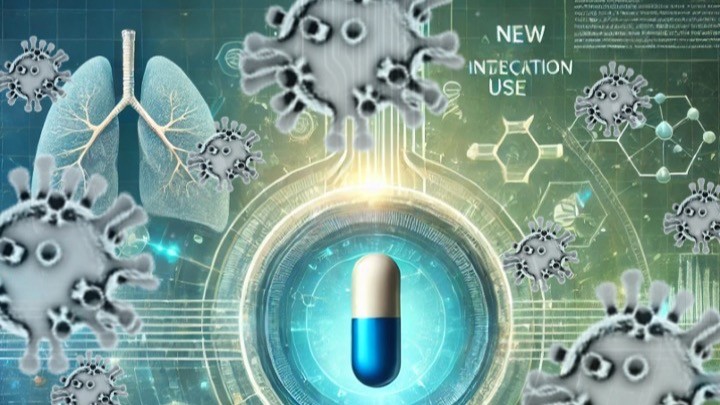
A fascinating science news story hit the headlines in the last 24 hours, that a common over-the-counter ingredient in many cough syrups may have a greater purpose for people suffering from lung fibrosis that is related to any number of serious health conditions.
Scientists from EMBL Heidelberg were part of a collaborative effort to discover an effective treatment for lung fibrosis and found that the best candidate may be one that is already available as a cough medicine around the world: dextromethorphan. The study was recently published in Science Translational Medicine and showed how dextromethorphan can impede the collagen that forms scars inside cells, reducing lung fibrosis [1].
Lung fibrosis, caused by an excess of scarring, formed when fibrillar collagen accumulates in the lung, most often occurs in older adults for a variety of reasons: exposure to environmental irritants such as asbestos, coal dust, and mould; as a side effect from chemotherapy agents; as a long-term consequence of serious lung disease such as tuberculosis; and as part of certain autoimmune or inflammatory diseases, such as lupus or rheumatoid arthritis. A subset of long Covid patients develop pulmonary sequelae, marked by a decline in lung function and a fibrotic process in the lungs, leading to long-term functional impairment. Current treatment approaches for the pulmonary sequelae of Covid-19 lack robust clinical evidence specific to this condition, leaving many patients without reliable options [2][3].
Fibrotic scarring causes lung tissue stiffness, which leads to breathing difficulties and reduces oxygen concentration in the bloodstream, ultimately resulting in organ failure. Since 2019, the World Health Organization (WHO) estimates that 761,000 people in its European region suffer from lung fibrosis. In addition, WHO estimates that 25,000 patients have died and 496,000 healthy years have been lost because of lung fibrosis [4].
Knowing the challenge of developing new drugs, Khan and the team decided to explore drugs that are already approved and readily available. EMBL scientists screened a library of FDA-approved drugs, including dextromethorphan. In collaboration with the Translational Lung Research Center Heidelberg and the German Center for Lung Research, the researchers worked with human lung cells and applied a variety of modern technologies that didn't even exist when many of these drugs were first approved.
This was similar to the considerations that Petrovax made when they looked at the impact of a repurposed drug on fibrosis in long-COVID [5]. Their drug reduced exertional desaturation and dyspnoea by 62% and 27%, respectively, in patients with Covid-19 pulmonary sequelae, according to a recent Phase 3 study. In patients with cardiovascular comorbidities, Longidaza improved pulmonary function recovery by 26%.
Testing registered drugs with well-established modes of action is a primary strategy in the search for a long Covid cure.Drug repurposing is a valuable strategy in pandemic situations, when it is nearly impossible to design and implement a new drug target in a short timeframe [6]. A research team led by pulmonologist Dr. Sergey Avdeev has adopted a novel approach to addressing lung function decline: hyaluronidase injections. This choice is supported by growing evidence that hyaluronan is more than an inert component of the extracellular matrix. Research shows it plays a critical role in fibrotic tissue remodelling and chronic inflammation, both of which are key drivers of post-Covid pulmonary sequelae [7]. Serum levels of hyaluronic acid are significantly elevated in patients with post-COVID-19 pulmonary fibrosis and are positively associated with the severity of lung damage seen on high-resolution computed tomography (HRCT) [8].
The team selected a specific hyaluronidase with 20 years of clinical use, a well-established safety profile, and a prolonged half-life as their study drug: bovhyaluronidase azoximer (brand name Longidaza, not registered in the USA). Preclinical animal studies had demonstrated Longidaza's potential to reduce fibrosis, while a pilot study in 160 post-Covid-19 patients showed statistically significant improvements in pulmonary function, respiratory symptoms, and exercise tolerance [9]. These results prompted the researchers to initiate a larger, randomized trial.
The study included a diverse population, with initial SARS-CoV-2 infection occurring anywhere from 1 to 12 months before inclusion. It encompassed both non-hospitalized individuals and those who required mechanical ventilation. Participants were infected with a variety of strains, from the severe Delta variant to the milder Omicron BA. While this broad population posed some limitations, it also made the findings more relevant to real-world patient experiences and strengthened their applicability.
In conclusion, Petrovax found that BA significantly increased exercise tolerance in patients with long-term pulmonary sequelae of COVID-19. BA also significantly accelerated pulmonary function recovery in patients with cardiovascular comorbidities, patients infected with earlier variants of SARS-CoV-2, female patients, and patients aged > 60 years. However, it did not affect pulmonary function recovery in the overall population. The differential effects of BA on patients with and without cardiovascular comorbidities highlight the antagonistic roles of HA in post-COVID-19 pulmonary sequelae and suggest that HA-targeting therapies require careful selection of study populations. The study findings also suggest that longer exposure to hyaluronidase may be necessary to impact lung function recovery. Overall, the findings support the further investigation of hyaluronidase-based therapies for long COVID, with or without pulmonary sequelae.
References
Get our latest news and publications
Sign up to our news letterResources
Social


Contact us
Address
Niche Science & Technology
Unit 26 Falstaff House
Bardolph Road
Richmond TW9 2LH
United Kingdom