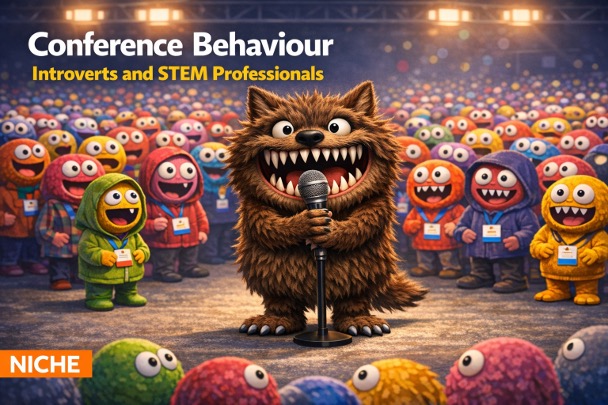
Escaping the workplace for a conference allows us to change out of our humdrum ‘office’ persona. Free from the confines of protocols, politics and colleague expectations we can briefly become who we aspire to be. That, at least, is the theory.
Sadly, reality often frustrates our best intentions. Research indicates that a substantial proportion of university‑educated professionals experience discomfort in networking contexts [1]. Unfamiliar social environments increase cognitive load and stress, often leading to withdrawal or reduced engagement [2]. Annual conferences are a great example of where you can observe the full horror transformation gone wrong. Metamorphosis more often reflects that of Dr Jekyll to Mr Hyde than caterpillar to butterfly. Next time you attend a conference you might want to take a few moments to watch your fellow participants. Will they be ghost, zombie, vampire or werewolf.
Conferences can barely be considered a normal situation for any but that rare breed of individuals who organise them (you can find more on that here). For the rest of us, they represent an unnatural environment resulting from the combination of a particular set of circumstances.
Conference attendance is only the last step of a long process of preparation. As your impending absence looms you take precautions to pre-empt possible disasters, brief everyone on their roles and responsibilities and empty your in box (secure in the knowledge they will be full on our return). You also need to plan your travel: tickets, clothes, bags and work (to take along). The burden of preparation is even greater if you are presenting. Many attendees arrive already fatigued, primed for overload. This anticipatory workload is associated with elevated cortisol, reduced cognitive flexibility, and impaired decision‑making [3][4].
Once on site, the conference environment amplifies the pressure. Cognitive Load Theory helps explain why conferences feel overwhelming: intrinsic load from complex scientific content, extraneous load from navigation and logistics, and germane load from integrating new information all converge simultaneously [5]. It falls on your shoulders to collect as much information from the event as possible, returning with wisdom to share with your colleagues. To best achieve this, we often review the conference’s program beforehand and plan the most efficient use of our time: choose between parallel sessions, navigate unfamiliar venues, and make rapid decisions about where to be and when. Research on multitasking shows that such rapid context switching reduces comprehension and increases fatigue [6].
You need to map the most efficient route through poster sessions, seminars, concurrent workshops and what seems like an endless networking session. The levels of preparation required generally compound the cognitive burden [7] and results in the ‘responsible’ conference attendee being exhausted before they even begin their journey. The slightest complication with the travel arrangements will only serve to further oppress your overall demeanour.
We all perform context‑dependent roles to manage the impression we aim to give others [8]. Social Identity Theory similarly argues that people adjust behaviour to align with group norms [9]. Conferences heighten these processes because hierarchies are ambiguous, audiences are mixed, and social cues are unfamiliar. For early‑career professionals or presenters, the pressure to perform can be particularly intense. Arrival marks the final stage in the personality pressure cooker, queuing for the hotel check in, conference registration and evening reception. Only then do you have time to relax and undergo your transmogrification. What will they become after the complementary glass of cheap wine?
In my time I have been zombie, ghost werewolf and vampire, often transitioning from one to another during the course of a single meeting: I am sure it has not gone unnoticed. Attendance of conference represents an investment of time and money for both you and your employer. The question is, how do you get the best out of the experience?
In ‘An introvert’s guide to conferencing for nerds – top 10 tips’ I shared insights into how those of us who tend towards the introverted, geeky and/or nerdy persona can get the most out of conference situations [14]. Conferences represent an opportunity to make an impression and broaden networks. As such, they form an important part of your career development as a STEM professional (or an aspiring one), irrespective of whether you work in academia, government or industry.
If you followed my advice you will have applied a new verve to your conference attendance. No longer are you seen cowering in the corner, plate in hand, hoping that someone will come and speak to you. Using the techniques described you should be aware of how to make the most of these unmissable opportunities to extend your network, progress your career and learn what’s new in your industry. I’m not suggesting that you will yet have overcome your shyness or introversion. Rather, I expect that you have managed to navigate around the debilitation, making the whole exercise less stressful.
I followed the ‘introvert’ article with a ‘3-step hack to conference superhero’ describing conference etiquette and how to get maximise the opportunities that conferences offer [15]. I would add to my earlier list that, when reviewing the freebies at vendor booths, it is only polite to speak with the representatives. At best it is common courtesy to ask them how the conference is going for them.
In the end, your best outcomes are achieved by planning your activities thoroughly. However, to avoid being overtaken (possessed) by the experience you want to keep your objectives flexible. Note that although it's important to identify your priorities in advance, you will probably need to adjust them once you're at the conference. For example, you could end up in a fruitful discussion that runs on for longer than you had anticipated. Shift your itinerary, make the most of the opportunity.
Have a few primary goals but keep them manageable, don’t be over ambitious [16]. Triage your activities, pursue your primary objectives but remain open to letting go of the less important ones [17]. This will give you the flexibility to go for coffee with a new friend, connect with a potential mentor or take a well-deserved break without suffering from the dreaded ‘fear of missing out’ which will restore attentional capacity and improve learning [18].
Prepare an itinerary package before you leave that includes critical information for the trip, like travel details, accommodation, conference centre location, registration, agenda and contact numbers. Even if you don’t refer to the information, having the package handy will make you feel a little more relaxed.
Take breaks to regenerate. As much as I enjoy attending conferences, I can only process a set amount of information or undertake so much networking before my brain shuts down. When I recognise that I'm approaching my limit, I take time to socialise or decompress, I do whatever is necessary to refocus and feel human again. If you're in a seminar/lecture/networking session, but you're mentally elsewhere, you're already missing the conference. Take breaks so that you can get back in the game: perhaps take a nap, eat a snack, visit vendors. Be careful not to enter the caffeine-surging snack trap, that monster is waiting [10].
References

Get our latest news and publications
Sign up to our news letterResources
Social


Contact us
Address
Niche Science & Technology
Unit 26 Falstaff House
Bardolph Road
Richmond TW9 2LH
United Kingdom