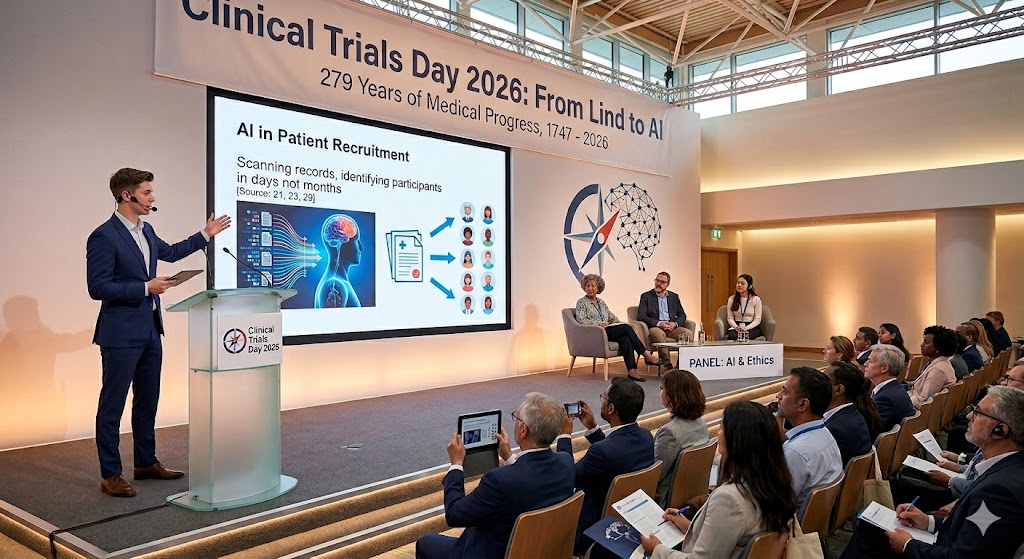
Clinical Trials Day 2026
Each year on May 20th, the global research community marks International Clinical Trials Day [1]. The date commemorates the anniversary of James Lind’s 1747 scurvy experiment aboard HMS Salisbury, an event widely regarded as the first controlled clinical trial [2]. In 2026, celebrations worldwide focus not only on historical milestones but also on the transformative role of artificial intelligence (AI) in reshaping how trials are designed, conducted, and analysed. From virtual symposia on adaptive designs to workshops on AI-powered patient recruitment, this year’s activities reflect a field that has become vastly more sophisticated while retaining Lind’s core principle: structured comparison to find what truly works.
The First Trial: A Model of Simplicity and Insight
Lind’s original experiment was remarkably elegant. He recruited 12 sailors with similar scurvy symptoms, divided them into six pairs, and provided each pair with a different dietary supplement, cider, vinegar, seawater, a nutmeg-and-garlic elixir, oranges and lemons, or continued ship’s rations [3]. The pair receiving citrus fruits recovered rapidly, providing clear evidence that vitamin C prevented and treated scurvy.
Crucially, Lind was cautious in interpreting his results, questioning whether the citrus effect might be due to other factors. This humility, acknowledging the limits of one’s own data, remains a hallmark of good science. However, Lind’s trial lacked key features we now take for granted: randomisation, blinding, placebo control, and formal statistical analysis. It was a controlled trial in design but not yet a randomised controlled trial (RCT) [4].
From Lind to the RCT: A Journey of Rigour
The evolution from Lind’s 18th‑century comparison to today’s RCTs required centuries of methodological and ethical progress. In 1834, Pierre Louis used numerical methods to debunk bloodletting, showing that earlier intervention did not improve outcomes [5]. Florence Nightingale’s graphical presentations of mortality data during the Crimean War demonstrated the power of statistics in public health [6]. What might more correctly be considered the first modern RCT, the 1948 British Medical Research Council streptomycin trial for tuberculosis, introduced random allocation and concurrent control groups, establishing the RCT as the gold standard [7].
Ethical frameworks followed more slowly. The Nuremberg Code (1947) mandated informed consent after Nazi atrocities, while the Declaration of Helsinki (1964) and the Belmont Report (1979) enshrined respect for persons, beneficence, and justice [8][9 Tim]. These principles now underpin every legitimate clinical trial. The Tuskegee syphilis study, where treatment was withheld from Black men without their knowledge, remains a chilling reminder of why ethics cannot be an afterthought [10 Tim].
Global Activities in 2026: AI at the Forefront
This Clinical Trials Day, professional bodies, academic centres, and patient groups are hosting events that highlight AI’s growing footprint. Sessions include:
These activities reflect a broader consensus: AI is not merely an efficiency tool but a means to correct historical shortcomings, such as poor diversity and slow recruitment, while (we hope) maintaining scientific rigour.
The Contribution of AI: Promise and Caution
Modern AI can scan millions of patient records to identify eligible participants in days rather than months. It can optimise adaptive trial designs, allowing pre‑planned modifications based on interim results without compromising statistical validity [15]. Generative AI assists in writing patient‑friendly informed consent forms and in monitoring adverse events through natural language processing of clinical notes.
Yet caution is warranted. AI models trained on biased data may perpetuate or amplify existing disparities [16]. Black‑box algorithms can obscure the reasoning behind treatment allocation or safety signals, challenging transparency. Therefore, regulatory bodies such as the FDA and EMA are developing guidance on “good machine learning practice” to ensure that AI complements, not replaces, human oversight [17].
Reflecting on Importance: Why Trials Remain Indispensable
Despite AI’s advances, the fundamental question asked by Lind—which of these interventions works better?, remains unchanged. RCTs are still the most reliable way to establish causality, and they depend on the voluntary participation of human beings. Without participants willing to trust the process, no algorithm can generate evidence.
This year’s commemorations also honour trial volunteers and the research teams who run complex global studies. As one organiser noted, “AI will never replace the courage of the first participant in a Phase I oncology trial” [1].
Conclusion: From Scurvy to Sequences
International Clinical Trials Day 2026 bridges a 279‑year arc: from a ship’s surgeon with a dozen sailors to global networks powered by machine learning. What remains constant is the commitment to evidence, ethics, and improvement. As Louis Pasteur observed, “Chance favours the prepared mind,” and today, AI helps prepare that mind faster, but it cannot replace the human judgment that gives trials their meaning.
References

Get our latest news and publications
Sign up to our news letterResources
Social


Contact us
Address
Niche Science & Technology
Unit 26 Falstaff House
Bardolph Road
Richmond TW9 2LH
United Kingdom