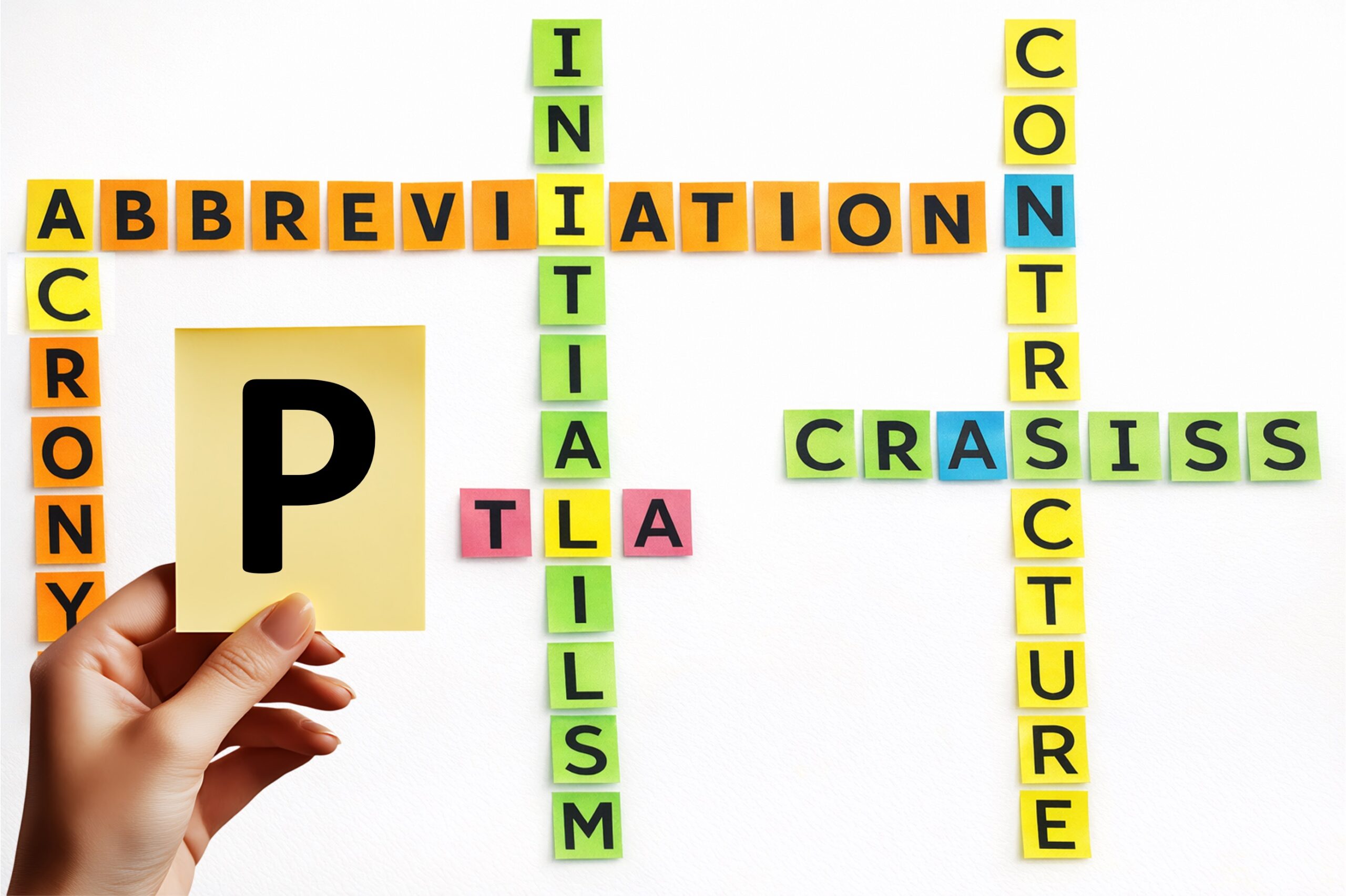
Let us be honest: we are lazy. I have just finished reviewing a 3,000-word document that contained nearly 60 abbreviations. Sixty! That is not writing; that is archaeology, requiring the reader to constantly dig for meaning. If you want your audience to actually engage with your work rather than just decode it, use abbreviations sparingly.
Abbreviations have a long history, first used by the Ancient Greeks to save precious papyrus and ink [1]. But we are no longer chiselling stone tablets or paying by the letter. So why do we cling to these cryptic hieroglyphics?
Reading is work. Functional magnetic resonance imaging (fMRI) data show that reading requires metabolic effort, but every writer should know this intuitively [3]. Each time a reader hits an abbreviation, they stall. They must decode. If they forget the meaning, they scroll back, guaranteed to break their narrative flow.
A study from 2005 demonstrated that ambiguous abbreviations reduce reading speed by up to 11% and significantly impair comprehension [4]. Another paper, reviewing medication errors, found that abbreviations were responsible for nearly 5% of all prescribing mistakes in a tertiary hospital setting [5]. These are not trivial numbers.
Before we go further, a word of caution about tone. When enforcing these rules, do not become what linguists call a ‘Grammar Nazi,’ a term that trivialises historical atrocity to describe pedantry [6]. Being a stickler is fine; being a jerk is not. If a colleague uses ‘i.e.’ incorrectly, correct them quietly. If a student starts a sentence with ‘PCR,’ remind them gently. We are aiming for clarity, not creating a hostile environment where people are afraid to write.
As linguist David Crystal noted in 2006, prescriptivism without empathy is simply bullying [7]. The goal is to help, not to humiliate.
I often meet writers who do not know the difference between a contraction and an initialism. Let us fix that.
This is not about style; it is about life and death. The Joint Commission, a healthcare accreditation body, introduced a "Do Not Use" list in 2004 following a Sentinel Event Alert in 2001 [10][11]. Why? Because ‘U’ looks like ‘0’ (zero) or ‘4.’ ‘IU’ (International Unit) looks like ‘IV’ (intravenous). ‘MS’ could mean morphine sulphate or magnesium sulphate. If you are writing in a clinical context, spell it out. Abbreviations kill [12].
A seminal paper in 2007 reviewed 22,000 medication errors and found that abbreviation use directly contributed to 7% of fatal errors [13]. Seven percent. That is a chilling statistic.
There is a grey area. Do you really need to define ‘DNA’? Or ‘NASA’? Probably not. The literature is mucked up with ‘common knowledge’ abbreviations. A 2019 study on readability suggested that while defining an abbreviation helps novices, it actually slows down experts who already know it [14]. Therefore, use common sense. You do not need to define ‘UK’, ‘PhD’, or ‘AIDS’ in a general audience document. But when in doubt, define it. It costs you nothing and saves your reader everything.
How you use abbreviations tells me everything about your experience. Amateurs use the ampersand (&) in running text (except when part of an official name like Johnson & Johnson). Beginners use ‘etc.’ (Latin for et cetera, meaning ‘and the rest’) as a crutch, often without knowing what the rest actually is. Professionals know that while TLAs (Three-Letter Abbreviations) have their place, the best writing is the most transparent.
Wikipedia notes that TLAs entered the popular psyche in the 1980s with the home computer revolution [15]. The geeks really do rule the world. But even geeks appreciate a fully spelled-out sentence now and then.
Be kind to your reader. Spell it out. If you must abbreviate, do so sparingly, define clearly, and never at the expense of safety or sense. And above all, correct with compassion, not contempt.
References

Get our latest news and publications
Sign up to our news letterResources
Social


Contact us
Address
Niche Science & Technology
Unit 26 Falstaff House
Bardolph Road
Richmond TW9 2LH
United Kingdom