My first encounter with the term ‘salami slicing’ did not come from a textbook on publication ethics or a seminar on research misconduct. It came unexpectedly during the peer-review process in the early 1990s, at a time when I was actively publishing findings from our research programme investigating diabetes in twins.
The research was focused on the complex interplay between genetic susceptibility and environmental influences in diabetes, using the unique opportunities provided by twin cohorts to explore metabolic traits, cardiovascular risk factors, and potential mechanisms underlying disease development [1]. Like many researchers working with carefully characterised cohorts, we had accumulated a rich dataset containing multiple scientific questions. The challenge was not a lack of findings, but rather how best to communicate those findings responsibly and coherently.
During the submission of one of our manuscripts to Diabetes Care, describing our work on erythrocyte sodium–lithium countertransport and its relationship to diabetes-related phenotypes [2], the journal editor raised a question that was unfamiliar to me at the time: was there a risk that the dataset was being “salami sliced”? The term immediately created a vivid image—the idea that a single body of research could be cut into increasingly thin slices, with each fragment presented as a separate publication.
My initial reaction was one of surprise. The intention behind the research programme was not to generate publications for their own sake, but to answer distinct biological and clinical questions using the information available from a unique, carefully characterised population. However, the editor’s question highlighted an important distinction that has remained central throughout my career: the difference between legitimate scientific division and fragmentation designed primarily to increase publication numbers.
The concern raised by the editor reflected a broader conversation that was becoming more prominent within academic medicine. By the early 1990s, the stresses of the ‘publish or perish’ environment were becoming increasingly visible. Researchers were often assessed through publication counts, journal prestige, and citation records, creating incentives that could unintentionally encourage quantity over scientific coherence. The challenge for investigators was therefore not simply deciding whether findings were publishable, but whether each manuscript represented a genuinely independent contribution to knowledge.
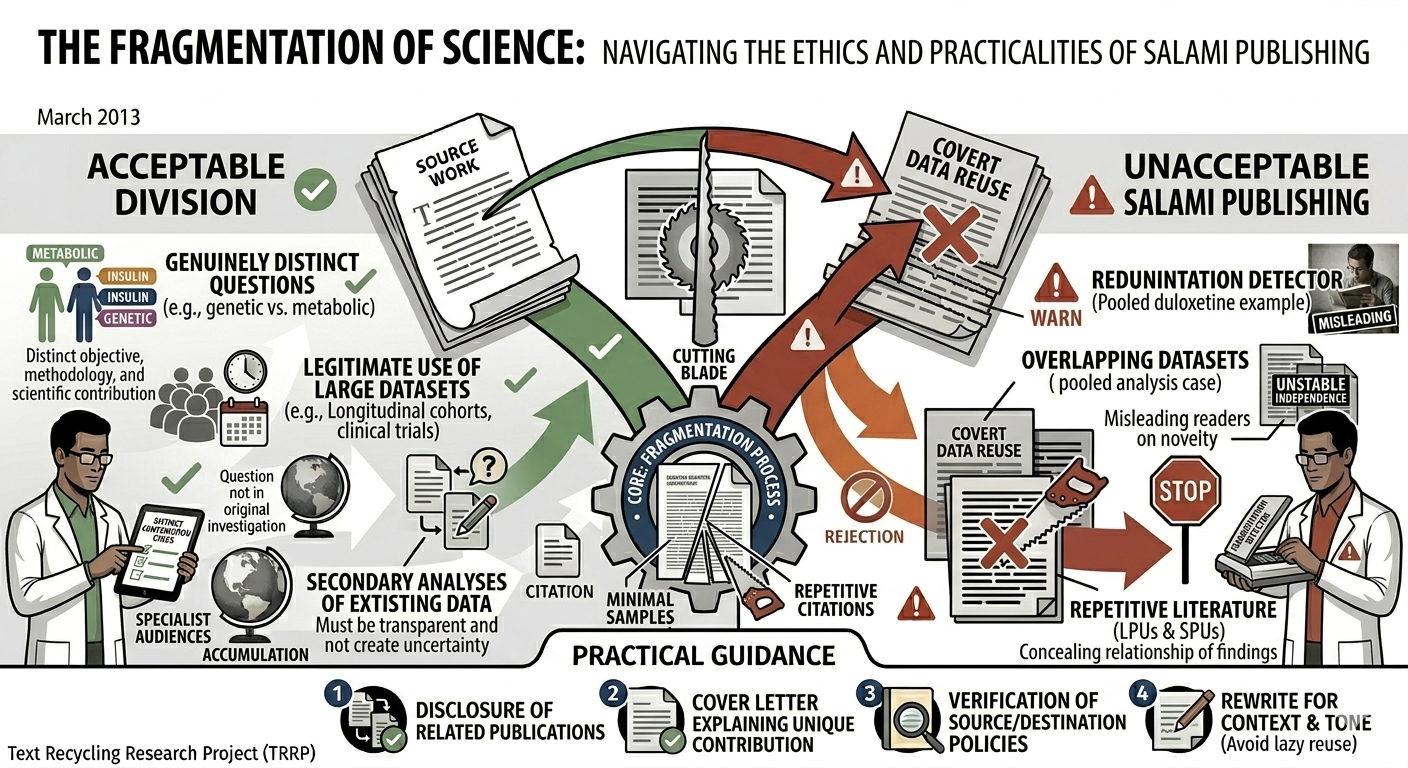
Looking back, that editorial exchange was an early lesson in the responsibilities that accompany ownership of valuable datasets. Large research studies, particularly longitudinal cohorts, genetic studies, and clinical trials, will often produce multiple publications. Indeed, dividing findings across papers is frequently necessary to allow specialist audiences to engage with specific research questions. The issue is not the number of publications arising from a dataset; it is whether each publication adds meaningful scientific value, is transparently linked to related work, and allows readers to understand the relationship between studies.
The term salami slicing has since become widely recognised within biomedical publishing as a shorthand for the inappropriate fragmentation of research findings into multiple minimal units of publication. Yet my first experience of the concept demonstrated that the boundary is rarely simple. Good science often requires careful separation of findings, while responsible publishing requires careful judgement about when separation becomes unnecessary division. You also have to remember that journals only offer limited page numbers to publish your findings [3].
That early interaction with an editor ultimately shaped my understanding of scientific communication. It reinforced that publication is not merely a mechanism for recording discoveries; it is a process of constructing an accurate and interpretable scientific record. The responsibility of authors is therefore not simply to publish, but to ensure that every paper tells a meaningful part of the scientific story.
Scientific publishing has always operated within a tension between the legitimate dissemination of knowledge and the incentives created by academic competition. The modern researcher is judged not only by the quality of discoveries but also by the visible record of publication. Over the past several decades, this pressure has encouraged increasingly sophisticated strategies for maximising publication output. Among the most persistent and controversial of these is salami slicing: the division of a single research project into multiple papers, each representing only a fraction of the original scientific project.
The phrase has become familiar within medical publishing, yet the underlying concern is older than the terminology itself. In 1981, William J. Broad described the growing tendency of scientists to manipulate publication practices in his influential Science article, “The Publishing Game: Getting More for Less.” Broad examined how academic reward structures could encourage researchers to produce more papers without necessarily producing more knowledge, highlighting the incentives that allowed scientific output to become a measurable currency in career advancement [4]. Although the expression “salami slicing” was not universally established at that time, Broad’s analysis anticipated the ethical debate surrounding the fragmentation of research findings.
The central problem is not the existence of multiple publications from a research programme; science often requires incremental reporting. Rather, the concern arises when investigators partition a coherent study into the smallest possible units primarily to increase publication counts. These fragments have variously been called “Least Publishable Units” (LPUs) or “Smallest Publishable Units” (SPUs), reflecting the idea that researchers may seek the minimum amount of information required for a paper to pass editorial scrutiny [5][6]. When excessive fragmentation occurs, the scientific literature becomes crowded with fragmented and repetitive publications, while readers, reviewers, and evidence synthesists must reconstruct a complete research story from artificially separated pieces.
The ethical framework surrounding scientific publication developed gradually. In medical research, a major milestone was the creation of formal authorship and reporting standards by the International Committee of Medical Journal Editors (ICMJE), originally established in 1978 as a collaboration among medical journal editors seeking consistency in manuscript preparation and publication practice [7]. Over subsequent decades, the ICMJE recommendations evolved into a widely adopted framework addressing authorship, duplicate publication, transparency, conflicts of interest, and responsible reporting.
The emergence of the Committee on Publication Ethics (COPE) further strengthened the international response to questionable publishing practices. Established in 1997, COPE developed guidance for editors and publishers dealing with misconduct allegations, including redundant publication, plagiarism, and inappropriate authorship practices [8]. These developments reflected a broader recognition that publication ethics could not depend solely on individual judgement; consistent standards were required across journals and disciplines.
Salami publication occupies a particularly difficult position because it exists on a continuum. At one extreme lies clear duplicate publication, where substantially identical findings are published more than once without disclosure. At the other lies legitimate scientific communication, like our twins studies, where a large research programme produces multiple papers addressing genuinely different questions. The challenge for editors is determining where useful scientific division ends and artificial fragmentation begins.
Several authors have attempted to define this boundary. Abraham described salami publication as the inappropriate division of study results into multiple manuscripts with insufficient added value [5]. Rogers similarly warned that excessive segmentation, alongside practices such as ‘shotgunning’ multiple related manuscripts to different journals, could distort the scholarly record and undermine confidence in authorship and publication practices [9]. Norman and Griffiths emphasised that the issue is not simply the number of papers produced but whether each paper provides a distinct and meaningful contribution [10].
The consequences extend beyond academic inconvenience. Fragmented reporting serves to obscure the relationship between individual findings, complicate interpretation, and create the risk that the same participants contribute repeatedly to the apparent evidence base. This is especially important in clinical research, where systematic reviews and meta-analyses depend upon accurate identification of independent datasets.
One landmark investigation demonstrated the dangers of covert duplicate publication in clinical evidence synthesis. Examining trials of ondansetron for postoperative nausea and vomiting, the authors found that unpublished or duplicated data could substantially influence meta-analytic conclusions when the same patient information was counted more than once [11]. The work provided a powerful demonstration that fragmented reporting is not merely a question of academic style; it can alter estimates of treatment effectiveness and potentially influence clinical decisions.
Nowadays, the traditional culture of publish or perish is beginning to face significant criticism. Historically, publication numbers served as a convenient proxy for academic productivity, encouraging researchers and institutions to value quantity. However, increasing awareness of publication bias, reproducibility concerns, and research waste prompted a shift toward evaluating the quality and significance of scholarly contributions.
In the United Kingdom, the Research Excellence Framework (REF) represented this changing philosophy by placing greater emphasis on research quality, impact, and broader contributions rather than simply counting publications. Internationally, measures such as the h-index attempted to balance productivity with citation influence, although these metrics also attracted criticism because they could themselves create new incentives for strategic publishing.
Within this changing landscape, the value of a paper increasingly depended on whether it advanced understanding rather than merely adding another item to a curriculum vitae. Some authors argued that the SPU approach represented an outdated response to academic pressure and that researchers should consider whether a manuscript represented a meaningful scientific unit rather than the smallest possible publishable fragment [6].
Nevertheless, legitimate division of research findings remains essential. Large longitudinal studies frequently generate numerous important publications because different scientific questions require separate analyses. The Framingham Heart Study and the Nurses’ Health Study, for example, have produced extensive bodies of literature because their datasets address diverse epidemiological, clinical, and public health questions over many years. Such programmes are not examples of unethical salami slicing when each publication has a distinct objective, appropriate methodology, and clear contribution.
Similarly, a large clinical trial may reasonably generate multiple manuscripts when investigators have prospectively defined different hypotheses, outcomes, or analytical approaches. The distinction lies in whether each paper answers a separate scientific question or whether the same findings have simply been repackaged.
The most important safeguard against inappropriate fragmentation is transparency. Authors submitting manuscripts must disclose related publications and submissions involving the same dataset or research question. This includes manuscripts that are published, accepted, in press, or currently under review. The ICMJE recommendations require authors to provide relevant information to editors so that the relationship between manuscripts can be assessed properly [7].
A cover letter should therefore identify related work and explain the unique contribution of the submitted manuscript. Authors should provide copies of related papers when requested, allowing editors to determine whether the new submission offers sufficient “value added.” Concealing related manuscripts prevents proper editorial assessment and may transform an otherwise acceptable secondary analysis into redundant publication.
Secondary analyses represent one of the most challenging areas. Reanalysis of existing data can produce valuable insights, particularly when addressing questions not considered in the original investigation. However, authors must clearly distinguish secondary objectives from previously reported outcomes and avoid presenting overlapping findings as novel discoveries. Spielmans and colleagues illustrated these concerns in their analysis of pooled duloxetine studies, showing how multiple publications derived from overlapping datasets can create uncertainty regarding the independence and interpretation of findings [12].
The question “where does fraud begin?” is therefore not answered by a simple publication count. Pundits have argued that legitimate division of datasets, salami slicing, and duplicate publication exist along a continuum, requiring judgement based on scientific purpose, transparency, and contribution [13]. The ethical dividing line is crossed when publication strategy becomes detached from scientific communication.
Scientific literature is cumulative. Each article becomes part of the evidence available to clinicians, researchers, and policymakers. When that evidence is unnecessarily fragmented, the burden of interpretation shifts from authors to readers, reviewers, and future investigators. The responsibility of modern scholarship is therefore not merely to publish, but to publish clearly, honestly, and in a manner that allows knowledge to accumulate rather than multiply artificially.
Salami publishing represents a symptom of a broader challenge: measuring science without allowing measurement systems to distort scientific behaviour. As academic institutions move toward evaluating quality, impact, and integrity, the most successful researchers will not necessarily be those who publish the most papers, but those whose publications provide the clearest and most valuable contributions to human knowledge.
References

Get our latest news and publications
Sign up to our news letterResources
Social


Contact us
Address
Niche Science & Technology
Unit 26 Falstaff House
Bardolph Road
Richmond TW9 2LH
United Kingdom