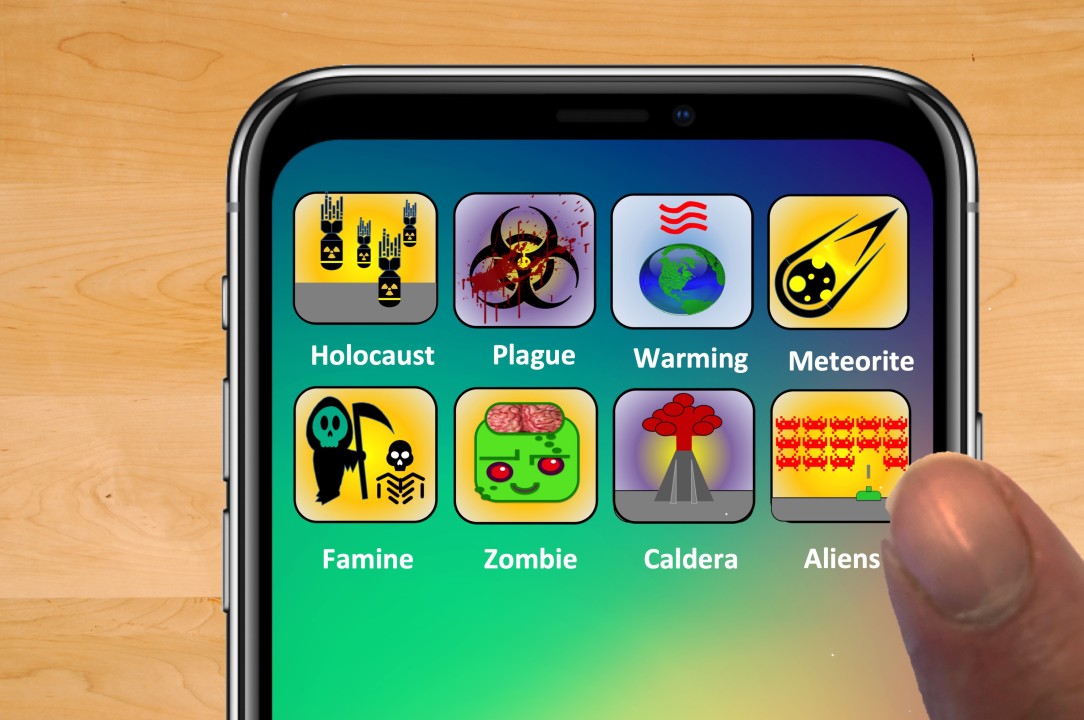
Every generation has its own favourite catastrophe. My childhood’s ‘soundtrack’ was the Cold War, when the possibility of nuclear annihilation was treated less as a distant geopolitical theory and more as an unfortunate administrative error waiting to happen. Today, younger generations have inherited a much broader menu of existential concerns: climate change, pandemics, artificial intelligence, ecological collapse and, occasionally, a suspiciously large asteroid heading our way.
The apocalypse has always been good for business. Hollywood knows this. Streaming services know this. Even the humble supermarket knows this when a rumour of disruption sends shoppers racing for pasta, bottled water and, for reasons nobody can fully explain, unusually large quantities of toilet paper.
Perhaps this fascination exists because disasters allow us to rehearse uncertainty. Humans are not particularly comfortable with events that cannot be predicted or controlled. Psychological research suggests that perceived lack of control increases anxiety, while having a realistic plan can improve coping and resilience during stressful situations [1]. Preparing for disaster is less about expecting civilisation to collapse and more about reassuring our ancient survival machinery that we have at least considered an exit strategy.
I once knew someone who took preparation very seriously. He kept several weeks of dried food, purchased small amounts of tradable precious metals and spent considerable time thinking about how society might function after a major breakdown of ‘normality.’ At first glance, this sounds eccentric. Yet, as an employee he was intelligent, rational and well informed. His concerns were not entirely unreasonable.
History provides plenty of examples of disasters that arrived with little warning. Earthquakes, hurricanes, industrial accidents and infectious disease outbreaks have repeatedly demonstrated that modern societies, despite extraordinary technological achievements, are vulnerable. The illusion that technology has made us invincible is one of humanity’s more persistent misconceptions.
Pandemics are particularly unsettling because they combine scientific uncertainty with social disruption. Infectious diseases follow biological rules, but their consequences are shaped by human behaviour, travel networks, public trust and government response. The emergence of a novel pathogen can create rapid global consequences because modern societies are highly interconnected [2].
This is why pandemic preparedness has always been part of public health planning. Influenza pandemics occurred throughout the twentieth century, including the devastating 1918 influenza pandemic, which caused millions of deaths worldwide [3]. Scientists have long warned that another severe pandemic was not a question of if, but when.
Of course, recognising risk is not the same as predicting disaster. Humans are remarkably poor at judging rare events. We tend to underestimate unlikely threats until they happen, then overestimate their likelihood afterwards. This phenomenon, known as the availability heuristic, means dramatic events receive disproportionate attention because they are easier to imagine [4].
A meteorite striking Earth makes an excellent movie. A gradual failure in supply chains, healthcare capacity or infrastructure does not. Unfortunately, the second scenario is far more representative of how real crises unfold.
I have watched enough disaster films to understand the basic rules. First, never investigate strange noises in abandoned buildings. Second, never trust anyone who says they have “a plan”. Third, apparently all survivors become expert fighters, engineers and wilderness specialists within 48 hours of the primary event.
Reality is considerably less cinematic.
Disasters rarely produce a single dramatic moment. Instead, they create cascading failures. Electricity affects communication. Communication affects coordination. Transport disruption affects food supply. Healthcare systems become strained. Social systems depend on thousands of small interactions occurring reliably every day.
Research into disaster resilience shows that communities generally cope better when they have strong social networks, reliable communication and shared expectations about how to respond [5]. The lone survivalist with a shed full of baked beans may have some advantages, but cooperation usually beats isolation.
This is an important lesson because preparedness is often portrayed as an individual activity. Buy supplies. Build shelters. Learn survival skills. However, genuine resilience depends heavily on collective capability.
The person who knows how to repair a water system, organise information or support vulnerable neighbours will be more valuable (and less of a target) than someone guarding a mountain of canned food.
Although I like to imagine myself as the hero of my own disaster movie, reality suggests otherwise. My survival equipment consists mainly of a questionable collection of odd batteries, a toolbox containing items I cannot identify and enough knowledge of fictional pandemics to win a pub quiz. My underground bunker remains theoretical.
The same principles apply to organisations. Businesses do not need zombies at the door to experience disruption. A cyberattack, infectious disease outbreak, transport failure or sudden loss of key personnel can create significant operational challenges.
Business continuity planning exists because disruption is inevitable. Effective organisations identify critical processes, understand dependencies and create practical recovery strategies before they are needed [6].
In regulated industries, especially healthcare and pharmaceuticals, preparedness is embedded into the culture because failure can have serious consequences. Risk management is not based on assuming disaster will happen tomorrow. It is based on accepting that uncertainty exists and building systems capable of adapting.
A surprisingly common weakness in organisations is not a lack of enthusiasm for planning, but a failure to document what happens during an emergency. Companies often have procedures for routine operations but insufficient guidance for what exactly to do when unusual circumstances arise. The question is not simply “What happens if something goes wrong?” It is “Who does what, when, and how will we know whether it worked?”
A disaster recovery plan is essentially a rehearsal for uncertainty.
There is a fine line between sensible preparation and becoming overwhelmed by catastrophic thinking. Constantly imagining disaster can increase stress and reduce wellbeing. However, thoughtful preparation can provide psychological benefits by increasing confidence and reducing helplessness [1].
The goal is not to live permanently in survival mode. Nobody wants to become the person who owns 12 years of emergency supplies but cannot remember where they put their house keys. A sensible approach is surprisingly ordinary. Maintain basic supplies. Understand local risks. Keep important documents accessible. Know how to communicate during disruption. Develop useful skills. Support your community.
Preparedness is not about expecting the end of the world. It is about accepting that unexpected events are part of life.
The irony is that preparing for disaster often leads us back to appreciating normality. The everyday systems we barely notice, clean water, functioning transport, reliable healthcare, food distribution and communication networks, are extraordinary achievements.
So yes, I still occasionally think about survival strategies. I still know which London Underground stations are deep enough to make me feel vaguely reassured during a fictional nuclear crisis. I still enjoy disaster films, despite knowing that most characters would benefit enormously from a basic emergency management course.
But I have also accepted something important.
The apocalypse probably will not arrive with dramatic music, special effects and a conveniently placed escape vehicle. It will arrive, if it arrives at all, through ordinary systems failing under extraordinary pressure.
The best preparation is therefore not fear.
It is knowledge, planning and a little humility.
And perhaps a few tins of baked beans, packets of dried rice and water filters.
References

Get our latest news and publications
Sign up to our news letterResources
Social


Contact us
Address
Niche Science & Technology
Unit 26 Falstaff House
Bardolph Road
Richmond TW9 2LH
United Kingdom