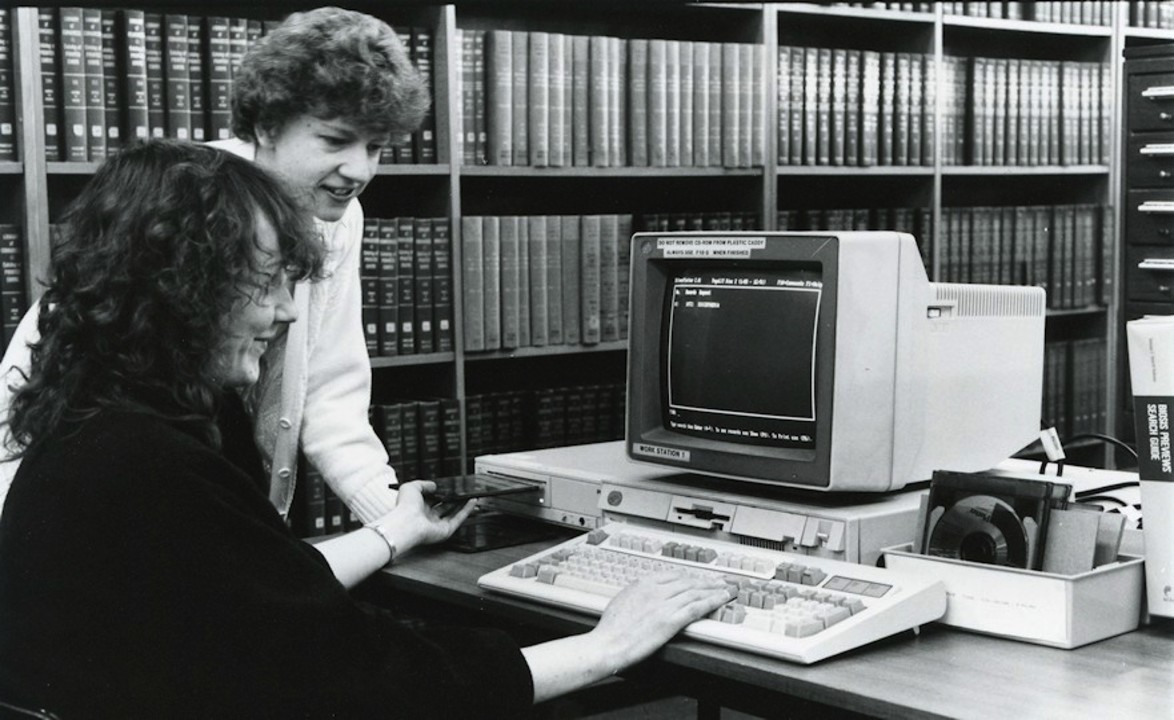
Having passed the halfway mark of my career in science I realise that the scientific community is deeply divided, and those sitting on my side of the fence are dying out. I refer to the difference between scientists who are digital natives and those who are digital immigrants. What does this mean and what can we learn from each other before it is too late?
Nowhere has this attrition had more bearing (perhaps) than in the way we perform our background research. Scientific projects require extensive contextual reading to obtain a thorough understanding of the field of study, enabling us to postulate theories, relate our findings to past observations and justify conclusions. Today, this task would be performed at the desk, and the pertinent papers downloaded instantly, in less time than it took me to write down this paragraph. In the pre-personal computer/internet era the way in which we sought this understanding was very different.
In the 1980s, research required a different set of skills. You would begin by identifying the appropriate key words used to catalogue references in Index Medicus. Index Medicus epitomises research in the 20th century; founded in 1879, it remained in continuous print publication until 2004 [1][2]. Ultimately, it evolved into the National Library of Medicine and all references may now be accessed electronically via PubMed (click here for a brief history of the Index Medicus). At my institution, a small London teaching hospital now long gone, Index Medicus was kept in the library. It was published as annual volumes, printed on paper that resembled hard (and rather ineffective) Izal toilet paper of the time. Our volumes dated back to 1910 and were kept deep in the bowels of an oak-shelf lined testament to a bygone age of luxurious learning (The Reading Room). To perform a literature search, you had to physically take each bound copy from the shelf, look up your key words, intuit from the article titles (recorded therein) whether they were pertinent to your topic and (if so) write down the details of the reference. You then repeated that task for the previous year...and the year before... and the year before... until you were satisfied you had searched far enough back into the literature.
Once you had created your list of candidate articles you needed to find and review them. Depending on your project, you might have a list of a dozen references to review or, in the case of kicking off something like a PhD, more than a hundred. With your references scribbled on a pad, you entered the library stacks of one of the various London academic libraries... multiple floors of bookshelves, usually dimly lit, with the unmistakable odour of old books. You would need to find the appropriate shelving unit, pull each bound journal, locate the article and scan it to see if it contained information of interest. If it passed muster, you might add it to a wheeled cart and proceed to the location of the next journal. Since the stacks were often on multiple floors, a geriatric elevator would normally be involved in the process. Attempting to save time, you might have a brief look at the bound volume while standing by the shelf. This was considered poor library etiquette and might be greeted with hard stares from other users and, in extreme cases, a disapproving tut. Returning to your desk to review your booty you might, at times, find that the bound copy of a particularly important article was missing, torn out of the journal by some academic miscreant. In these cases, you would need to speak with the librarian to request that a copy be mailed to you from another library. This process of document delivery, mediated by library staff, was the only way to access materials not held locally (in London).
With your overflowing cart in tow, you would take your pile of journal volumes (bound monthly periodicals each the size of a small encyclopaedia) to the photocopy room to make copies of your collected articles. This sometimes involved standing in a long queue, as others were also copying dozens of articles; in later years there was the added complication of completing copyright documentation. Once you had your copies it was considered good etiquette to return the various volumes to their place in the stacks – repeating your ‘stack zombie’ womble in reverse. The entire process would take several hours (at least). As libraries only held specific journals, you would repeat the process at various libraries across London. After several days, perhaps weeks, your search would be complete and you were finally ready to read, synthesise and write about your research.
Although computerised library systems began in the 60’s (MEDLARS), they were not widely accessible to the individual researcher [3]. Our current ability to search the entire medical literature, nearly instantaneously, from virtually any electronic device, is clearly a quantum leap from the old methods [4][5]. It is a leap that we take for granted (as highlighted in our recent Insider’s Insight – a brilliant free guide on searching the literature [6]). Was anything valuable lost in the transition? Can any lessons be learned from the old ways? Possibly:
- Planning: As outlined above, the old method of literature review was incredibly labour intensive and a good plan was essential. The complexity alone forced you to plan your literature review in advance detailing even the order in which you would visit certain shelves (mapping the most time efficient route as you would invariably run out of time, needing you to triage your searches). Occasionally, the medical librarian might be free to share their knowledge on the development of efficient, thorough and systematic search strategies. Modern searchers should still invest in developing their search methodology, the process they will follow to ensure the best outcomes. Although time efficiency is no longer such an issue, it is still essential to be systematic and thorough [7].
- Quality versus quantity: The modern search generates a tremendous volume of references. It is easy to use the first couple of key words that come to mind, cross reference them and generate what seems to be a plentiful supply of references. It is my opinion that the old search methods tended to produce a more thoughtfully assembled list (if only because you couldn't afford to photocopy everything). The old methods felt more like being a collector of stamps -- where the collector, over a long period of time, searches for and acquires a critical piece that helps to augment the collection. It is possible that modern searchers would benefit from treating their efforts more like the assembly of a treasured collection.
- Focus: The old search process was incredibly inefficient. There was a great deal of what might seem unproductive time, rifling through the Index Medicus and wandering through the stacks. However, it was also a peaceful experience. The information came slowly, in bits and pieces, allowing time to contemplate the value of each new candidate publication and how it fitted to your developing theories. There was time for your mind to wander, and to ruminate on what you just read. If ideas tend to come to you in the shower, you would likely have the same experience in the stacks. Modern searchers would be well served by actively working to create quiet, reflective time, free of distractions.
The last 30 years have seen the way we undertake our research change beyond all recognition. Stack wandering has been replaced by elegant Boolean search strategies performed on multiple data platforms and generating comprehensive candidate articles to review and rank for relevance and importance [7].
Younger researchers, born into these systems, now adopt a learn-as-they-go approach, adapting their searching strategy 'on the fly'. In the present age, with the reduction in the number of institutional libraries and explosion in the number of journals (to review) it would probably be impossible for today's students to undertake research as we did 30 years ago.
What we have lost in elegance has been replaced by efficiency. But for me there is one aspect of the research that would not be possible today. In my regular searches in the library at Westminster Hospital in the 1980s I worked with the medical librarian, Reinhard Wentz [8]. A most wonderful fellow, he not only instructed me on how to use Index Medicus (the paper version) but also how to construct and perform elegant literature searches: first by hand and later in the first computer systems. More importantly, he also introduced me to several other researchers in the wider community who he knew to be working in a similar field. Thanks to those introductions I formed several life-long collaborations, friendships and publishing partnerships that would otherwise not have happened.
References
- National Library of Medicine. MEDLINE History [Internet]. Bethesda (MD): National Library of Medicine
- Index Medicus. In: Encyclopaedia Britannica [Internet]. Chicago: Encyclopaedia Britannica, Inc.; 2016
- The Online Books Page. Index Medicus archives [Internet]. Philadelphia (PA): University of Pennsylvania; 2019
- Canese K. PubMed Celebrates its 10th Anniversary! NLM Tech Bull. 2006 Sep-Oct;(352):e5.
- Lindberg DAB. The National Library of Medicine and the Birth of PubMed. J Am Med Inform Assoc. 2005;12(2):108–110.
- Niche Science & technology Ltd. (2016). An Insider’s Insight into Literature Searches
- San Diego State University Library. Research by Subject: RWS 508W: Scientific Writing: Database searching (How-to) [Internet].
- Wentz R. Bravo, brave BMJ. BMJ. 2002;325(7357):223.