Several years ago I was working on an important project for a client. The holidays were imminent and the US team were eager to finish up. We agreed to blitz the job with a marathon conference call. By the end of a long meeting the client's UK offices were dark and the building was deserted. I took another hour writing up notes and annotating the report while I waited for the US team to send me a summary of their comments. It was past midnight when I finally mounted my motorbike to drive home.
My journey involved navigating Europe's most notorious and insanely busy motorway junction, Hanger Lane. I knew that if I entered the junction at the right speed I could achieve circumnavigation in one move. However, I got my timing wrong and I had to accelerate hard to get through the last of the traffic lights.
As I ‘accelerated’, the contents of my bag fell into the path of the oncoming traffic. The meeting of the two was like a confetti explosion at a gender reveal party. I spent 4 hours picking up laptop debris, report pages and pens from several different slip roads, extending as far as half a mile down each. My initial concern was that someone might find pages of the report that were clearly marked with the client's name and identified as 'confidential'. However, as time passed, I became more and more concerned that I would have to tell the client their efforts in the meeting had been wasted.
My laptop was destroyed, most pieces no larger than a box of cigarettes. My phone, used to record the meeting, was terminated. I only found 75 of the 120 pages of annotated report. Most were impossible to read; I was grateful however that it wasn't raining. The binder itself, sans pages, I had travelled about 300 metres down the A40 and was badly ‘chewed’ by the experience.
After a short sleep I set to preparing a new draft from the remnants of the old report. I used what I could remember and the few remaining annotated pages to address (what I could only hope was) all the points discussed during the meeting. Imagine my surprise when the client contacted me a week later to thank me for providing such a thorough and well-executed draft.
How did I manage that? I don't have the best memory and, after a long day at work, my otherwise addled brain was surviving on little more than adrenaline and instant coffee. Scientific observations may give us a clue.
During my undergraduate studies my limited memory was one reason I always took extensive notes; 25 years ago, there were few practical alternatives to recording lectures beyond pen and paper. Over the years I have incorporated new technologies into my work routine. However, they have mainly been used as a failsafe mechanism to confirm understanding and context.
Fast forward to the present, and many people now sit in meetings with laptops open, allegedly ‘taking notes.’ However, I find many to be unengaged. This is only my subjective opinion, but I am acutely aware how distracting it can be if your phone vibrates or buzzes during a meeting. Is it possible that email, instant messaging, the internet and the demands of 'other projects' divert their focus? Mindlessly typing certainly seems to reduce the contribution that people make to meetings, but might does it impact on their ability to retain information that is being discussed?
Research on digital distraction supports this concern. A 2018 study published in Computers in Human Behavior found that students who kept their cellphones during a lecture performed worse on quizzes for material presented 10–15 minutes into the session compared to those who had their phones removed. Notably, participants who were noticeably distracted by text messages performed worst of all, and those scoring higher on measures of nomophobia, the fear of being without one's phone, also showed impaired learning [1]. Clearly, the mere presence of digital devices, even when not actively used for multitasking, subtly erodes focus.
The relationship between notetaking and learning has been systematically studied for decades. Two primary theoretical frameworks have emerged to explain how note-taking aids memory. The encoding hypothesis proposes that the act of taking notes itself facilitates learning by requiring the note-taker to process, summarise, and reframe information. The external-storage hypothesis, by contrast, emphasises the value of having a complete record for later review [2]. Research from as early as the late 1970s demonstrated that notetaking serves both functions, with students adjusting their note-taking strategies based on anticipated test formats, those expecting an essay examination took notes on sentences of higher structural importance than those anticipating a multiple-choice test [2].
The most significant recent contribution to this field came in 2014, when psychologists Pam Mueller and Danny Oppenheimer published a landmark study in Psychological Science [3]. Their research addressed a crucial gap in the literature: prior studies had focused primarily on students' capacity for multitasking and distraction when using laptops. The authors asked a more fundamental question: what if laptops impair learning even when used solely for note-taking, with no multitasking at all?
Across three studies, it was clear that students who took notes on laptops performed worse on conceptual questions than students who took notes longhand. Analysis of the notes revealed why: laptop users tended to transcribe lectures verbatim, capturing more words but processing information more shallowly. Handwriters, constrained by the slower speed of pen and paper, were forced to listen, digest, and summarize information in their own words [3][4].
The researchers tested this effect under various conditions. Even when they explicitly instructed laptop users to avoid verbatim transcription, the tendency persisted. In a third study, students were tested a week after the lecture and allowed to review their notes beforehand. Once again, handwriters outperformed laptop users on conceptual questions. Interestingly, when students were not allowed to review their notes before the test, both groups performed equally poorly, underscoring that while encoding matters, review remains essential [4].
This pattern aligns with earlier work on depth of processing. Research from 1979 by Bretzing and Kulhavy, published in Contemporary Educational Psychology, had already demonstrated that notetaking involving summarisation and paraphrasing leads to deeper semantic encoding and better retention than verbatim recording [5]. Mueller and Oppenheimer's contribution was to show that the choice of writing instrument systematically biases learners toward either deep or shallow processing.
Beyond behavioural studies, emerging neuroscience research suggests that handwriting engages the brain differently than typing. A 2015 study examining text input on tablet computers investigated whether the motor-perceptual interactions involved in handwriting might influence memory formation. While the researchers found no significant difference in recognition and recall between handwriting and typing on a tablet, they noted that factors such as the characteristics of digital handwriting, user skill, and time spent on task could affect outcomes. They called for further research to understand how to maximise the cognitive benefits of digital devices [6].
Subsequent work has explored the neurocognitive foundations of the handwriting advantage. A 2016 study using the Wechsler Memory Scale to compare memory performance after handwriting and typing tasks investigated how different writing methods affect memory retrieval. The research considered factors of time and age in recollection, contributing to the growing evidence base on writing modality and memory [7].
The sensorimotor hypothesis suggests that the complex, fine motor movements required to form letters by hand create richer motor memories that support letter recognition and recall. This may be particularly important in educational contexts where students are developing foundational literacy skills.
The research has clear implications for professional and educational practice. If you want to get the best out of a meeting, you should adapt one of these three options:
Although it may seem a little Draconian, adopting a 'no laptops or cell phones' policy for meetings will improve retention for everyone [9]. Research on far transfer—the application of learning to new contexts, suggests that the manner of initial encoding affects the accessibility and applicability of knowledge in future situations [10]. Furthermore, you can spend the time at the start of the meeting talking with colleagues rather than worrying about Wi-Fi passwords, power sources and finding the perfect acoustics. Obviously, you are at risk of facilitating conversations, fostering mutual respect and regaining the value of group thinking.
One final benefit. Over the years I have built a library of past notebooks that serve as a ready source of ideas and a handy aide memoire when I want to check facts and figures from past projects.
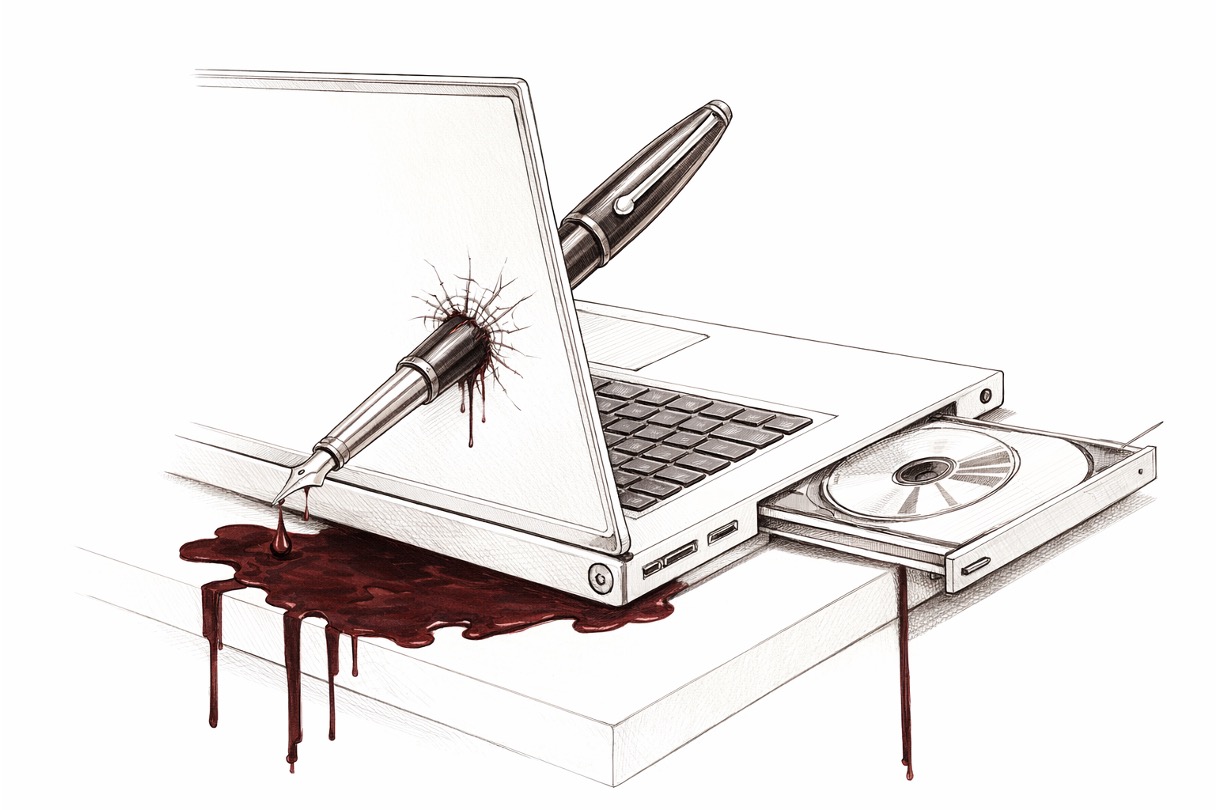
In conclusion, don't kid yourself. Science confirms that your efforts at multitasking are in vain (and science confirms this). You are simply doing more things less successfully, failing at two (or more) tasks rather than succeeding at one. More fundamentally, the way you take notes shapes how you think. The process of summarising and rephrasing information in your own words engages deeper cognitive processing than verbatim transcription [3]. Over the last five millennia we have established an intimate relationship with the written word, using it to capture our thoughts. It seems that technology has yet to unlock or exploit the intricacies of that relationship. In 1839, Edward Bulwer-Lytton coined the phrase "The pen is mightier than the sword," almost 150 years before the launch of the first portable computer. If he were around today he might have concluded that the pen (and paper) is still mightier than the word processor.
References

Get our latest news and publications
Sign up to our news letterResources
Social


Contact us
Address
Niche Science & Technology
Unit 26 Falstaff House
Bardolph Road
Richmond TW9 2LH
United Kingdom