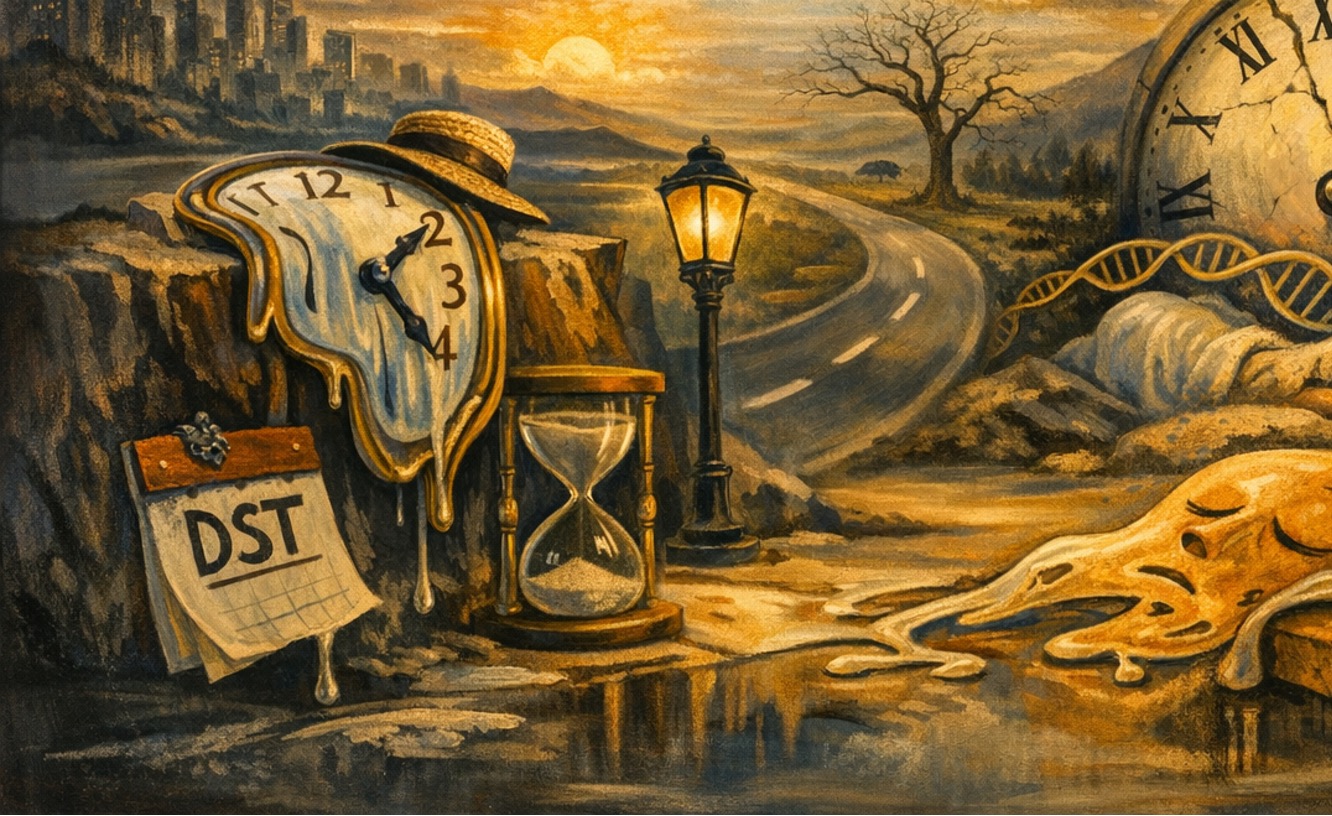
Twice a year, entire nations participate in a peculiar civic ritual: we collectively pretend that time itself is adjustable. This weekend we all ‘lose’ an hour. In October, we retrieve it, like a rabbit from a hat. Nothing astronomical changed. The Earth continued to spin, the sun didn’t blink. And yet, for many, the experience feels oddly seismic. Meetings wobble. Alarm clocks betray us. Somewhere in every kitchen, a microwave clock remains defiantly incorrect for the next 6 months.
Daylight Saving Time (DST) was born in an era of coal lamps and wartime austerity. In the early twentieth century it was promoted as a fuel-saving measure, designed to reduce artificial lighting demand during evening hours [1]. A century later, the energy argument is far less compelling. Modern analyses suggest that while DST can produce modest electricity savings in some contexts, the gains are small and often offset by increased heating or air-conditioning demands [2][3]. In other words, we may save on lightbulbs only to spend it on boilers and coffee machines.
If the energy case for DST ambiguous, the biological case against it is not. The question is no longer whether DST is administratively convenient, but whether it is physiologically coherent.
Human circadian rhythms are governed by the suprachiasmatic nucleus (SCN), a small cluster of neurons in the hypothalamus that functions as the brain’s master clock [4]. The SCN synchronises internal physiology to the external light–dark cycle. Light is not merely helpful; it is the primary zeitgeber, the environmental time-giver that anchors the system each day [5].
As daylight fades, melatonin secretion rises under dim light conditions, signalling biological night [6]. Core body temperature follows a predictable rhythm, peaking in the evening before declining toward its nocturnal minimum near maximal melatonin levels [4]. Meanwhile, cortisol begins its pre-awakening ascent hours before we open our eyes, preparing metabolism and cognition for the day ahead [7].
This orchestration is precise, but it is not a perfect 24 hours. The intrinsic human circadian period averages slightly longer than 24 hours, requiring daily adjustment through morning light exposure [8]. When social schedules shift abruptly, particularly when they shift earlier, we create a misalignment between internal and external time known as social jetlag [9]. Unlike the airport variety, there is no complimentary snack and a drink.
The March transition into DST produces acute sleep loss. Population-level data suggest that on the first weekday after the spring shift, individuals lose approximately 40 to 60 minutes of sleep on average [10]. Because REM sleep is concentrated in the latter part of the night, advancing the clock truncates this stage disproportionately, with implications for emotional regulation [11].
The downstream effects are measurable, though modest in absolute terms. Several large epidemiological studies report an increase in acute myocardial infarction incidence in the days immediately following the spring transition [12][13][14]. Similar short-term increases have been observed for ischaemic stroke [15] and atrial fibrillation presentations [16]. These studies are observational, and the absolute risk increase for any given individual is small. But at population scale, small percentage shifts translate into real clinical consequences. Coronary arteries, it seems, do not observe British Summer Time.
Public safety data tell a similar story. Fatal motor vehicle collisions spike in the days following the spring transition, consistent with the known cognitive effects of acute sleep deprivation [17]. Workplace injuries also rise immediately after the shift [18]. Again, the signal is not apocalyptic; it is statistical. But public policy decisions are generally made in aggregates.
Mental health outcomes show similar patterns. Analyses in several countries have reported short-term increases in suicide rates following the spring transition [19]. REM sleep disruption and circadian misalignment are mechanistically linked to mood dysregulation [11], offering biological plausibility without overstating causation.
The burden is not evenly distributed. Adolescents and individuals with late chronotypes are especially vulnerable. Adolescence is marked by a natural delay in circadian phase; forcing earlier wake times compounds chronic sleep restriction [20]. Social jetlag in young people correlates with depressive symptoms and adverse metabolic profiles [9][ 21]. In this group, DST functions less as a seasonal adjustment and more as an annual stress test.
It is important to distinguish transient adjustment from chronic misalignment. The spring transition produces an acute disconnect. Permanent DST would impose a sustained one.
Chronic circadian misalignment is associated with impaired insulin sensitivity, higher body mass index, and features of metabolic syndrome [21][22][23]. Experimental studies demonstrate that circadian disruption alters leptin, ghrelin, and glucose regulation, even under controlled caloric intake [23]. Immune signalling is similarly rhythmic; disruption of clock genes exacerbates inflammatory pathways implicated in gastrointestinal and autoimmune disorders [24]. Neurodegenerative processes, including Alzheimer’s disease, are increasingly understood through a circadian lens [25]. Cluster headache patterns, too, exhibit striking chronobiological regularity [26].
The language here warrants care: DST does not ‘cause these diseases in isolation. But chronic misalignment is associated with physiological states that elevate risk. Over time, small perturbations accumulate. Population health rarely collapses dramatically; it erodes.
Solar time varies across a time zone. Western regions experience later sunrise and sunsets than eastern counterparts. Amazingly, studies indicate that individuals living on the western edge of time zones sleep less on average and show higher rates of obesity and metabolic dysfunction [27]. The further one drifts from solar noon alignment, the greater the social jetlag.
In the UK, where geography trends northwest, this effect builds. Under permanent DST, winter sunrise in Glasgow would approach 10:00 am. That is not ‘lighter evenings’; it is a seasonal night shift. Morning light is the critical anchor for circadian alignment [5]. Delaying it delays biology.
This is not merely a chronobiology debate; it is a public health equity issue. Northern and western populations would shoulder a disproportionate burden from a policy framed primarily around southern evening leisure.
Professional bodies including the British Sleep Society [28] and the American Academy of Sleep Medicine [29] now advocate for permanent Standard Time. Their position is biologically straightforward: align the clock with the sun.
The UK British Summer Time Act 1972 and the US Uniform Time Act structure the current system. A 2008 report from the US Department of Energy estimated approximately 1.3 billion kilowatt-hours of electricity savings from extended DST [3]. Even if accepted at face value, that figure must now be weighed against contemporary epidemiological evidence. Energy efficiency has evolved. So has our understanding of circadian biology.
Until policy catches up with physiology, mitigation remains the most pragmatic approach. Morning light exposure remains the most powerful intervention for advancing circadian phase [5]. Evening light restriction protects melatonin onset [6]. Caffeine consumed within 8 to 10 hours of bedtime measurably disrupts sleep architecture [30]. Gradual 15-minute adjustments before the spring transition can soften the acute shift [10]. Morning exercise may further assist phase advancement and alertness [31].
These measures reduce harm. They do not abolish it.
DST was conceived in an industrial age to solve an industrial problem. In the 21st century, its benefits appear marginal and context-dependent, while its physiological costs, though modest in isolation, are repeatedly observable at scale.
The scientific case does not rest on the drama of misfortune. It rests on convergence: cardiovascular events, collision data, sleep loss metrics, metabolic research, and chronobiological consensus, all pointing in the same direction. Permanent Standard Time best aligns social schedules with human biology.
Our circadian system is exquisitely sensitive to photons. It is remarkably indifferent to parliamentary debate. The SCN does not subscribe to Hansard.
Twice-yearly clock changes may feel trivial. Statistically, they are not. And while society may continue its temporal acrobatics for now, the evidence suggests that the sun remains the only timekeeper our biology reliably obeys.
References

Get our latest news and publications
Sign up to our news letterResources
Social


Contact us
Address
Niche Science & Technology
Unit 26 Falstaff House
Bardolph Road
Richmond TW9 2LH
United Kingdom