Defining the Healthy Phase I Study Participant

In early-phase drug development, selecting the right participant is one of the most critical and most complex decisions a research team will make. "Healthy" is not a simple checkbox.

Learn how to:

Define eligibility criteria for your specific IMP
Interpret borderline lab values and ECG findings
Monitor participants against their own baseline
Apply stopping rules and dose escalation principles
Navigate the shift toward "healthy diseased" participants
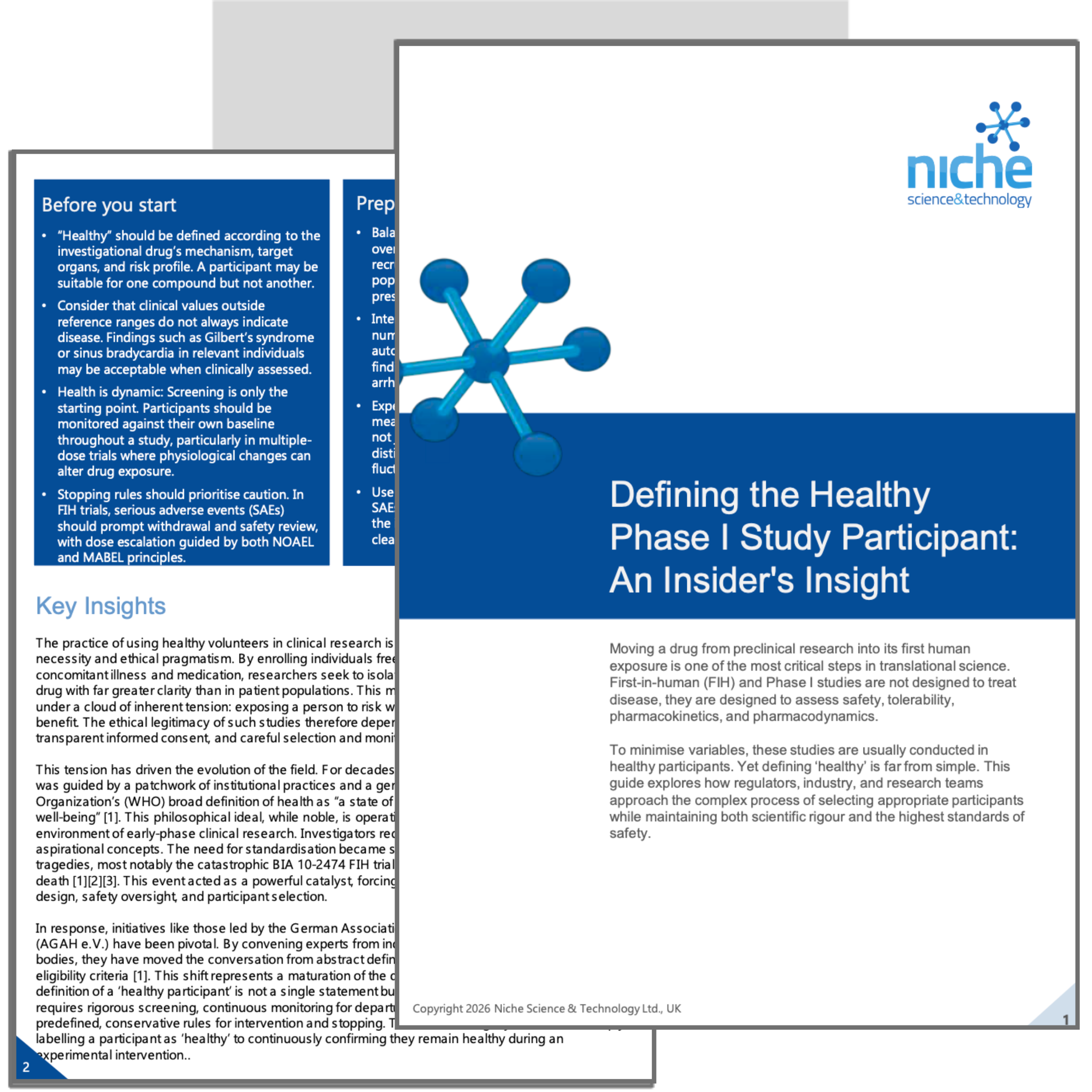
Guide cover and sample pages showing Defining the Healthy Phase I Study Participant: An Insider's Insight with blue sections containing bullet points about participant selection criteria.
Join the other 20,000+ pharma colleagues who have downloaded our Insider’s Insights.

Get Your Insider's Insight

* indicates required

Frequently Asked Questions about the Insider’s Insight: Healthy Subjects

To help you get the most out of our resource library, we have compiled answers to the most common questions regarding the development, application, and distribution of our specialist guides.

At Niche Science & Technology, we believe that sharing expertise is the first step toward industry-wide excellence.
In Phase I research, healthy is not a fixed definition—it depends on the investigational drug’s mechanism, target organs, and risk profile. A volunteer may be suitable for one compound but not for another. Clinical assessment takes precedence over numerical cut‑offs, and some findings (e.g., sinus bradycardia in athletes or Gilbert’s syndrome) may still be compatible with trial inclusion.
Healthy volunteers help minimise confounding factors such as concomitant illness or interacting medications, allowing researchers to assess safety, tolerability, pharmacokinetics, and pharmacodynamics with greater clarity. However, exposing healthy people to risk requires stringent safety oversight, conservative stopping rules, and continuous monitoring.
Screening is multi‑layered and includes detailed medical history, physical exam, lab tests (haematology, chemistry, urinalysis), ECG, and vital signs. Importantly, clinicians must distinguish between clinically meaningful findings and benign variation—for example, mildly elevated ALT due to recent exercise versus pathological liver injury.
A participant’s health status is dynamic. Even placebo recipients can show changes (e.g., transient liver enzyme elevations or benign arrhythmias) due to confinement or study conditions. Therefore, participants are monitored against their own baseline, not just population norms. This approach improves detection of clinically meaningful changes and supports safer dose escalation decisions.
Yes—if supported by adequate nonclinical reproductive safety data. Their inclusion requires stringent risk‑mitigation measures, including sensitive pregnancy testing and use of highly effective contraception (<1% failure rate). Additional precautions are required when drugs may reduce hormonal contraceptive effectiveness (e.g., via enzyme induction).

Get our latest news and publications

Sign up to our news letter

© 2025 Niche.org.uk     All rights reserved

HomePrivacy policy Corporate Social Responsibility
chevron-down