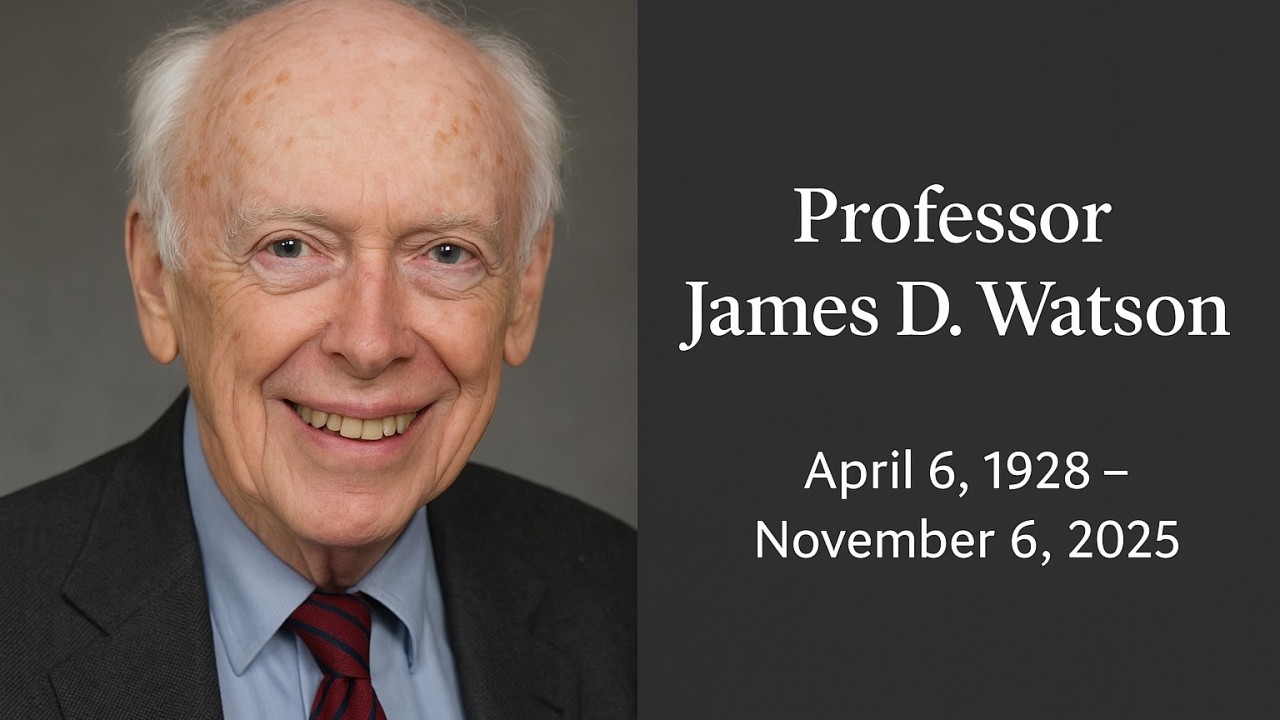
Professor James Dewey Watson (6 April 1928 – 6 November 2025), one of the forthright science figures of twentieth-century biology, has died at the age of 97. His life was one of both extraordinary scientific recognition and deeply troubling controversy, leaving behind a legacy that is at once celebrated, challenged and complex.
At the age of 24, while working at the Cavendish Laboratory in Cambridge, James Watson (with Francis Crick) helped to jigsaw-piece the structure of deoxyribonucleic acid (DNA) together — recognising the ‘fit’ provided by the iconic double helix. Their 1953 model transformed the understanding of hereditary information, replication and the molecular basis of life itself. Watson, Crick and Maurice Wilkins were awarded the 1962 Nobel Prize in Physiology or Medicine for their discovery, which opened the door to genome mapping, gene therapy, forensic science and modern molecular medicine.
From Genealogy to Genome
Watson’s intellectual curiosity extended beyond pure molecular biology. Inspired by a childhood affinity for birds, nature and pattern-seeking, he earned his doctorate in zoology at Indiana University, then joined the scientific elite with appointments at Harvard and Cold Spring Harbor Laboratory. His interests ranged from the genetic basis of disease (motivated in part by his son’s schizophrenia) to the early days of the Human Genome Project, for which he provided leadership and advocacy. He saw DNA not only as a blueprint of life but as a tool for genealogy, crime fighting and the tracing of human identity.
The Science Landscape in the 1950s–60s
Watson’s formative years in science were intimately shaped by a male-dominated research culture, in which young male scientists were lauded for their boldness, aggression and self-proclaimed ‘eureka’ moments. The era’s academic environment rewarded rapid breakthroughs, intuitive model-building and confident authorship. Women and minoritized scientists were often excluded from the centre of acclaim. The case of Rosalind Franklin stands at the centre of this imbalance: her X-ray crystallography image (Photograph 51) was essential to the defining of DNA’s structure, yet she died in 1958 and was not included in the Nobel recognition.
This male-oriented scientific culture prized bold opinionated characters over collaborative nuance, and Watson’s memoir, The Double Helix, reflected the wry, competitive voice of the time. It also revealed the systemic prioritisation of male voices, the under-recognition of women’s contributions, and the influence of social privilege on scientific credit.
Scientific Leadership and Service
Throughout the 1960s and 70s, Watson assumed leadership roles that expanded his influence beyond the bench. He served on the faculty at Harvard, directed Cold Spring Harbor Laboratory from 1968 onward, and helped mobilise government and private investment into the genome era. His ability to insinuate molecular biology into broader applications — for medicine, agriculture and forensics — proved practical. His work in crime-scene DNA analysis and ancestry mapping introduced new thinking that extended the boundaries of how science could be applied in society.
The Shadow of Controversy
Despite—or perhaps because of—his achievements and outspoken self-opinion, Watson’s later life was increasingly marked by controversy. Over decades he made repeated public statements attributing differences in IQ to race or sex, and espousing views that were widely condemned as racist, sexist and unscientific. In 2007 he asserted that Black people were “less intelligent than white people,” triggering international uproar; Cold Spring Harbor severed major ties and revoked honorary titles.
His portrayal of Rosalind Franklin in The Double Helix and his public fondness for a university environment “without too many women” reinforced the perception of a scientific milieu permeated by gender bias. These remarks and attitudes cast a long shadow over an otherwise prominent career — reminding us that one or two moments of scientific insight does not immunise one from the responsibility of ethical, inclusive conduct.
Legacy: A Mixed Inheritance
James Watson leaves a legacy both significant and deeply conflicted. On one hand, he helped inaugurate the molecular biology revolution — DNA’s structure remains a foundational pillar of modern biomedical science. His observations (a word I chose over ‘work’ which I believe was performed by someone else) has since underpinned diagnostics, therapeutics and the biotechnology revolution.
The scientific community must reckon with the cultural milieu Watson embodied: one in which credit was too often consolidated among a small cadre of men, and where collaborative, inclusive science took a lesser role. The marginalisation of Franklin and others exemplifies the so-called “Matilda Effect” — women’s contributions being overlooked or attributed to male colleagues.
As medicine continues to evolve, Watson’s story offers a cautionary tale rather than inspiration. It reminds us that the search for knowledge is not only about discovery but also about responsibility: to evidence, to colleagues, and to society at large. Isaac Newton’s famous line, “If I have seen further, it is by standing on the shoulders of giants,” is often quoted as a model of scientific humility. But in context, it’s not so straightforward — and perhaps even deeply ironic, reflecting something we need to keep looking to address in science. Newton’s line is true, all out advances are built on the contributions of others.
Final Thoughts
It could be argued that Professor James Dewey Watson changed the world. He opened the door to genetics in a way that allowed us to rewrite our understanding of life’s code and broadened the reach of molecular science into human health, ancestry and identity. Yet his story also underscores the importance of recognition, humility and equity in scientific endeavour. In remembering him, we honour the discovery of DNA’s elegant helix, acknowledge the credit due to all contributors, and reaffirm our commitment to a science that is both brilliant and responsible.