Crafting Catchy Titles That Capture Attention

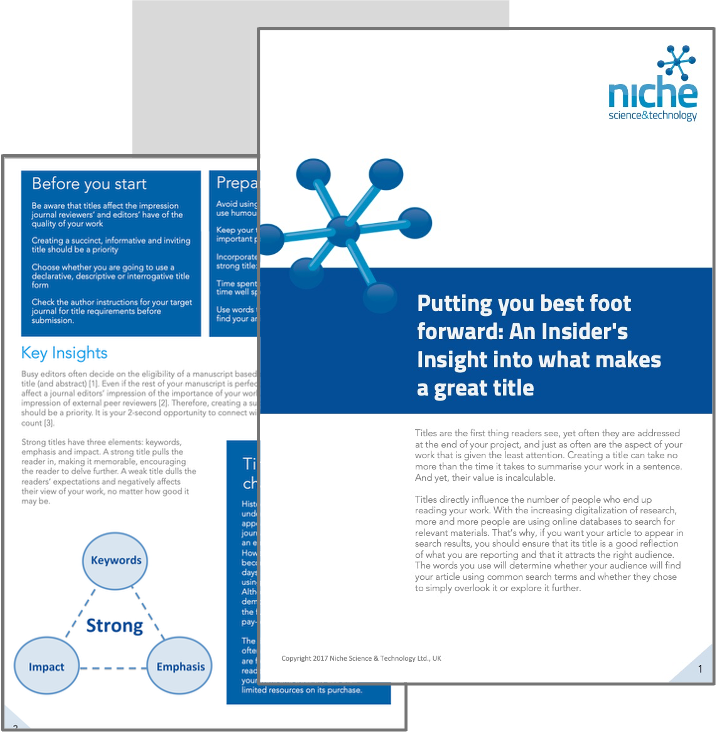
Titles are the first thing readers see, yet often they are addressed at the end of your project, and just as often are the aspect of your work that is given the least attention. Creating a title can take no more than the time it takes to summarise your work in a sentence. And yet, their value is incalculable.

Learn about:

Planning to maximise success
Fostering findability
Summarising concisely
Exploiting key words
Making an impression
Join the other 20,000+ pharma colleagues who have downloaded our Insider’s Insights.

Get your Insider's Insight

* indicates required

Frequently Asked Questions about the Insider’s Insight: Titles

To help you get the most out of our resource library, we have compiled answers to the most common questions regarding the development, application, and distribution of our specialist guides.

At Niche Science & Technology, we believe that sharing expertise is the first step toward industry-wide excellence.
A title forms the first impression for editors, reviewers, and readers. It influences whether someone chooses to read further and affects discoverability in online databases. Since titles and abstracts are often the only freely accessible parts of an article, a strong title is essential for attracting attention and increasing readership
Scientific titles typically fall into three categories:
- Declarative – state the main findings
- Descriptive – present the subject without revealing results
- Interrogative – pose the research question

Each has advantages, but declarative titles are common in biomedical fields, while interrogative titles may attract clicks but fewer citations
Although recommendations vary, effective titles are usually: 12–16 words or short enough to fit comfortably on digital/mobile displays. Shorter titles are often cited more frequently, but titles that are too short may lack clarity. The goal is to balance clarity, conciseness, and informativeness
A strong scientific title should be:
- Clear – unambiguous wording and structure
- Concise – no filler terms like "a study of"
- Informative – include essential study details

We recommend the SPICED framework: Setting, Population, Intervention, Condition, Endpoint, Design. These elements help ensure accurate discovery and indexing
Generally, no. Humour can be culturally specific, hard for non‑native speakers, and may reduce citation impact. Abbreviations should be avoided unless they are well‑known standards like DNA or RNA. Nonstandard abbreviations can confuse readers and harm indexing accuracy. Use these elements only when appropriate and permitted by the target journal

Get our latest news and publications

Sign up to our news letter

© 2025 Niche.org.uk     All rights reserved

HomePrivacy policy Corporate Social Responsibility
chevron-down