Navigating The Pitfalls Of Plagiarism

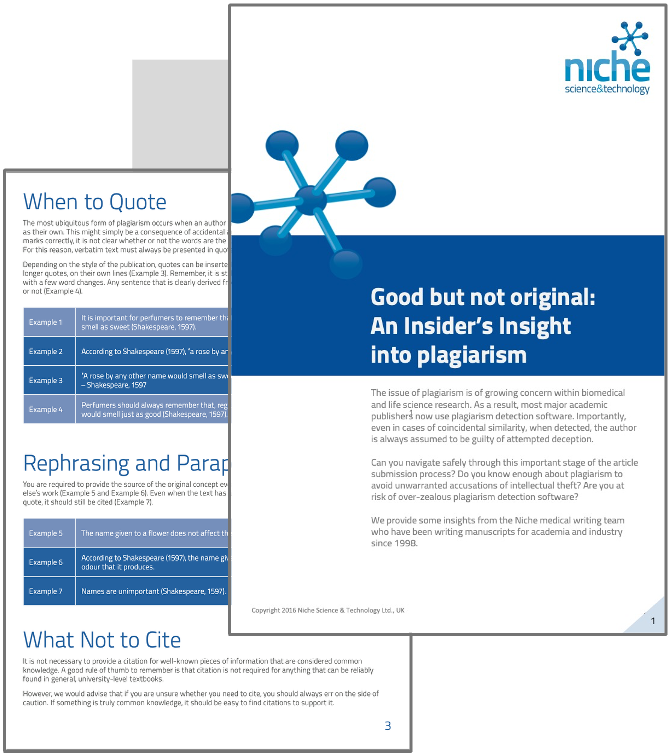
The issue of plagiarism is of growing concern within biomedical and life science research. Most major academic publishers now use plagiarism detection software and even in cases of coincidental similarity, the author is always assumed to be guilty.

To navigate plagiarism safely:

Understand plagiarism policies
Cite, cite, cite
Be aware of copyright status
Organise source documents
Track usage
Join the other 20,000+ pharma colleagues who have downloaded our Insider’s Insights.

Get your Insider's Insight

* indicates required

Frequently Asked Questions about the Insider’s Insight: Plagiarism

To help you get the most out of our resource library, we have compiled answers to the most common questions regarding the development, application, and distribution of our specialist guides.

At Niche Science & Technology, we believe that sharing expertise is the first step toward industry-wide excellence.
Plagiarism is one of the leading causes of article retractions, accounting for nearly one in four retractions in these fields. Journals rely heavily on plagiarism‑detection software, and even coincidental similarities can lead to serious allegations, reputational damage, and paper withdrawal
As an author, you must guard against:
- Direct copying without quotation marks
- Improper paraphrasing, even when only a few words differ
- Incorrect or missing citations
- Self‑plagiarism, including duplicate publications and “salami slicing” of your own prior work
- Even reusing one’s own figures, tables, or standard methods requires permission or careful rewriting
Keep well‑organised source materials, read all cited articles themselves, avoid relying on just a few reviews, and use quotation marks for verbatim text. Understand what constitutes common knowledge and when citation is still required. Developing your own writing style helps reduce risks of similarity to others
Tools like iThenticate compare manuscripts against billions of web pages, books, and articles. While sophisticated, they can still generate false positives, particularly when an author’s work coincidentally mirrors existing text or includes standard methods. Even replacing every seventh word can evade detection, while replacing every fifth word may still be flagged
All listed authors share responsibility. According to publication guidelines, each author must be confident in the integrity of their co‑authors’ contributions. Failure to report known issues can lead to “plagiarism by association,” resulting in institutional censure and potential career consequences for all involved

Get our latest news and publications

Sign up to our news letter

© 2025 Niche.org.uk     All rights reserved

HomePrivacy policy Corporate Social Responsibility
chevron-down