Abstracts: Beyond A Simple Summary

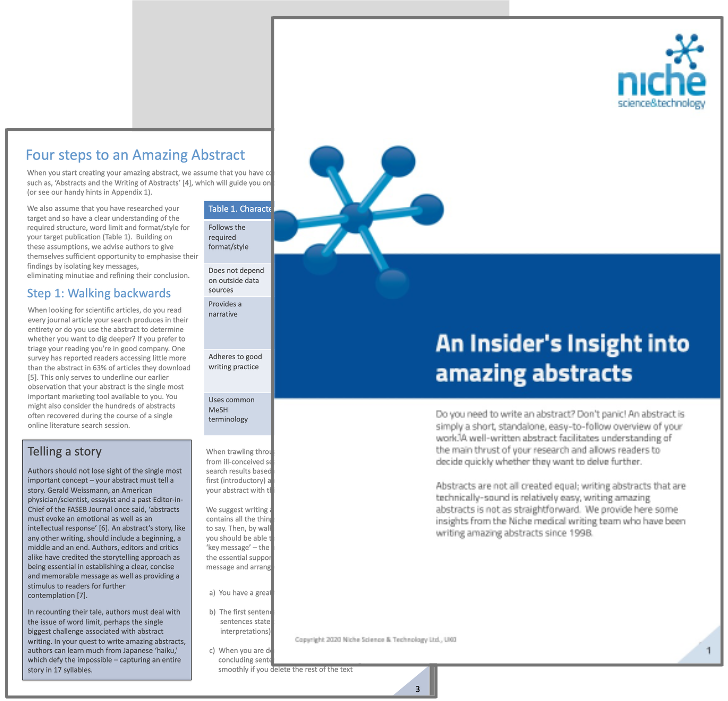
Do you need to write an abstract? Don’t panic! An abstract is simply a short, standalone, easy-to-follow overview of your work. A well-written abstract facilitates understanding of the main thrust of your research and allows readers to decide quickly whether they want to delve further.

Learn how to:

Make every word count
Keep it simple
Tell a story
Write for posterity
Adopt optimal writing strategies
Join the other 20,000+ pharma colleagues who have downloaded our Insider’s Insights.

Get your Insider's Insight

* indicates required

Frequently Asked Questions about the Insider’s Insight: Amazing Abstracts

To help you get the most out of our resource library, we have compiled answers to the most common questions regarding the development, application, and distribution of our specialist guides.

At Niche Science & Technology, we believe that sharing expertise is the first step toward industry-wide excellence.
The abstract is often the only part of a paper that most readers ever see, and one survey reported that readers access little more than the abstract in 63% of downloaded articles. It is therefore your single most important “marketing tool” for your research.
A well-written abstract should contain an aim or objective, brief methodology, key results or data, and a clear conclusion that answers the hypothesis. It must stand alone without relying on outside sources, tables, or references not included in the abstract itself.
The best abstracts “tell a story” with a beginning, middle, and end, evoking both intellectual and emotional engagement. Storytelling can help create a memorable, high impact message even within the strict word limits of an abstract.
There are four major steps:
- Walk backwards – draft freely, then refine key messages;
- Hit the target – tailor the abstract to its intended audience;
- Ockham’s razor – cut ruthlessly, removing anything non-essential;
- Diamond in the rough – polish repeatedly and apply the ABC rule (Articulate, Brief, Careful).
Yes. Abstracts for scientific journals differ from those for posters, grants, PhD applications, lay audiences, and public summaries. Each must be tailored to audience expectations, level of expertise, and format requirements, or risk missing its mark entirely.

Get our latest news and publications

Sign up to our news letter

© 2025 Niche.org.uk     All rights reserved

HomePrivacy policy Corporate Social Responsibility
chevron-down