Text recycling has become an increasingly important issue with regards to research integrity and scholarly publishing. The expansion of digital publishing, automated similarity detection systems, open access dissemination and increasing pressure on researchers to produce high numbers of publications have intensified scrutiny of how authors reuse their previous written material. Although the practice has existed for decades, the terminology, ethical expectations and editorial responses surrounding text recycling are evolving.
Historically, the reuse of an author’s own text was frequently described as self-plagiarism [1]. However, this terminology has been criticised because it conflates fundamentally different behaviours. Plagiarism traditionally involves the appropriation of another person’s intellectual contribution without appropriate acknowledgement, whereas text recycling involves the reuse of material created by the same author. The ethical concern is therefore not ownership of the words but whether readers are misled regarding originality, novelty and contribution [2][3].
The current consensus is that text recycling is not inherently unethical. Instead, it exists on a spectrum ranging from acceptable scholarly continuity to inappropriate duplication. The determining factors include the purpose of reuse, the amount and location of reused material, transparency, disciplinary expectations and compliance with copyright requirements [2][4].
The Text Recycling Research Project has provided one of the most influential definitions of the practice. Text recycling occurs when previously written material is reused in a new document where the content is identical or substantially equivalent to the original, is not presented as a quotation, and at least one author contributed to both documents [2]. This definition includes prose, figures, tables and technical expressions.
The importance of this definition lies in recognising that scientific progress is often cumulative. Researchers frequently conduct sequential studies within the same programme of work, requiring them to describe established theories, methodologies or analytical approaches repeatedly. Completely eliminating textual overlap would certainly introduce the potential for reduced clarity and consistency rather than improve scientific communication [1].
However, transparency remains central. Readers expect a published article to represent a distinct scholarly contribution. When substantial previously published material is presented without disclosure, the scientific record can become distorted because the apparent amount of new knowledge is exaggerated [4][5].
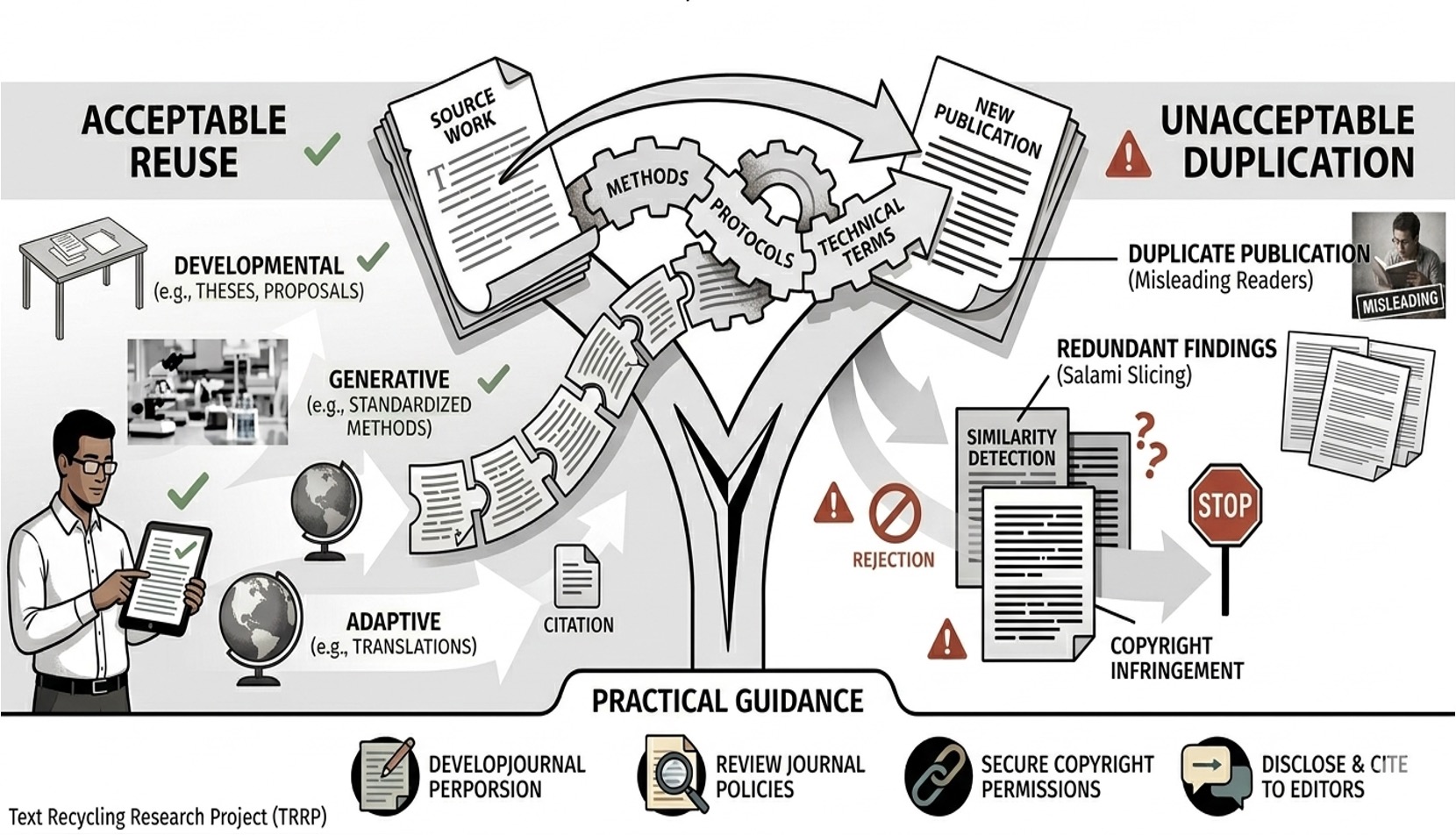
Text recycling is best understood as a contextual practice rather than a binary ethical violation. Several forms of reuse are generally considered acceptable when undertaken transparently.
Developmental recycling refers to the reuse of material from unpublished sources such as research proposals, conference presentations, laboratory notes or thesis documents. This is usually acceptable because the material has not yet entered the formal scholarly record, although authors must consider contractual restrictions or institutional requirements [2].
Generative recycling often occurs in scientific and technical writing when authors reuse descriptions of established methods, analytical procedures or background concepts. In many disciplines, particularly the laboratory sciences, repeated methodological descriptions improve reproducibility and reduce unnecessary variation. Nevertheless, authors most acknowledge previous publications when substantial wording is reused [2][6].
Adaptive recycling involves transforming previous work for a different purpose or audience, such as translating an article, preparing a policy document or developing educational material. This can support knowledge transfer, but appropriate citation is necessary (as may be permission from copyright holders) [2].
Several forms of reuse are generally considered unacceptable. Duplicate publication occurs when substantially the same work is published more than once without adequate disclosure. This practice creates the false impression of independent evidence and can bias literature reviews, systematic reviews and meta-analyses [4][5].
Redundant publication involves presenting overlapping findings across multiple publications without clear justification. Similarly, salami slicing refers to dividing a single research project into multiple minimally differentiated publications to increase publication numbers rather than scientific value [7]. Such practices can fragment knowledge and place unnecessary burdens on peer review systems [4][7].
The ethical acceptability of text recycling depends strongly on where reuse occurs within a manuscript.
The introduction and background sections of your texts may contain limited overlap because researchers working in the same area often describe established concepts repeatedly. Nevertheless, you should avoid reproducing large sections of previous introductions (which will not be popular with editors) without explanation and should ensure that the current manuscript provides a distinct intellectual contribution.
The methods section represents the area where text recycling is perhaps most frequent and can be justified. Standardised descriptions of experimental protocols, statistical approaches or technical procedures may require consistency across studies. Reusing such descriptions can support reproducibility, provided the relationship with previous work is transparent[2][6].
In contrast, the results section of a manuscript requires much greater caution. Results represent the unique findings of a particular investigation, and recycling previously published findings or presenting old analyses as new constitutes a serious breach of publication ethics [3].
The discussion and conclusion sections also require careful judgement as they involve the interpretation of findings and are often used to establish scientific meaning. Some conceptual continuity is expected across a research programme, but authors must clearly distinguish established knowledge from new interpretation. Reusing conclusions from previous publications risks overstating novelty and you may pay the ultimate price, rejection.
Finally figures, tables and datasets require particular attention because they represent scientific outputs rather than merely written descriptions. Reusing previously published visual material may require explicit permission, acknowledgement or licensing agreements depending on copyright ownership [4].
The growth of open science has increased expectations that authors clearly document relationships between publications, datasets and research outputs. Linking related articles through transparent citation practices helps readers understand the development and direction of a research programme rather than interpreting multiple papers as independent discoveries.
Artificial intelligence assisted writing technologies introduce another emerging consideration. Automated tools may reproduce or transform existing text, creating challenges around provenance and accountability. Authors remain responsible for ensuring that submitted manuscripts accurately cite original contributions, disclose relevant reuse and comply with journal requirements regarding artificial intelligence assistance.
Another important consideration is international variation in academic writing practices. Researchers from different linguistic and educational backgrounds may have different expectations regarding acceptable reuse, particularly when writing in a second language. Clear institutional training and publisher guidance are therefore preferable to punitive approaches based solely on similarity scores [6].
Similarity detection software will often identify textual overlap, though it is currently challenged when it comes to determining whether reuse is ethical or unethical. Human judgement remains essential because identical wording may represent either legitimate methodological repetition or inappropriate duplication depending on context. The advice is always keep a record of your sources and why you have used them.
Researchers can minimise ethical problems by considering text recycling during manuscript planning rather when your manuscript is ready for submission. Maintaining a library of previous publications, datasets and reused material allows authors to identify and address potential overlap early.
When reuse is necessary, authors should cite the original publication, explain the relationship between studies and disclose relevant information to editors. Manuscript preparation should focus on developing a clear new narrative rather than simply transferring sections from previous work. You may want to explain you use in your letter to the editor on submission.
Authors should also review journal policies before submission because expectations differ between publishers and disciplines. Where copyright for earlier work has transferred to a publisher, permission is often required even when authors reuse their own words or figures.
Text recycling represents an important but complex aspect of contemporary academic publishing. It should not be viewed simply as misconduct nor as an unrestricted right of authors to reuse their previous work. Ethical acceptability depends on transparency, proportionality, context and respect for the reader’s expectation that published research represents a genuine contribution.
Appropriate reuse can improve scientific communication by maintaining methodological consistency, supporting knowledge translation and reducing unnecessary repetition. Conversely, undisclosed or excessive reuse can compromise trust in the scholarly record. The future of responsible publishing depends not on eliminating text recycling but on establishing clearer norms, improving education and promoting a culture of openness and accountability.
References

Get our latest news and publications
Sign up to our news letterResources
Social


Contact us
Address
Niche Science & Technology
Unit 26 Falstaff House
Bardolph Road
Richmond TW9 2LH
United Kingdom