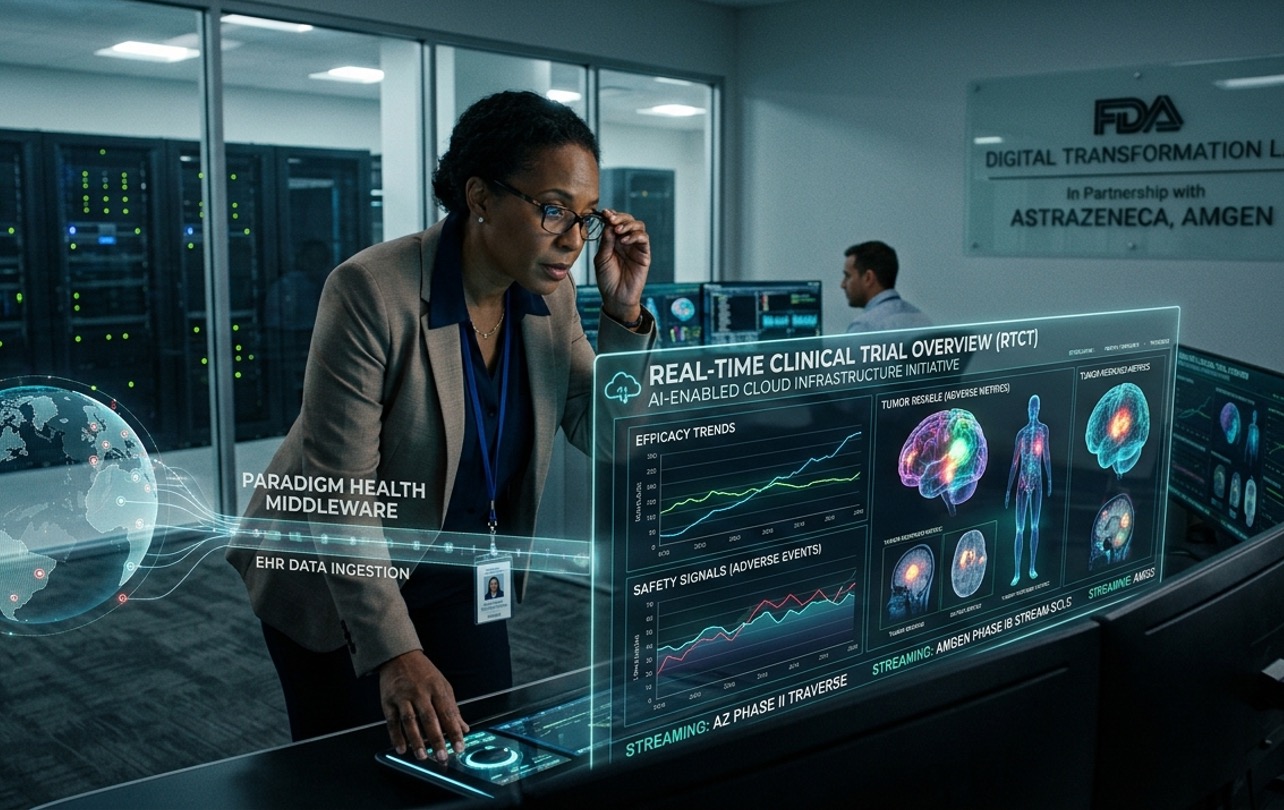
The US Food and Drug Administration is piloting a new regulatory framework that would allow agency scientists to monitor clinical trial endpoints and safety signals in near real time using AI-enabled cloud infrastructure. The initiative, launched with AstraZeneca and Amgen oncology studies, could reshape how drugs are tested, reviewed, and approved.
For decades, the cadence of drug development has been governed by a familiar rhythm: patients enrolled, data collected, databases cleaned, interim analyses conducted, regulatory packages assembled, and months or years later, FDA reviewers finally seeing the evidence.
The US Food and Drug Administration now wants to compress that timeline substantially.
In a move that could represent one of the most consequential overhauls of clinical oversight since the modern phased trial system emerged in the 1960s, the agency has launched two proof-of-concept ‘real-time clinical trials’ (RTCTs) being conducted in collaboration with AstraZeneca and Amgen. The initiative aims to enable regulators to view key safety signals and efficacy endpoints as trials unfold, using AI-enabled analytics and cloud-native data pipelines rather than traditional retrospective submissions [1]. This was a development that has been predicted by pharma pundits for some time, but perhaps it wasn’t expected to emerge so soon [2].
At the centre of the experiment is a provocative question: what happens when regulators no longer wait for clinical trials to end before beginning scientific review?
Modern drug development remains structurally sequential. In conventional trials, investigators collect patient data at clinical sites, sponsors aggregate and clean datasets, statisticians perform analyses, and results are compiled into formal submissions reviewed by regulators weeks or months later. The process is especially cumbersome in early-stage oncology studies, where sponsors are attempting to establish preliminary safety, pharmacokinetics, dose-response relationships, and early efficacy signals in relatively small patient populations.
Phase I trials primarily evaluate safety, tolerability, dose escalation, and pharmacology. Phase II studies begin assessing therapeutic efficacy while continuing safety evaluation. Each phase typically operates as a discrete protocol with separate regulatory interactions, institutional review board approvals, database locks, and statistical analyses. Those transitions create substantial operational latency, what some have termed white space.
Some have argued that as much as 45% of development time is consumed not by biological discovery but by administrative and procedural lag [3].
In traditional workflows, safety signals may emerge months before regulators formally review them. Endpoint analyses are frequently delayed by source data verification, adjudication procedures, and data reconciliation processes. Even adaptive trials, designed to modify enrolment, dosing, or cohort structure as interim data emerges, still operate within relatively rigid reporting cycles. To be fair, those rigid systems were imposed by the regulatory authorities due to safety concerns. The FDA’s RTCT initiative attempts to dismantle those temporal barriers.
Under the new framework, selected sponsors can transmit predefined clinical signals directly to FDA reviewers through validated cloud-based infrastructure while trials remain active. Rather than receiving raw patient records, the FDA receives curated, structured signal streams, including adverse-event rates, tumour-response metrics, dose-limiting toxicities, and endpoint trends, all generated through AI-assisted analytics pipelines [1].
The agency says the architecture has already been technically validated in AstraZeneca’s ongoing trial. According to the FDA and participating companies, the system relies on:
Paradigm Health’s Study Conduct platform serves as the technical intermediary enabling the data exchange. The infrastructure captures information directly from electronic health records and algorithmically evaluates FDA-defined reporting criteria before transmitting relevant signals simultaneously to sponsors and regulators [1]. FDA Chief AI Officer Jeremy Walsh described the effort as potentially “transformative for the clinical trials ecosystem” [4].
The first RTCT proof-of-concept studies are both oncology programs, a deliberate choice reflecting cancer drug development’s dependence on rapid signal detection and adaptive decision-making. AstraZeneca’s Phase II TRAVERSE study is evaluating a combination regimen including acalabrutinib, venetoclax, and rituximab in treatment-naïve mantle cell lymphoma patients [1]. The multicentre trial includes participation from MD Anderson Cancer Center and the Perelman School of Medicine at the University of Pennsylvania. Amgen’s STREAM-SCLC trial, meanwhile, is a Phase Ib study evaluating the bispecific T-cell engager tarlatamab in patients with limited-stage small cell lung carcinoma [5].
Oncology is particularly well suited for real-time oversight because endpoints such as tumour response, progression-free survival trends, cytokine release syndromes, and haematologic toxicities can emerge rapidly and require dynamic dose management. The relatively small patient populations common in haematologic malignancies and rare cancers also make efficient signal interpretation especially valuable.
The FDA has already confirmed it successfully received and validated live signals from the AstraZeneca study through Paradigm Health’s infrastructure [1].
If scalable, RTCTs would fundamentally alter regulatory science. The most immediate impact may be reduced delay between data generation and regulatory feedback. Earlier access to evolving efficacy and safety signals could allow regulators and sponsors to optimize dosing strategies, modify enrolment criteria, or terminate ineffective arms sooner.
The initiative also aligns naturally with adaptive trial methodologies, which permit protocol modifications based on accumulating evidence. Adaptive designs have gained traction in oncology, rare disease, and precision medicine because they reduce patient exposure to ineffective therapies while accelerating decision-making [6].
The FDA has signalled that RTCTs may eventually support ‘continuous’ or ‘seamless’ trials that blur conventional boundaries between Phase I, II, and III development [4]. We predicted this development in our 2023 speculations [2].
It could prove especially consequential in biomarker-driven precision medicine, where molecularly defined patient subsets often require flexible, continuously evolving study architectures. Some observers believe the initiative could ultimately reshape FDA review culture itself, transforming reviewers from retrospective evaluators into near-contemporaneous scientific collaborators.
The RTCT program arrives amid accelerating adoption of AI across the pharmaceutical development process. Industry players are increasingly using machine learning for patient recruitment, protocol optimization, adverse-event detection, document automation, and real-world evidence integration [7][8]. The FDA itself has expanded internal AI deployment, including generative AI systems designed to assist scientific review workflows. Reuters reported that Johnson & Johnson has reduced certain regulatory document preparation tasks from hundreds of hours to roughly 15 hours using AI-assisted systems [3].
Walsh emphasised that the RTCT framework differs from generative AI applications because the platform operates on structured clinical telemetry with auditable schemas and validation controls rather than probabilistic language generation [9]. The broader strategic context is unmistakable: life sciences companies are being pushed increasingly toward cloud-native operational models in which clinical, genomic, imaging, and real-world datasets are continuously integrated rather than periodically consolidated.
The initiative nevertheless faces scepticism from clinical researchers and statisticians (who face redundancies if this approach proves successful). One concern is that of data integrity. Early clinical datasets are often incomplete, unadjudicated, and vulnerable to protocol deviations. Continuous exposure to evolving interim data could introduce statistical bias or influence regulatory judgment prematurely.
Online discussions among clinical research professionals reflected widespread unease about regulators viewing ‘unclean’ data streams before database lock procedures are complete. Cybersecurity and patient privacy represent additional challenges [10]. Although the FDA says it will receive only aggregated signals rather than raw patient records, maintaining secure interoperable data pipelines across sponsors, hospitals, CROs, and regulators introduces substantial operational complexity. Global regulatory harmonisation may prove equally difficult. European Medicines Agency and Japanese PMDA frameworks may not initially align with FDA-specific real-time oversight models. Smaller biotechnology companies will clearly struggle to implement the required infrastructure. Building validated cloud-native architectures, interoperable electronic data capture systems, and AI-enabled signal processing capabilities requires substantial capital investment and technical expertise.
Critics additionally warn that real-time visibility may not eliminate core bottlenecks such as source data verification, adjudication, statistical review, or preparation of integrated benefit-risk narratives necessary for approval decisions. And let’s remember, drug development is more engineering than putting Lego blocks together.
Officials have explicitly linked the initiative to geopolitical competition. According to the FDA commissioner, China surpassed the United States in the number of Phase I clinical trials around 2021, with growth accelerating since then [3]. That shift reflects broader changes in global biomedical infrastructure. China has rapidly expanded clinical trial capacity, translational medicine investment, AI-enabled hospital systems, and genomic research ecosystems [11]. Faster development cycles increasingly carry strategic implications extending beyond commercial competitiveness into national biotechnology leadership.
RTCTs will also reshape the pharmaceutical workforce itself. Traditional functions centred on manual data reconciliation, periodic monitoring, and retrospective reporting may gradually give way to continuous analytics, computational pharmacovigilance, and real-time operational oversight. This raises the question of whether ‘the industry,’ either as single functional units (like biotech companies) or as a whole, will retain the cognitive reserve to navigate development challenges we experience frequently.
If successful, the model could lower overall development costs by reducing administrative latency and shortening time-to-market, although achieving that efficiency will likely require substantial upfront infrastructure investment [12]. In the words of Theodore Rosevelt, “Nothing in the world is worth having or worth doing unless it means effort, pain, difficulty.”
The FDA’s current oncology pilots most likely represent only the beginning. As Marcus Aurelius said, “The impediment to action advances action. What stands in the way becomes the way.” It feels that the industry will take to this like a dog to a bone. Future RTCT deployments will soon expand into neurology, immunology, cardiometabolic disease, and rare disorders, particularly areas involving digital biomarkers, wearable monitoring, and decentralised trial infrastructure. As we predicted in 2023 [2], continuous evidence-generation models could eventually integrate:
The long-term implication is a pharmaceutical ecosystem less dependent on rigid phase boundaries and more oriented toward continuously updating evidence architectures. Such a transformation would fundamentally alter not only regulatory oversight, but also how pharmaceutical companies organize clinical operations, biostatistics, medical affairs, and translational research [2].
Whether the FDA’s real-time clinical trial initiative becomes a historic regulatory breakthrough, an idea that has not yet reached its time, or an overhyped technical experiment remains uncertain. The promise is substantial: faster safety detection, accelerated dose optimisation, reduced development latency, and a more adaptive evidence-generation system aligned with modern computational medicine.
But the risks are equally real, including statistical misinterpretation, operational complexity, unequal infrastructure access, and the possibility that real-time visibility creates new forms of regulatory friction rather than eliminating old ones. We could very simply convert the industry from one of thought leadership to box ticking.
Still, the agency’s partnership with AstraZeneca and Amgen marks a notable inflection point. For the first time, the FDA is attempting to transition clinical oversight from episodic review toward continuous observation. If successful, RTCTs could become the most significant modernisation of clinical development in decades.
References

Get our latest news and publications
Sign up to our news letterResources
Social


Contact us
Address
Niche Science & Technology
Unit 26 Falstaff House
Bardolph Road
Richmond TW9 2LH
United Kingdom