What am I? This is a question many new medical writers ask themselves. Often writers join our industry after completing their PhDs, perhaps, like myself, after several years pursuing post‑doctoral research goals. During much of that time, our fellow academics will have waxed lyrical about the Star Wars‑like “Dark Side” of science, The Industry. The high competition for permanent posts, scientific recognition, and funding serves to create an unclear career path for young scientists, and eventually they begin to consider ‘abandoning’ their research and turning to the Dark Side.
For some, the transition from bench scientist to medical writer is not a fall from grace but a natural evolution. As others have noted, scientists completing PhDs or postdoctoral fellowships often reach a point where the next step is uncertain, and medical writing offers a path that harnesses their scientific expertise while providing varied work, intellectual engagement, and professional growth [1][2][3].
The journey from academic to professional writer is relatively straightforward. The overwhelming number of recruitment agencies hungry to fill empty posts across the satellite companies surrounding the pharmaceutical industry means that the slightest expression of interest is quickly followed by your first posting. However, the speed with which recruiters place you in a position, and the desperation of your new company to “fill that hole,” can result in both parties forgetting to initiate you properly into your new profession.
Your title (or at least your job description) will most likely include the term medical writer. But what does this mean? The term itself is imprecise, as most medical writers spend equal amounts of time reading, assimilating data, and thinking. I like the title Medical Thinker, but I doubt it will catch on. And it is perhaps not the singular skill for which we are employed.
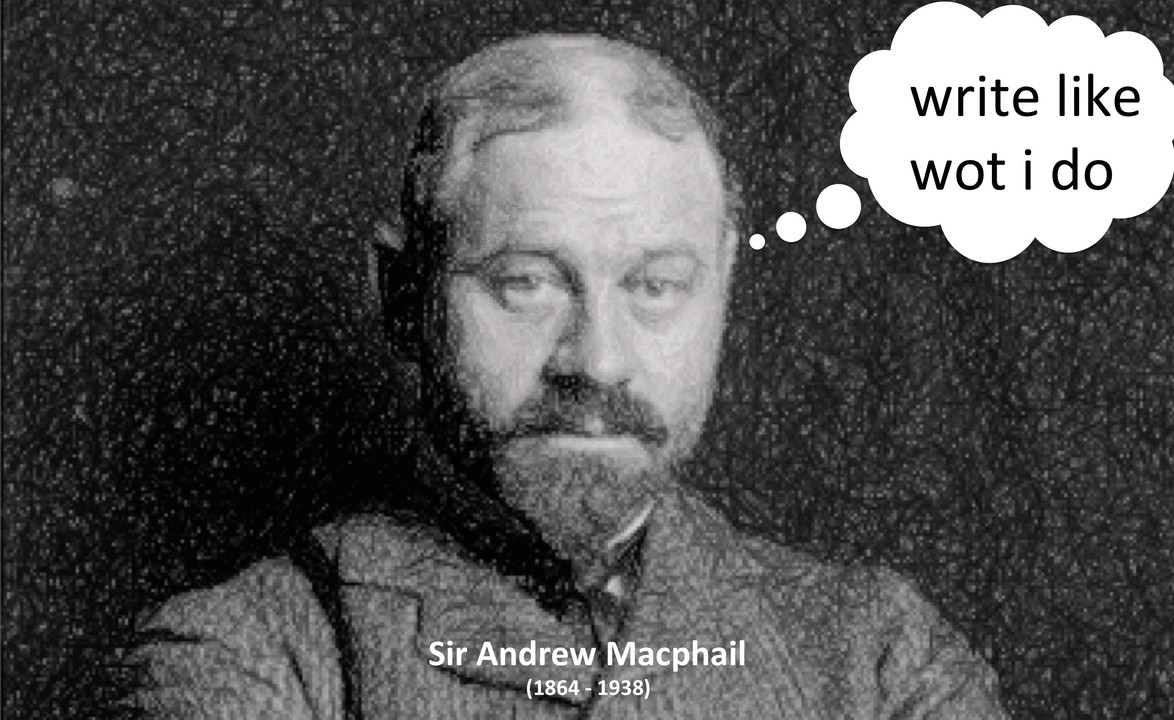
Perhaps our raison d’être was best captured by Dr Andrew Macphail, whom I see as the father of medical writing. Commenting in the inaugural issue of the Canadian Medical Journal in 1911, he wrote:
“It has not escaped notice that all important scientific observations have been recorded with a singular fitness of words… It must be governed by a hand which, in turn, is directed by a mind.”
I make no apology for quoting him at length. The language evokes dusty libraries, leather‑covered chairs and oak desks belonging to an era when scientific writing was inseparable from scientific identity. Yet his words still provide the introduction to medical writing that is often omitted from our initiation.
Even august societies prefer to focus elsewhere. The American Medical Writers Association (AMWA) introduces the concept of medical communicators, defining them as those who write, edit, or develop materials about medicine and health. They note that we communicate scientific and clinical data in a variety of formats to a range of audiences. At their core, medical communicators know how to gather, organise, interpret, evaluate, and present information appropriately.
This aligns with modern perspectives: scientists entering medical writing bring with them critical analysis skills, structured writing experience, and a deep familiarity with scientific discourse, these are skills that translate directly into effective communication [4].
Macphail also offered a classification that remains painfully relevant:
“There are three kinds of writers: those who never think at all; those who think only as they write; and those who have thought before they take pen in hand.”
I stand with Macphail in believing that careful observers belong to the last category, and that is why they write well. New medical writers should endeavour to become such.
The AMWA New Medical Writer’s Toolkit provides an exhaustive list of companies that employ medical writers and an equally exhaustive list of the types of documents you may be asked to produce. For those who have exchanged the lab for the laptop, it is comforting to know that a rewarding and diverse career awaits. But it is equally valuable to remember Macphail’s admonition:
“Good writers employ words; and they compel each word to give a proper account of itself.”
Macphail wrote in an age of the gentleman scientist, when communication channels were limited. Today’s medical communicators prepare content for a vast array of media formats: print, electronic publications, multimedia presentations, videos, podcasts, websites, and social media. They also contribute to mobile applications used for disease management, continuing education, medical reference, and practice monitoring.
This expansion mirrors broader trends in evidence‑based medicine, transparency initiatives, and regulatory complexity, all of which have increased demand for skilled medical communicators [7].
Throughout this orgy of opportunity, I suggest you keep Macphail as your guide and remember that “loose and slatternly writing is a mark of a slovenly habit of mind” and that “easy reading is hard writing.”
Most people do not begin their careers as medical communicators. Many fall into writing: scientists, physicians, pharmacists, journalists, English graduates, and communications professionals. Whatever your background, there is no harm in perfecting your craft and extending your skills base.
Scientists in particular bring:
These skills form a strong foundation for medical writing, though additional capabilities—such as adapting tone for non‑specialist audiences and learning regulatory standards (ICH, GPP3), must also be developed [4].
The Niche website (www.niche.org.uk) hosts a growing library of resources, including Insider’s Insights, case studies, and links to blags and training materials. These can help early‑career scientists understand the profession, build portfolios, and identify suitable entry points.
The greatest challenge for many scientists is reframing their professional identity. Moving from the bench to a communication‑oriented role can initially feel like stepping away from “doing science.” In reality, medical writers continue to make vital contributions to biomedical progress by ensuring that findings are disseminated accurately, transparently, and ethically [5].
Structured training, such as that offered by EMWA, provides invaluable grounding [6][7]. Building a portfolio, even from reworked sections of one’s own research papers or lay summaries, helps demonstrate competence. Yet even with such resources, new writers may still feel dissatisfied, unsure why they are where they are. Here again Macphail offers clarity:
“A man may be a most expert operator in surgery, and yet be no more qualified to set forth his methods in plain terms… than a craftsman can explain… how he tinkers a kitchen clock.”
His century‑old observations remain strikingly relevant in an age of Good Publication Practice.
I encourage all medical writers to read Macphail’s work, kindly made freely available by the Canadian Medical Journal. Through a century of innovation and obfuscation, Macphail speaks clearly across almost 100 years.
Transitioning from scientist to medical writer is not a retreat from science, it is a redefinition of how scientific knowledge shapes medicine and health. Communication is the bridge between discovery and human benefit. For many PhDs and postdocs, medical writing offers a career that honours their training while expanding their influence beyond the laboratory.
For those seeking guidance, structured pathways, and mentorship, the Niche website (www.niche.org.uk) provides a continually expanding set of resources to support this rewarding transition.
References

Get our latest news and publications
Sign up to our news letterResources
Social


Contact us
Address
Niche Science & Technology
Unit 26 Falstaff House
Bardolph Road
Richmond TW9 2LH
United Kingdom