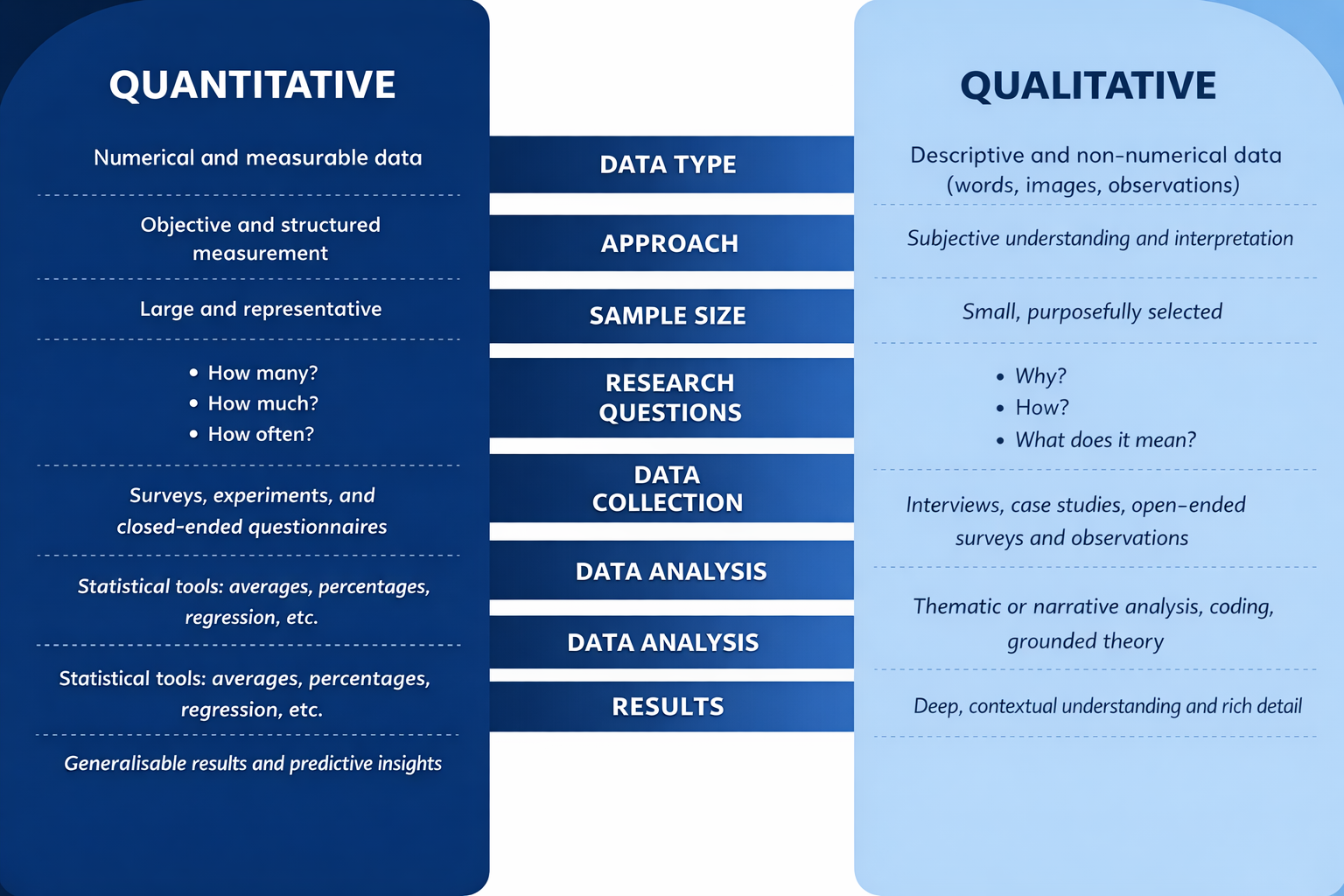
As scientists, we learn early on that research methodology forms the foundation of scientific inquiry. Across disciplines such as psychology, sociology, healthcare, and education, scientists and scholars alike have long debated the relative strengths and limitations of qualitative and quantitative research. Although both approaches seek to generate valid understanding through logic, they differ significantly in philosophical assumptions, methods of data collection, analytical strategies, and interpretive objectives. Appreciating these differences is essential for the design of rigorous studies and selecting the most appropriate methodology for any given research question.
In its simplest form, quantitative research focuses on numerical measurement and statistical analysis, whereas qualitative research seeks to understand human experiences, meanings, and social realities through non-numerical forms of evidence [1]. This distinction reflects broader epistemological differences concerning what constitutes evidence and how we establish the truth.
Quantitative research is rooted in positivism, a tradition asserting that reality exists independently of human perception and can be measured objectively [2]. Researchers who adopt such an approach aim to identify patterns, test hypotheses, and establish general laws that can be replicated and generalised across settings.
In contrast, qualitative research is grounded in interpretivist and constructivist traditions, which emphasise that reality is socially constructed and understood through the subjective experiences of individuals [3]. Rather than seeking universal laws, qualitative researchers aim to understand meaning, context, and lived experience.
Many researchers mistakenly treat these methods as interchangeable, despite their being fundamentally different in their purpose and assumptions. Quantitative research is generally suited to questions of “how much?”, “how often?”, or “to what extent?”, whereas qualitative inquiry is better aligned with “how?” and “why?” [4].
The two approaches differ substantially in how data are gathered. Quantitative research relies on structured, standardised instruments designed to ensure consistency and minimise bias. Frequently used methods include experiments, surveys with closed-ended questions, longitudinal studies, and systematic observations [5]. Variables are operationalised before data collection begins, allowing researchers to test predefined hypotheses.
Qualitative research employs more flexible and adaptive methods. Interviews, focus groups, ethnographic observation, diary accounts, and document analysis are widely used [6]. Data collection often evolves during the study as new themes emerge, enabling researchers to capture unanticipated insights. A defining characteristic of qualitative inquiry is its emphasis on studying phenomena in natural settings. Rather than imposing rigid categories, researchers seek to understand how participants interpret their world [3].
The process of data sampling reflects the distinct goals of each methodology. Quantitative studies typically require large, representative samples to support statistical inference and generalisation. Random sampling techniques are frequently used to reduce selection bias and improve external validity [7].
Qualitative studies, by contrast, rely on smaller purposive samples selected for their relevance to the research question. The aim is not representativeness but conceptual depth and richness of insight [8]. Participants are chosen because they can illuminate key dimensions of the phenomenon under study. Thus, while quantitative sampling seeks breadth, qualitative sampling seeks depth.
Quantitative and qualitative research differ not only in data collection but also in how findings are analysed. Quantitative analysis depends on mathematical and statistical procedures. Descriptive statistics summarise patterns, whereas inferential statistics evaluate mathematic relationships and determine significance [9]. In many quantitative studies, a probability threshold such as p < 0.05 is used to assess whether observed effects are unlikely to be due to chance. This emphasis on numerical precision underpins the objectivity associated with quantitative inquiry.
Qualitative analysis, in contrast, is interpretive and iterative. Researchers examine transcripts, notes, and artifacts to identify themes, meanings, and conceptual relationships. Common approaches include grounded theory, thematic analysis, and discourse analysis [10]. Rather than seeking statistical significance, qualitative researchers establish rigor through credibility, reflexivity, and contextual understanding [11].
Quantitative research offers several important advantages. First, its structured nature allows for replicability and comparability across studies. As findings are based on measurable variables, they can often be verified independently [12]. This makes quantitative designs particularly valuable in experimental sciences, epidemiological studies, and clinical trials. The use of statistical analysis enables researchers to test hypotheses rigorously and identify causal or correlational relationships. Large sample sizes enhance generalisability, supporting evidence-based decision-making in policy and practice [13].
Furthermore, technological advances and statistical software have greatly improved efficiency in managing and analysing complex datasets [9].
Qualitative research provides strengths that complement quantitative methods. Its immersive and flexible design enables exploration of complex social processes, motivations, and meanings that cannot be easily reduced to numbers [14]. Researchers gain an insider’s perspective, uncovering subtleties and contradictions often overlooked in standardized instruments.
Qualitative inquiry is particularly useful in early-stage or exploratory research, where little is known about a phenomenon. It can generate hypotheses, reveal unexpected dimensions of experience, and provide context for interpreting quantitative findings [3]. In applied fields such as healthcare and education, qualitative studies often yield insights directly relevant to practice by capturing the voices and perspectives of participants [15].
Neither methodology is without limitations. Quantitative research may oversimplify human experience by reducing complex behaviours to measurable variables [4]. Structured instruments can miss nuance, context, and subjective interpretation. Findings may also be limited by artificial laboratory settings or poorly designed measures [16].
Qualitative research, on the other hand, faces challenges related to subjectivity and limited generalizability. Because studies often involve smaller samples and context-specific settings, findings may not transfer readily to broader populations [11]. The researcher’s interpretive role can also introduce bias, though reflexivity is used to address this concern. Consequently, each method has inherent trade-offs between precision and depth, breadth and context.
The longstanding divide between qualitative and quantitative paradigms has increasingly given way to methodological integration. Mixed-methods research combines numerical measurement with interpretive depth, allowing researchers to address complex questions more comprehensively [17]. For example, a public health study may quantify disease prevalence while also exploring patient experiences through interviews. This integration reflects growing recognition that no single method is sufficient for all inquiries. The choice of methodology should be driven by the research question rather than allegiance to a paradigm [18].
Qualitative and quantitative research represent distinct yet complementary pathways to knowledge. Quantitative methods emphasise measurement, objectivity, and generalisation, while qualitative approaches prioritise meaning, context, and lived experience.
Science advances most effectively when researchers understand the assumptions, strengths, and limitations of each approach. Rather than viewing them as competing traditions, they should be regarded as tools suited to different dimensions of inquiry.
In the end, the most rigorous research is not defined by adherence to one methodology or another, but by thoughtful alignment between the research problem and the methods chosen to investigate it.
References

Get our latest news and publications
Sign up to our news letterResources
Social


Contact us
Address
Niche Science & Technology
Unit 26 Falstaff House
Bardolph Road
Richmond TW9 2LH
United Kingdom