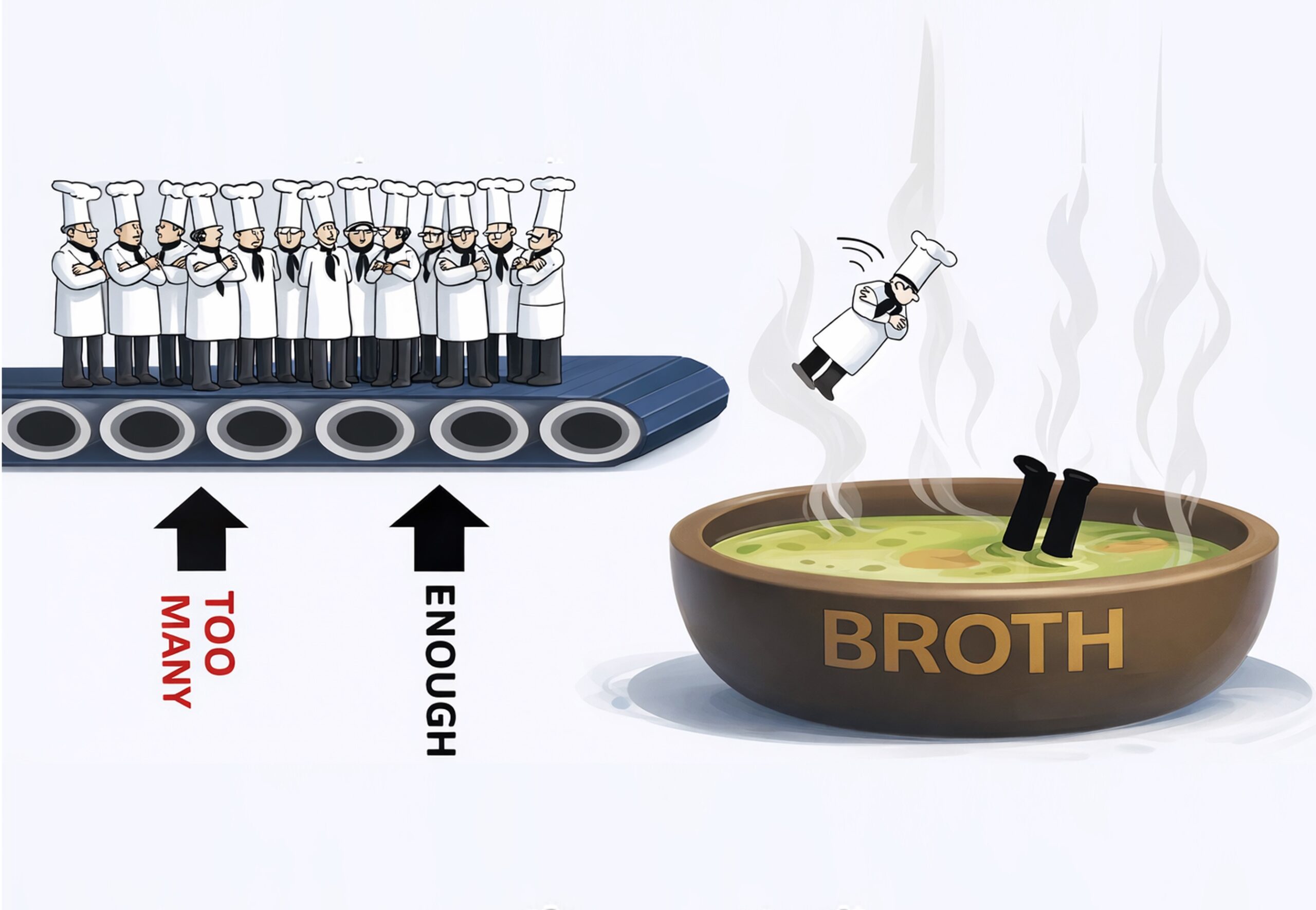
I was recently at a class reunion. There was a great deal of interest in what we were all now doing. Business owner, writer, accountant, surgeon, it seems that we have used our undergraduate studies widely. One answer in particular caught my attention, "Oh, I run a team of around 400 people for a blue-chip pharma company." He quickly clarified that they didn't all report to him directly but that he was 'responsible' for the massive team. It got me thinking, how can you possibly run a team of 400 people? Then I wondered whether there is some relationship between team size and its functionality, is there a golden number for how many should be in a team?
The general intent is that teams can spread workloads across a broad set of skills and get more done. And yet, as team size grows it gets harder to achieve consensus and make decisions, giving equal consideration to everyone ends up with 'designed by committee' solutions. Inflexible, intransigent and/or overly assertive team members are often blamed when projects fail or stall, or worse still, team leaders are seen as being weak. Take heart if you head up a team that is finding it hard to deliver; you may be working with too many people.
Common sense tells us that the task in hand, leadership style, team skills and available resources impact on how well a team works, but what do we know about the size of teams? Clearly, as you add people to your team you increase its output. For example, if you are performing a manual task like painting a fence, 30 painters will complete the task much faster than three. However, if your team has a more complex goal, we know that individual performances start to be affected. Here are some reasons why.
Communication spaghetti
Harvard psychologist J. Richard Hackman noted that big teams end up wasting everybody's time [1]. He observed that as teams grow, the number of links between individuals becomes unmanageable, increasing the potential for miscommunication and misinterpretation. Size becomes an impediment.
Successful team management requires mastery of the links between your players. Inefficacies emerge as the time and effort required to keep everyone informed, coordinated, and integrated snowballs. There is even a name for the delaying phenomenon: Brooks's Law [2]. The complexity of communication increases nonlinearly with team size, a principle long recognised in organisational behaviour [3].
Social loafing
The failure of some team members to contribute fully was remarked upon by the French agricultural engineer Maximilian Ringelmann (born in 1861). He observed that as you increased the number of people pulling on a rope, the less effort each person made. He attributed the diminishing level of return to 'social loafing,' where individuals hide within groups, concealing their lack of effort. More recent and (perhaps) more sophisticated studies investigated loafing in people wearing blindfolds and noise-masking headphones who were asked to shout as loud as they could. The authors noted marked degrees of social loafing in groups as small as two to six [4].
Leaderless-ness
As teams grow, their members begin to feel that they are getting less top-down emotional support and assistance. This has been termed relational loss. Data derived from performance evaluations, given by both peers and team leaders, as well as questionnaires on motivation, connectedness and coordination, confirms how individual team members feel support decreases with increasing team size. The consequent loss of trust and the growing feeling that leadership fails to recognise their contribution sees performance of team members begin to suffer [5].
Bigger teams tend to be more diverse, and a diversity of skills and opinions enables a team to come up with more creative solutions and increases their overall resilience (offering coverage of broader susceptibilities and/or weaknesses). And yet, people 'like' and work better with people similar to themselves [6]. The potential for disharmony from diversity grows as team numbers swell and the membership becomes less homogeneous. Studies confirm a real benefit where teams share an organised understanding of their working environment, showing enhanced coordination and effectiveness, particularly where tasks are complex, unpredictable, urgent and/or novel [7].
Group dumbing
Research has shown that IQs appear to fall when people are placed into groups and asked to solve problems. Members of large teams quickly gravitate toward the average skill set of the group [8]. I sat through a host of meetings as a junior member of clinical teams making little or no contribution; I was often too afraid to speak up. I am not alone. Serving in teams introduces the potential for criticism, which makes most people shut down. Your adrenal glands secrete cortisol when you feel anxious or stressed, one of the chemical triggers of the instinctive fight-or-flight reflex. Increased cortisol heightens your emotions, limits your creativity and reduces your ability to process complex information [9].
As the owner of a small company, I quickly learned to operate in small and flexible teams of three or four. I often found myself wishing for more hands (and brains). I assumed more people would allow me to get more awesome stuff done in less time.
As the company grew it became possible to throw more people with broader skills at the varied and challenging projects our clients brought to us. I was, however, repeatedly surprised by our resource utilisation data, which clearly showed that when our people worked in smaller teams, they seemed to be more productive. Unknown to me, I had discovered one of the most common productivity traps. Conventional wisdom that says two heads are better than one, or that the more brains you have on a problem the better, is wrong (or at least not wholly correct).
There are plenty of convincing empirical data to support this observation. For example, one study looked at optimum team sizes by analysing data on productivity, speed of delivery and cost of work from nearly 500 complex software projects. The authors concluded that teams of between three and seven people give the best performance across all their measures of performance. A more detailed breakdown of the data indicated that smaller groups of three to five performed better than those of five to seven [10].
Amazing research recently published in the journal Nature highlights the benefits of small teams (in science at least). Analysis of tens of millions of research papers and patent submissions indicates that if you want to make scientific breakthroughs that shatter the scientific status quo you are better off working in a small team [11]. It seems that smaller teams are more likely to produce disruptive scientific findings. Although it is generally accepted that bigger research teams produce higher impact scientific papers [12], the most ground-breaking results, the new big ideas, are produced by small groups.
One factor not addressed above is the role of task interdependence. Teams engaged in highly interdependent tasks (where members must coordinate closely) suffer more acutely from size-related coordination losses than teams performing additive tasks [13]. In addition, the optimal team size may vary depending on whether the goal is innovation (favouring smaller teams) versus reliability and safety (where slightly larger teams may provide redundancy) [14]. The personality composition of teams also matters; for instance, a high proportion of conscientious members can mitigate some of the productivity losses seen in larger groups [15].*
So, what can you do if you want to achieve new heights of group engagement and productivity? No matter how much we want to, we will never derive a straightforward formula that dictates how to size our teams. It is simply impossible to control for the many human and business variables. But, if we take some logical steps and ask the right questions based on the findings of scientific study we might be able to navigate past some of the more obvious pitfalls. The concept of small effiecit teams and only accessing the tailored resources you need it exactly what we built our BioStack™ service delivery model on.
Next time you form a team take these factors into consideration:
As the leader of any team it is critical that you remember that your role of creating a shared purpose and vision gets harder as a team grows. The size of your team may flatter your ego at the price of putting your goals out of reach.
References

Get our latest news and publications
Sign up to our news letterResources
Social


Contact us
Address
Niche Science & Technology
Unit 26 Falstaff House
Bardolph Road
Richmond TW9 2LH
United Kingdom