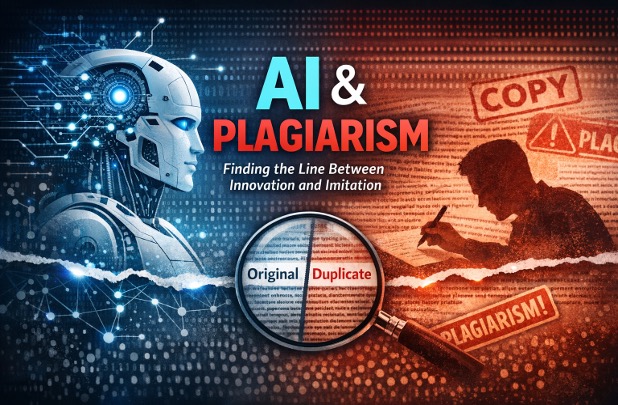
Plagiarism has long been a central concern in scientific communication, we have commented on it previously in 2016 and 2018 [1][2]. We have also shared our guide on how to address the issue of plagiarism in scientific writing in our 2018 Insider’s Insight [3]. But the meaning and mechanisms of plagiarism have shifted dramatically in the last few years with the widespread adoption of artificial intelligence (AI) and large language models (LLMs). Before this technological watershed, plagiarism was primarily understood as the inappropriate reuse of text, ideas, or structure, behaviours that could be mitigated through careful reading, disciplined citation, and personal writing style. I attempted to capture this earlier paradigm previously, describing how plagiarism was framed as a problem of diligence, organisation, and ethical authorship [1][2]. Even decades ago, accidental similarity could occur despite best efforts: “one in a million chances come up more often than you might think.” The pre‑AI era emphasised human fallibility, but it assumed that authors were the primary generators of text and ideas.
The post‑2024 environment is fundamentally different. LLMs can now generate fluent, domain‑specific scientific prose at scale, and their integration into drafting workflows has introduced new forms of plagiarism, new risks of misattribution, and new challenges for publishers and institutions. With the advent of the stochastic parrot, scientific writing is undergoing a structural transformation, and the norms that once governed originality, authorship, and scholarly credit are being rewritten in real time.
Traditional plagiarism centred on copying text, ideas, or structure from identifiable sources: the CITES framework: Combinatorial, Ideas, Text, Erroneous, and Self‑plagiarism. There was a practical taxonomy for avoiding unintentional misuse of source material. Writers were encouraged to “put something of yourself into your work” and to “write in isolation” to avoid over‑reliance on source texts.
Because they can generate text that resembles existing literature without directly copying it, LLMs serve to disrupt this model. Studies have shown that LLMs can reproduce distinctive phrasing, conceptual framings, or methodological descriptions that are statistically derived from their training data but not explicitly traceable to specific sources [4][5]. Consequently, they create what can be called a provenance problem: AI‑generated text will contain intellectual contributions from unknown authors whose work the user never consulted and therefore cannot cite.
This introduces a new category of unintentional plagiarism. Even when no direct copying occurs, the absence of attribution for ideas implicitly embedded in AI‑generated text must constitute an ethical breach. As one analysis notes, LLMs “blur the boundary between original synthesis and derivative reproduction” [6].
A related phenomenon is the rise of fabricated references, or ‘ghost references.’ LLMs are renowned for generating plausible‑looking citations that don’t correspond to real publications. This has been documented in recent evaluations of AI‑assisted academic writing [7][8]. Fabricated citations undermine the credibility of both writers and manuscripts misleading reviewers and readers.
In this evolving environment, plagiarism detection tools, once considered reliable safeguards, are no longer sufficient to the task. Previously I described how tools such as iThenticate and Turnitin “it rarely misses an unacknowledged work.” Today, however, AI‑generated text can evade detection because it is neither copied nor paraphrased from any single source. As a result, the ethical burden shifts back to authors, who must ensure that AI‑generated content is properly attributed, verified, and contextualised. We should note that these are the same authors that decided to use AI in the first place
Before 2024, transparency in scientific writing focused on conflicts of interest, funding sources, and methodological clarity. AI use was not a major consideration. The emphasis was on “never cit[ing] articles that you have not read yourself,” but it doesn’t consider the possibility that a tool might generate text or citations autonomously.
Undisclosed AI use represents a significant integrity gap. Surveys indicate that a substantial proportion of researchers use LLMs for drafting, editing, summarising, or generating citations, yet many do not disclose this assistance in manuscripts [9]. This lack of transparency obscures the provenance of the text and complicates assessments of authorship and accountability.
In response, major publishers, including Elsevier, Springer Nature, and Wiley, have introduced policies requiring explicit disclosure of AI use in manuscript preparation [10]. Some institutions have proposed treating AI‑use statements similarly to conflict‑of‑interest declarations. A growing debate concerns whether, as AI use is so widespread it should be ‘assumed’ unless stated otherwise. Given the difficulty of detecting AI‑generated text, this seems like the most sensible approach.
Transparency is becoming a core ethical requirement. Without it, readers cannot evaluate the reliability of the content or the extent of human intellectual contribution.
One concern associate with the use of LLMs is that most users don’t appreciate that they do not verify facts; they only generate statistically plausible text. This leads to what has been termed hallucinations, false statements, invented methods, or fabricated citations that appear authoritative. In scientific writing, inclusion of such erroneous content propagates misinformation, distorts evidence, and misleads reviewers.
Studies have shown that LLMs can fabricate entire experimental protocols, misrepresent statistical results, or generate non-existent clinical trials [11]. When authors incorporate such content without rigorous verification, they risk misrepresenting knowledge and distorting the scientific narrative. This is not merely a technical issue but an ethical one: accuracy is foundational to scientific integrity.
In 2018 I noted that “the best informed of us can still be surprised from time to time,” describing how even text derived from spoken presentations triggered false plagiarism alerts [2]. In the AI era, the risk is amplified: hallucinated content may be undetectable until peer review, if at all. Hard human oversight is therefore essential. AI can assist with drafting, but it cannot replace the expert judgment required to validate facts, interpret evidence, and ensure conceptual accuracy.
Most ethical guidelines, including those from the International Committee of Medical Journal Editors (ICMJE), state that AI tools cannot be listed as authors because they cannot take responsibility for the content they generate [12]. Yet LLMs are increasingly shaping the structure, argumentation, and narrative flow of scientific manuscripts. This raises difficult questions:
Previously, I emphasised the importance of personal voice and originality: “our own unique minds…are the best defence against plagiarism” [2]. In the ear of AI, this principle becomes even more important. Authorship must reflect human intellectual ownership, not merely editorial oversight of machine‑generated text. New norms are emerging that require authors to describe how AI tools were used, ensure that all intellectual contributions are human‑derived, and take full responsibility for verifying AI‑generated content.
Detectors of AI‑generated text have proliferated since 2024, but their reliability is limited. Research shows that detectors produce high rates of false positives, flagging human‑written text as AI‑generated, and false negatives, failing to detect lightly edited AI output [13]. Now we have an escalating ‘arms race’ between generation and detection technologies: AI checking AI.
Even carefully prepared text can trigger false alerts. In the AI era, this problem is magnified. Over‑reliance on detection tools can create a false sense of security and may unfairly penalise authors whose writing style resembles AI‑generated patterns, a particular problem for science writers who write to a very specific style. Human judgment, contextual evaluation, and policy reform are essential to avoid both wrongful accusations and undetected misuse.
The ‘publish or perish’ culture has long incentivised quantity over quality. With generative AI, this pressure can only lead to mass production of low‑quality manuscripts, some containing fabricated data or citations. Journals have reported surges in AI‑generated submissions, prompting retractions and stricter screening processes [14]. A considerable proportion of manuscripts that journals ask me to review give off a very strong AI vibe.
As I noted “desperation is the mother of plagiarism,” effectively time pressure and inadequate preparation increases the risk of ethical breaches [2]. In the AI era, desperation may manifest as over‑reliance on generative tools, bypassing critical thinking and scholarly rigour. There are plenty of articles discussing how, though the adoption of AI we are giving away our executive functionality. Long criticised academic reward systems may need reform to prioritise transparency, methodological soundness, and intellectual contribution over sheer output volume – good luck with that.
The widespread adoption of LLMs since 2024 has reshaped scientific writing and redefined the boundaries of plagiarism. No longer limited to copying text, plagiarism now includes uncredited conceptual ‘borrowing’, AI‑mediated synthesis without attribution, fabricated references, and hidden AI authorship influence. The emphasis on organisation, careful reading, and personal writing style discussed previously remains relevant, but the ethical landscape has expanded.
Addressing these challenges requires updated policies, transparent reporting of AI use, rigorous human oversight, and a renewed commitment to intellectual integrity. As scientific writing evolves, the academic community must rethink what originality means and how credit is assigned. The goal is not to reject AI but to integrate it responsibly, ensuring that human judgment, creativity, and accountability remain at the centre of scholarly communication. I think that it is time for us to update our Insider’s Insight on plagiarism.
References

Get our latest news and publications
Sign up to our news letterResources
Social


Contact us
Address
Niche Science & Technology
Unit 26 Falstaff House
Bardolph Road
Richmond TW9 2LH
United Kingdom