Medical Writing With Machine Minds

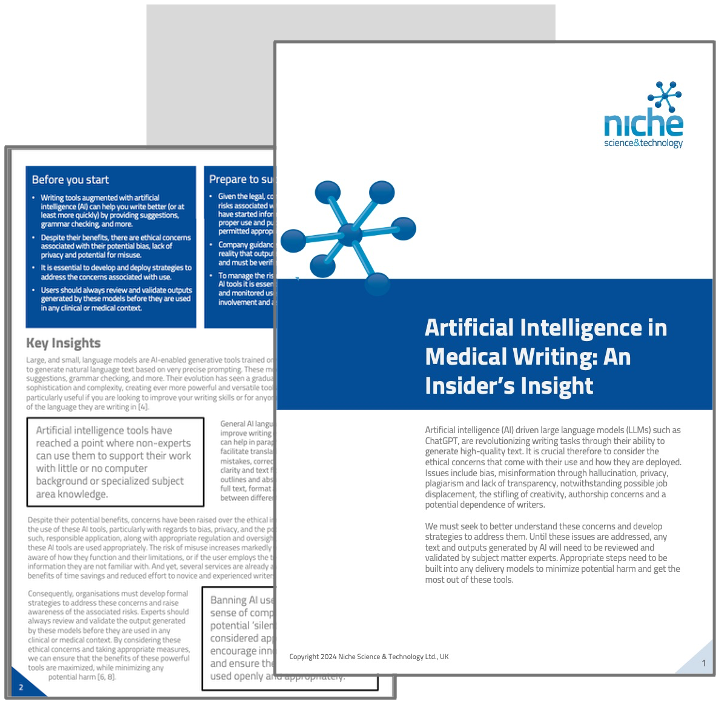
Artificial intelligence driven large language models such as ChatGPT, are revolutionizing writing tasks through their ability to generate high-quality text. Artificial intelligence has reached a point where experts and non-experts alike can use them to support their work. Should they?

Learn about:
Bias and misinformation through hallucination
Pitfalls for privacy and plagiarism
Threats to business
Addressing concerns
Use transparency and risk assessment
Join the other 20,000+ pharma colleagues who have downloaded our Insider’s Insights.

Get your Insider's Insight

* indicates required

Frequently Asked Questions about the Insider’s Insight: 
Artificial Intelligence in Medical Writing

To help you get the most out of our resource library, we have compiled answers to the most common questions regarding the development, application, and distribution of our specialist guides.

At Niche Science & Technology, we believe that sharing expertise is the first step toward industry-wide excellence.
GAIL models are AI‑enabled large language models trained on vast text datasets to generate natural‑sounding language. In medical writing, they can assist with paraphrasing, grammar improvement, translations, summarising documents, drafting outlines, creating patient‑friendly materials, and providing writing suggestions—but remember, all outputs must be reviewed by experts before use.
Key risks include hallucinations (fabricated or inaccurate information), privacy breaches, contractual violations, plagiarism, and consumer protection concerns if AI involvement is not disclosed. GAIL models may also generate biased or discriminatory content due to biased training data.
Because GAIL outputs may contain inaccuracies, fabricated references, biased perspectives, or misleading statements. In medicine—where incorrect information can lead to harm—AI‑generated material must be fact‑checked, edited, and validated by qualified professionals before use.
Good policies outline:
- Permitted, restricted, and prohibited uses
- Mandatory transparency (labelling AI-generated content)
- Risk rating systems
- A central inventory of AI use
- Training requirements, monitoring, and plagiarism checks

These controls help mitigate legal, ethical, and reputational risks.
Effective use requires, being specific and clear with prompts, using correct syntax, asking follow‑up questions, setting the desired tone and detail level, using multi‑turn dialogue to ensure iteration on prompts. Even with strong prompting, AI should provide drafts only, not final content.

Get our latest news and publications

Sign up to our news letter

© 2025 Niche.org.uk     All rights reserved

HomePrivacy policy Corporate Social Responsibility
chevron-down