Coming To A Consensus Creates Clinical Clarity

Clinical consensus statements reflect opinions drafted by experts for which agreement has been sought on specific clinical challenges. They are where there are opportunities to reduce uncertainty and improve quality of care for patients.

Learn how to:
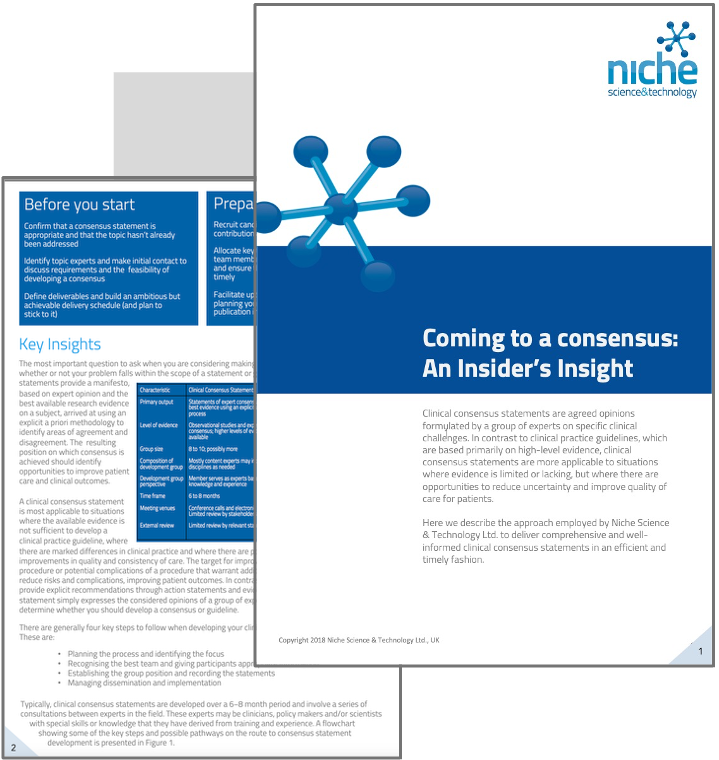
Plan the process and set the focus
Identify the best team and provide briefing
Establish the group position
Derive clear statements
Manage dissemination and implementation
Join the other 20,000+ pharma colleagues who have downloaded our Insider’s Insights.

Get your Insider's Insight

* indicates required

Frequently Asked Questions about the Insider’s Insight: 
Developing Clinical Consensus Statements

To help you get the most out of our resource library, we have compiled answers to the most common questions regarding the development, application, and distribution of our specialist guides.

At Niche Science & Technology, we believe that sharing expertise is the first step toward industry-wide excellence.
A clinical consensus statement is an expert‑driven position document used when evidence is limited, inconsistent, or insufficient to support a full clinical practice guideline. It is most appropriate when there is variability in clinical practice, uncertainty in care pathways, or opportunities to reduce risks and improve outcomes—especially for high‑risk procedures or topics lacking robust evidence
Consensus development requires a small, well‑balanced team (typically 8–10 experts) including clinicians, policymakers, and scientists with topic‑specific expertise. A strong chair is essential—someone experienced, unbiased, skilled in facilitating discussion, and capable of managing timelines. Team members must commit to participation, disclosure of conflicts, timely completion of tasks, and active engagement in meetings and surveys
The process typically includes:
- Planning – confirming the topic, conducting a preliminary search, defining scope, and setting timelines
- Selecting the team – ensuring expertise, balance, and availability
- Iterative development – through meetings, surveys, Delphi methods (see FAQ 4), and drafting statements
- Finalisation – refining statements, agreeing on wording, and completing documentation

Consensus development often spans 6–8 months and uses both remote and face‑to‑face engagements.
The Delphi method is a structured, iterative survey‑based process used to gather expert opinion without requiring in‑person interaction. Using tools like SurveyMonkey, team members score agreement on proposed statements (often using a 9‑point scale), helping the group identify priorities, resolve differences, and refine statements objectively while minimising bias
Publication in a peer‑reviewed journal is only the first step. Effective dissemination should extend across multiple channels—digital platforms, professional societies, conferences, and targeted communications—to ensure broad adoption. Because knowledge evolves, a plan for regular review and updates should be built into the dissemination strategy

Get our latest news and publications

Sign up to our news letter

© 2025 Niche.org.uk     All rights reserved

HomePrivacy policy Corporate Social Responsibility
chevron-down