Smart Sites, Strong Studies, Success Secured

High functioning investigator sites are essential to the delivery of a successful clinical trial. But not all sites seem able to fulfil their study. How do you identify sites that are most likely to deliver your study on time, on budget and on specification?

Learn about:
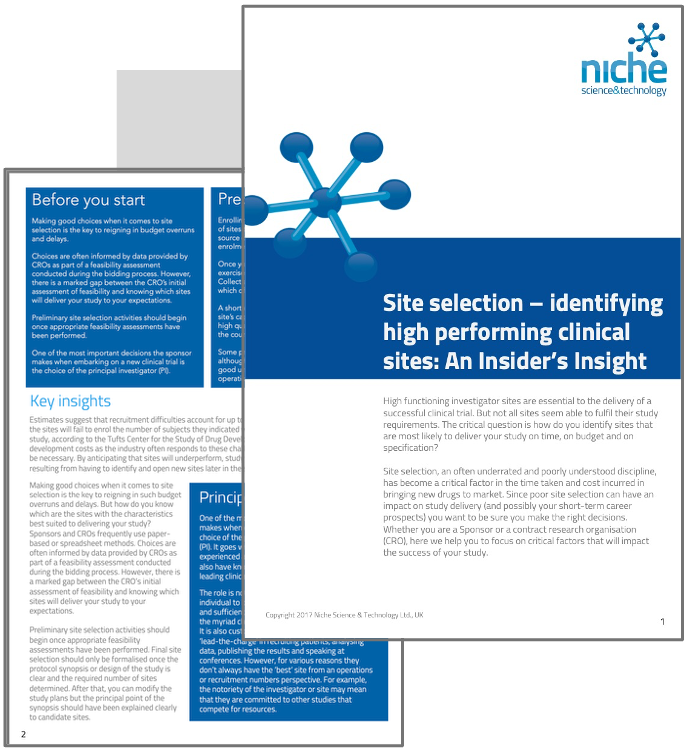
Identifying critical feasibility factors
Reviewing a site teams previous trial experience
Assessing the investigators intended engagement
Determining patient availability
Weighing up multiple factors
Join the other 20,000+ pharma colleagues who have downloaded our Insider’s Insights.

Get your Insider's Insight

* indicates required

Frequently Asked Questions about the Insider’s Insight: 
Site Selection

To help you get the most out of our resource library, we have compiled answers to the most common questions regarding the development, application, and distribution of our specialist guides.

At Niche Science & Technology, we believe that sharing expertise is the first step toward industry-wide excellence.
Selecting the right investigator sites directly influences enrolment timelines, data quality, study costs, and overall trial delivery. Poor site selection is a major contributor to delays—recruitment difficulties account for up to 45% of study delays, and more than 35% of sites fail to meet their own enrolment projections, ultimately increasing development costs and timelines
Key considerations include site infrastructure, PI experience and engagement, staffing levels, past performance in similar trials, patient availability, local disease demographics, competing trials, and start‑up cycle times. Sites specialising in the target disease tend to recruit more effectively and implement complex protocols more successfully
Not entirely. While feasibility questionnaires help gather data, they are often over‑optimistic, subjective, or incomplete. Sponsors routinely reduce site‑stated recruitment projections by over 75% because historical data show that feasibility estimates frequently fail to predict actual performance. A feasibility assessment should therefore be supplemented with site visits and deeper validation
Selection visits allow Sponsors/CROs to verify the accuracy of feasibility data, assess operational capabilities, evaluate staff engagement, check patient access, and build relationships. These visits help confirm that the site can realistically deliver on timelines and enrolment commitments, especially for complex protocols where operational teams may lack clarity
While objective scoring systems, data matrices, and feasibility tools provide structure, site selection still requires judgment, experience, and interpretation of subjective signals—such as staff motivation, team communication, and cultural or operational nuances. No single process works for every trial, and clinical project managers often rely on both data and intuition to choose sites most likely to perform

Get our latest news and publications

Sign up to our news letter

© 2025 Niche.org.uk     All rights reserved

HomePrivacy policy Corporate Social Responsibility
chevron-down