Bibliometrics: Beyond The Numbers

Do you know your h-index from your m-quotient? Familiarity with bibliometric parameters aids in your assessment of publications. There is a proliferation of bibliometric parameters and their actual meaning and how they might be used is not generally well understood.

Learn about:
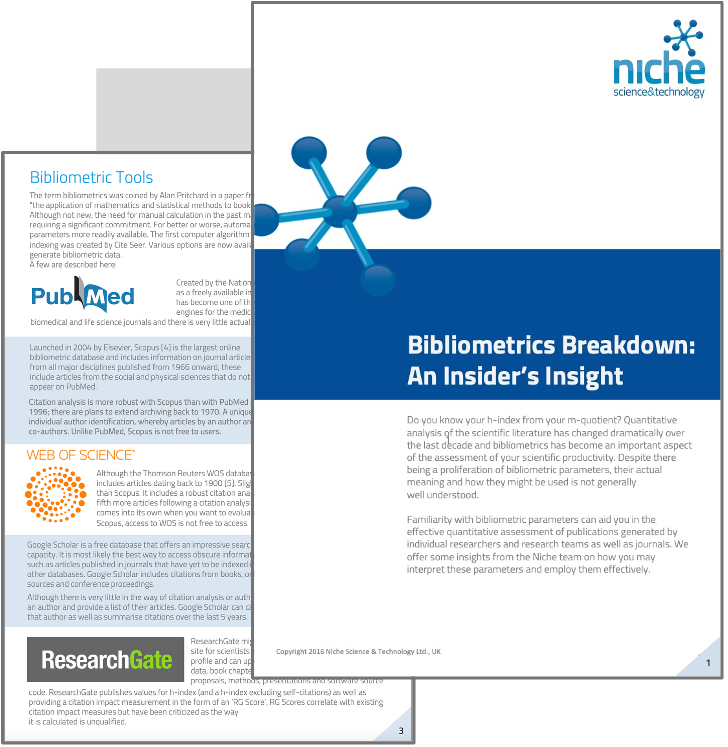
Effects of self-citation
Differentiating AIS from SNIP
Exploiting altmetrics
Quantifying the qualitative
What is a citable article
Join the other 20,000+ pharma colleagues who have downloaded our Insider’s Insights.

Get your Insider's Insight

* indicates required

Frequently Asked Questions about the Insider’s Insight: Bibliometrics Breakdown

To help you get the most out of our resource library, we have compiled answers to the most common questions regarding the development, application, and distribution of our specialist guides.

At Niche Science & Technology, we believe that sharing expertise is the first step toward industry-wide excellence.
Bibliometrics refers to the quantitative analysis of scientific literature, using mathematical and statistical methods to assess research productivity, influence, and trends. It helps evaluate authors, research groups, and journals, providing insight into scientific contribution beyond simple publication counts
Key author‑level metrics include the h‑index, m‑quotient, e‑index, g‑index, and i‑10 index, each of these addresses limitations of older measures like raw publication or citation counts. These metrics aim to balance publication volume, citation impact, and career duration to give a more meaningful view of scientific contribution
JIF is widely used but has major limitations: it can be manipulated, varies across fields, is distorted by outlier articles, and reflects journal‑level averages rather than the quality of individual papers. It also incentivises journals to avoid publishing low‑citation content such as case reports
Alternatives include Eigenfactor, Article Influence Score (AIS), SCImago Journal Rank (SJR), and Source Normalised Impact per Paper (SNIP). These consider factors such as citation networks, thematic relationships between journals, and field‑normalised citation behaviour, offering more robust assessments than JIF alone
Altmetrics measure research impact based on mentions in social media, blogs, news outlets, and online platforms. While they can capture immediate public engagement, they are easily manipulated and often lack relevance to scientific quality. Some critics argue they do not reflect meaningful research impact

Get our latest news and publications

Sign up to our news letter

© 2025 Niche.org.uk     All rights reserved

HomePrivacy policy Corporate Social Responsibility
chevron-down