Smart Searching, Stronger Science

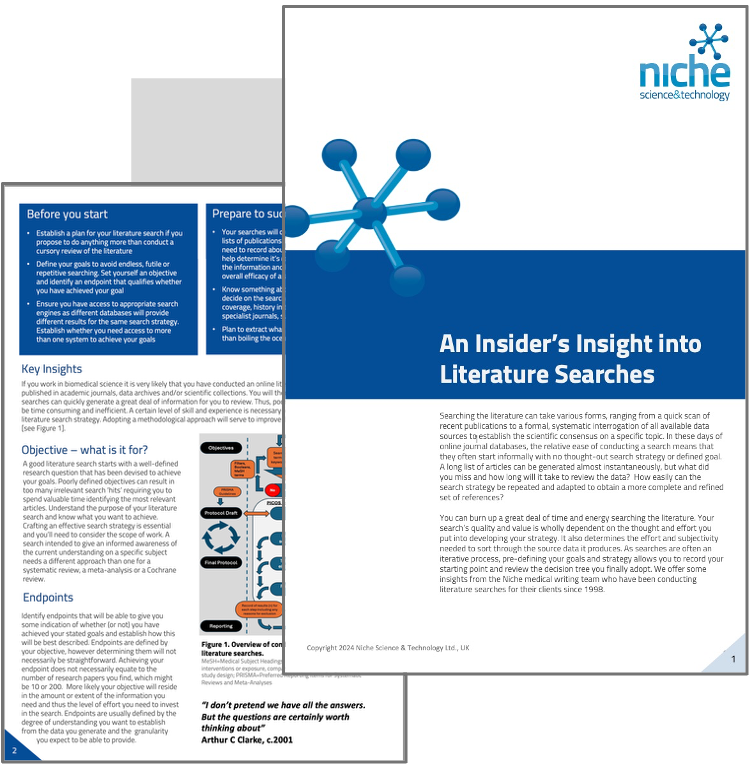
Searching the literature can take various forms, ranging from a quick scan of recent publications to a formal, systematic interrogation of all available data sources to establish the scientific consensus on a specific topic.

Learn how to:
Plan for success
Develop your strategy
Search efficiently
Refine your searches
Identify the most appropriate references
Join the other 20,000+ pharma colleagues who have downloaded our Insider’s Insights.

Get your Insider's Insight

* indicates required

Frequently Asked Questions about the Insider’s Insight: Literature Searches

To help you get the most out of our resource library, we have compiled answers to the most common questions regarding the development, application, and distribution of our specialist guides.

At Niche Science & Technology, we believe that sharing expertise is the first step toward industry-wide excellence.
A well‑designed plan prevents unfocused, repetitive searching and helps avoid wasting time on long, unfocused article lists. Defining goals, endpoints, and the scope of work ensures the search generates useful, relevant information and can be repeated or adapted methodically.
Define key concepts, consider population characteristics, and use synonyms, variant spellings, acronyms, and truncations (e.g., “cardio*”). Booleans (AND/OR/NOT) help refine searches, and filters such as publication type or date range improve specificity. Reviewing terminology changes across years may also be necessary
Using the PICOS framework (Population, Intervention, Comparison, Outcomes, Study design) helps craft focused research questions. MeSH (Medical Subject Headings) terms provide structured vocabulary for precise searching, and PRISMA guidelines support transparent reporting of systematic searches
Different databases index different sets of journals, and research shows that no single source reliably retrieves all relevant references. Guidance suggests using at least MEDLINE, Embase, Web of Science, and Google Scholar to improve sensitivity and capture rate—though this also increases screening workload
AI tools can assist by suggesting alternative search terms, enabling semantic searching, or mapping citation networks, but they cannot replace expert‑led search strategies. They may miss paywalled content, produce inaccurate results, or hallucinate information. A hybrid approach—traditional databases plus AI augmentation—is recommended

Get our latest news and publications

Sign up to our news letter

© 2025 Niche.org.uk     All rights reserved

HomePrivacy policy Corporate Social Responsibility
chevron-down